

What Is Solution Focused Therapy and How Does It Work?

Key Highlights
- Solution-focused therapy is a brief, goal-oriented approach that focuses on strengths and future solutions rather than analyzing past problems.
- Most clients see measurable progress within 5 to 10 sessions through structured goal setting and practical action steps.
- Core techniques include miracle questions, scaling questions, exception finding, and positive reinforcement to build momentum.
- Practical tools such as goal worksheets, scaling charts, and exception logs help track improvement between sessions.
- The SFBT approach is widely used in individual counseling, solution-focused couples therapy, and family therapy settings.
- Research supports its effectiveness for behavioral problems, relationship challenges, and short-term mental health care needs.
- At Total Life Counseling, therapists use the SFBT approach to deliver structured, goal-driven support tailored to each client.
Many people seek counseling because they feel stuck in recurring problems, strained relationships, or ongoing stress. According to the National Alliance on Mental Illness, nearly 1 in 5 U.S. adults experience a mental health condition each year, yet many delay seeking support because they feel unsure where to begin.
Traditional psychotherapy can feel overwhelming when the immediate goal is relief and forward movement. Individuals, couples, and families often want a structured approach that helps them set goals, recognize strengths, and experience measurable progress without revisiting the past for months.
This blog explains what solution-focused therapy is, how it works, the techniques and tools involved, its effectiveness, and who can benefit from this practical, goal-oriented approach to mental health care.
What Is Solution-Focused Therapy?
Solution-focused therapy is a brief, goal-oriented counseling approach that helps individuals focus on solutions rather than problems. Instead of exploring past trauma in depth, a solution-focused therapist guides clients toward identifying strengths, resources, and practical steps that support positive change.
This approach is built on the belief that people already have the tools needed to improve their lives. Through structured solution-focused therapy questions, such as scaling or miracle questions, clients clarify goals and recognize small successes.
The therapy is collaborative, future-focused, and action-driven. It is commonly used in individual, couples, and family counseling to promote meaningful progress within a short period of time.
Feeling overwhelmed by a major life change? Read our blog to learn how counseling for life transitions can help you thrive.
How Does Solution-Focused Therapy Work?
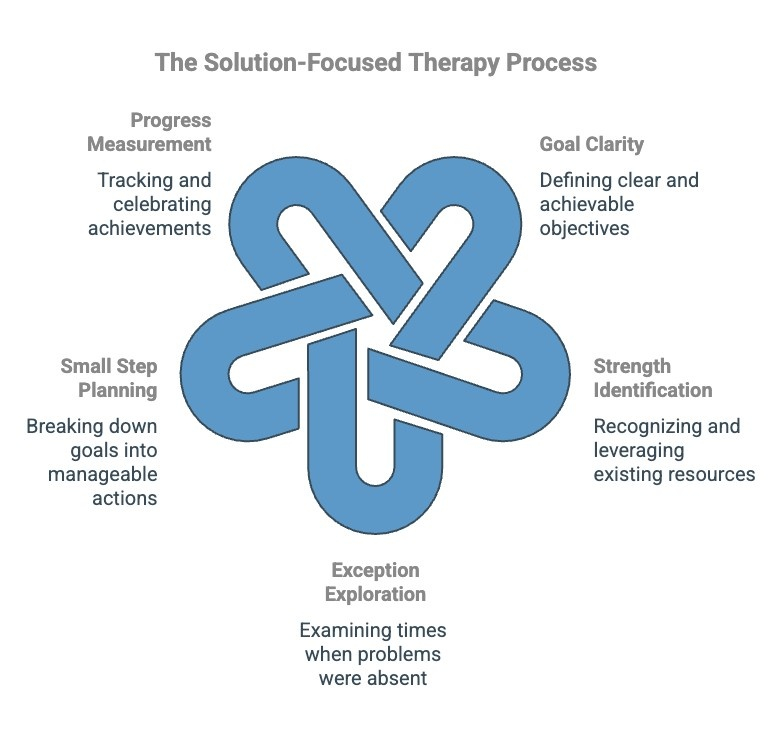
Solution-focused therapy guides clients toward practical, measurable change by focusing on strengths and clear goals rather than revisiting past problems. Here are the core ways solution-focused counseling creates meaningful forward movement:
- Goal Clarity: Focuses on defining specific, future-oriented outcomes rather than analyzing past difficulties.
- Strength Identification: Uses solution focused therapy questions to uncover existing skills, resilience, and personal resources.
- Exception Exploration: Identifies moments when the problem was less intense to highlight what is already working.
- Small Step Planning: Breaks large goals into manageable, actionable steps that build steady progress.
- Progress Measurement: Applies scaling techniques to track improvement and reinforce motivation.
By emphasizing achievable steps and visible growth, solution-focused brief therapy builds confidence while promoting realistic, sustainable change.
What Are the Most Effective Solution-Focused Therapy Techniques?
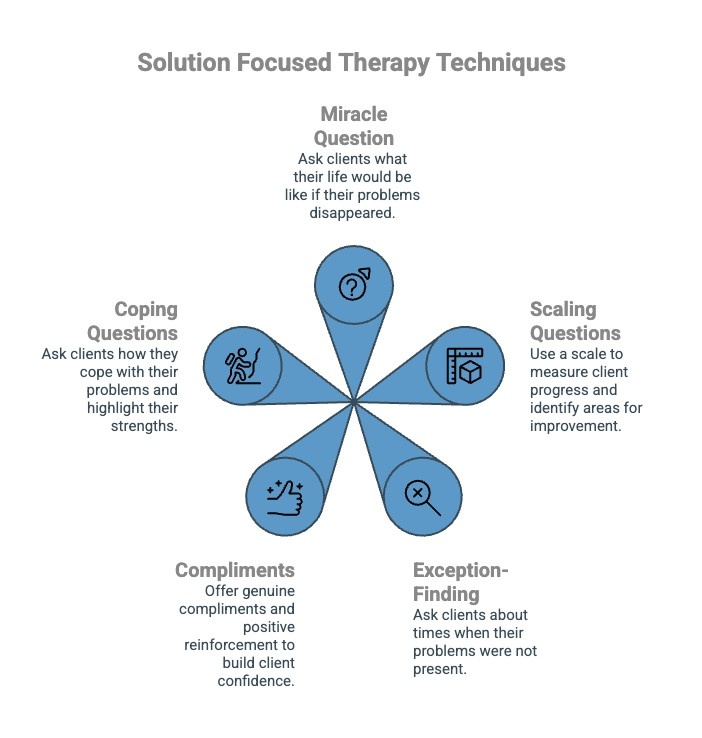
Solution-focused therapy uses structured, forward-focused strategies designed to create practical progress. Instead of analyzing past problems, it builds on strengths and emphasizes clear, measurable change.
Let’s look at some of these key techniques in more detail:
1) The Miracle Question Technique
One of the most well-known techniques in this therapy is the miracle question. Your therapist might ask you something like, “Suppose that while you are sleeping tonight, a miracle happens. The miracle is that the problem that brought you to therapy is solved. What will be the first things you notice that will tell you things are different?”
This question isn’t about finding a magical fix. It’s a creative way to help you bypass your current struggles and clearly visualize your preferred future. By describing what a “miracle” day would look like, you start to identify your best hopes and concrete goals. This process helps you see that positive change is possible and gives you a clear picture of what you’re working toward.
Answering this question can help you pinpoint specific, actionable changes, such as
- How would your interactions with others be different?
- What would you be doing with your time?
- How would you feel throughout the day?
2) Scaling Questions for Measuring Progress
Scaling questions are a simple yet powerful tool used to measure progress and motivation. A therapist will ask you to rate your problem, confidence, or progress on a scale, typically from 0 to 10. For instance, you might be asked, “On a scale of 0 to 10, where 10 is the day after your miracle, and 0 is the worst things have been, where are you today?”
This technique does more than just track your journey; it helps you recognize positive behavior and small improvements you might have overlooked. If you rate yourself a 3, the therapist won’t focus on why it isn’t a 10. Instead, they might ask, “What did you do to get to a 3 instead of a 0?” This question helps you identify your own strengths and the possible solutions you’re already using.
These questions shift your perspective and help you see that you have some control over your situation. They can be used to:
- Assess your current situation.
- Track progress between therapy sessions.
- Identify what small step could move you just one point up the scale.
3) Exception-Finding Questions
Exception questions are designed to help you discover times when your problem wasn’t present or was less severe. A therapist might ask, “Can you tell me about a time in the last week when this problem could have happened, but it didn’t?” This encourages you to look for exceptions to the rule that the problem is always there.
The goal is to identify what was different during those times. By exploring these exceptions, you can uncover hidden strengths, coping strategies, and resources you didn’t realize you had. It shows that the problem doesn’t have complete control over you and that you are capable of making positive change. Even small changes can highlight your ability to influence your circumstances.
Finding exceptions helps you realize what works. For example, this process can:
- Disrupts the belief that the problem is constant or uncontrollable.
- Brings attention to coping patterns you may already be using naturally.
- Reinforces your sense of control and personal agency.
- Identifies supportive people, environments, or routines that make a difference.
- Uses small successes as a foundation for larger, lasting change.
4) Compliments and Positive Reinforcement
Compliments and positive reinforcement are central to the spirit of solution-focused therapy. A therapist will genuinely acknowledge your efforts, strengths, and the difficult circumstances you are navigating. This isn’t just empty praise; it’s a way of validating your experience and building your self-esteem, which is a key part of positive psychology.
This technique helps create a strong therapeutic alliance and reinforces the idea that you are capable of effective change. The therapist might offer a direct compliment by saying, “It’s impressive how you managed to handle that situation.” Or, they might ask a question that implies a compliment, such as, “How did you manage to do that?”
This positive reinforcement helps you to:
- Recognize your own resilience and capabilities.
- Feel seen and understood by your therapist.
- Build confidence to continue making positive changes in your life.
5) Coping Questions and Highlighting Strengths
Coping questions are asked to help you recognize your own resilience. Even when things feel overwhelming, you are often managing to get through the day. A therapist might pose a coping question like, “I can see things have been really difficult for you. How have you managed to keep going?” This simple question shifts the focus from despair to your inherent strengths.
This technique helps you identify the coping skills you are already using, even if you don’t recognize them as such. It validates your struggle while simultaneously empowering you by highlighting your ability to endure. Mental health research supports that recognizing one’s own resilience is a powerful catalyst for change.
By exploring how you cope, you can:
- Identify effective strategies you already possess.
- Build self-respect for your ability to handle adversity.
- Realize that you are more resourceful than you might think.
By focusing on strengths, measurable progress, and achievable steps, solution focused therapy techniques create meaningful and sustainable change.
What Tools and Exercises Are Used in Solution-Focused Therapy?
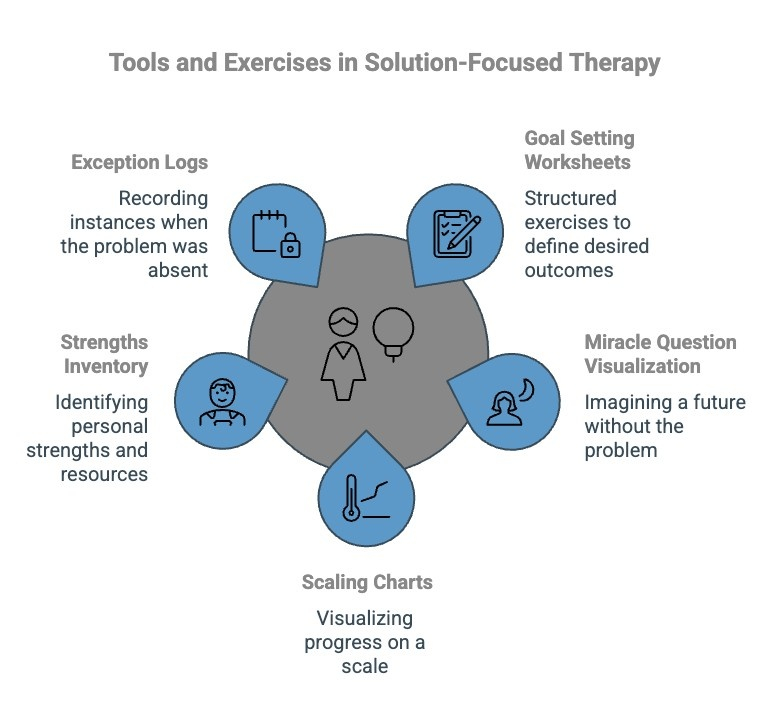
Solution-focused therapy uses practical tools and structured exercises to help clients clarify goals, identify strengths, and measure progress. These tools keep sessions action-oriented and focused on achievable change rather than extended problem analysis.
Here are the most commonly used tools and exercises in solution-focused therapy:
1) Goal-Setting Worksheets
Goal-setting worksheets help clients define clear, specific, and realistic outcomes. Instead of vague goals like “I want to feel better,” clients are guided to describe observable changes, such as improved communication or reduced stress levels.
These worksheets often include prompts that break larger goals into smaller, measurable steps. By documenting desired outcomes and timelines, clients gain clarity and direction. This structured approach increases accountability and makes progress easier to track across sessions.
2) Miracle Question Visualization Exercise
The miracle question visualization exercise encourages clients to imagine that their primary concern has been resolved overnight. The counselor asks detailed follow-up questions to help the client describe what would be different in their thoughts, behaviors, and relationships.
This exercise shifts focus away from limitations and toward possibilities. By visualizing a preferred future, clients gain motivation and clearer insight into practical steps they can begin implementing immediately.
3) Scaling Charts
Scaling charts use a 0 to 10 rating system to measure emotions, confidence, or progress. Clients may rate anxiety levels, relationship satisfaction, or goal achievement. The counselor then explores why the number is not lower, highlighting strengths and existing progress.
Scaling also helps identify what small change would move the number up by one point. This visual and measurable tool makes improvement concrete and reinforces momentum between sessions.
4) Strengths Inventory
A strengths inventory helps clients identify personal qualities, skills, and past successes that can support change. Clients reflect on previous challenges they have overcome and resources they can rely on, such as supportive relationships or coping strategies.
This exercise builds confidence and counters self-doubt. By recognizing existing capabilities, clients begin to view themselves as capable of solving problems rather than defined by them.
5) Exception Logs
Exception logs are simple tracking tools where clients record moments when the issue was less intense or successfully managed. These written reflections highlight patterns that can be repeated.
For example, a client managing stress may notice that exercise or structured planning reduces overwhelm. Reviewing these exceptions during sessions reinforces effective behaviors and helps transform temporary successes into consistent habits.
Together, these tools and exercises make solution-focused therapy structured, measurable, and focused on practical progress.
Knowing what you want to achieve can make therapy more focused and effective. Explore our blog on what are 10 effective tips for setting goals for therapy to clarify your direction.
How Long Does Solution-Focused Brief Therapy Take?
Solution-focused brief therapy is designed to be short-term and goal-oriented. Many clients begin noticing progress within 1 to 3 sessions because the approach focuses on immediate, practical change rather than long-term problem analysis.
On average, solution-focused brief therapy lasts between 5 and 10 sessions. Some individuals may reach their goals in as few as 3 to 5 sessions for specific concerns, while others may continue for 8 to 12 sessions if goals are broader or more complex.
The timeline depends on the client’s goals, engagement level, and the speed of measurable progress.
Are There Any Limitations to Solution-Focused Therapy?
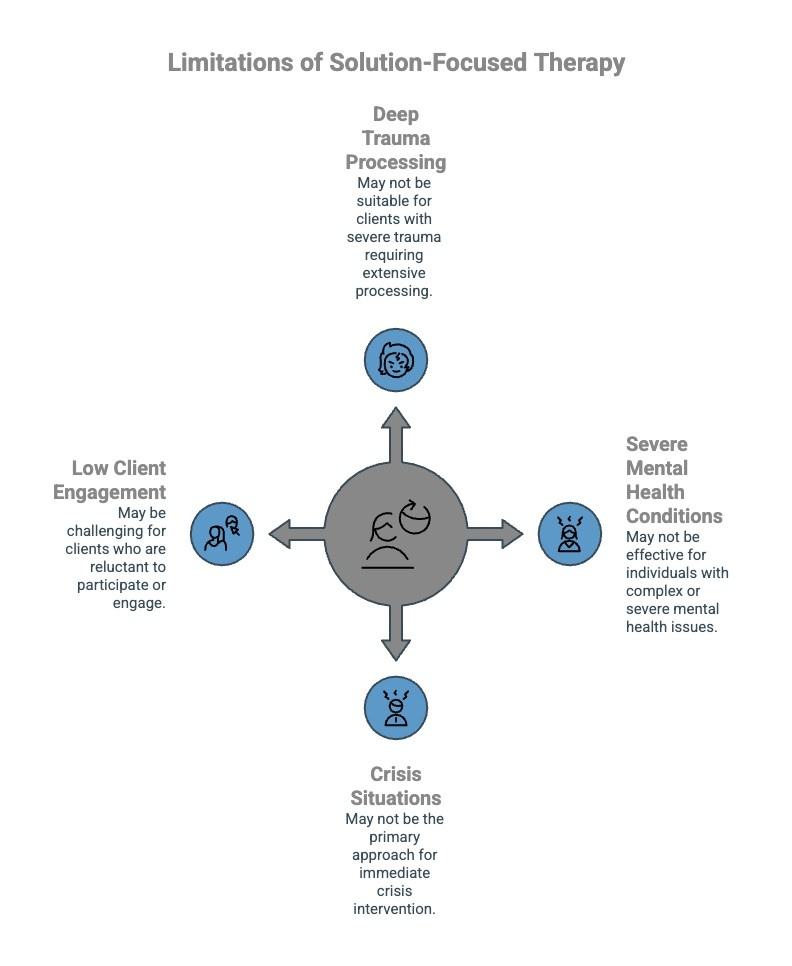
Solution-focused therapy is practical and goal-driven, but it may not address every clinical need. Its brief, future-focused structure can feel limited in complex cases. Below are situations where solution-focused counseling may require additional support:
- Deep Trauma Processing: May not fully explore long-standing trauma or unresolved emotional wounds.
- Severe Mental Health Conditions: Conditions such as major depressive disorder or psychosis may require comprehensive treatment.
- Crisis Situations: Immediate safety concerns often need intensive intervention beyond brief counseling.
- Low Client Engagement: Progress depends heavily on active participation and goal clarity.
Solution-focused therapy works best when your goals are clear, and you are ready to take actionable steps forward.
Who Can Benefit From Solution-Focused Counseling?
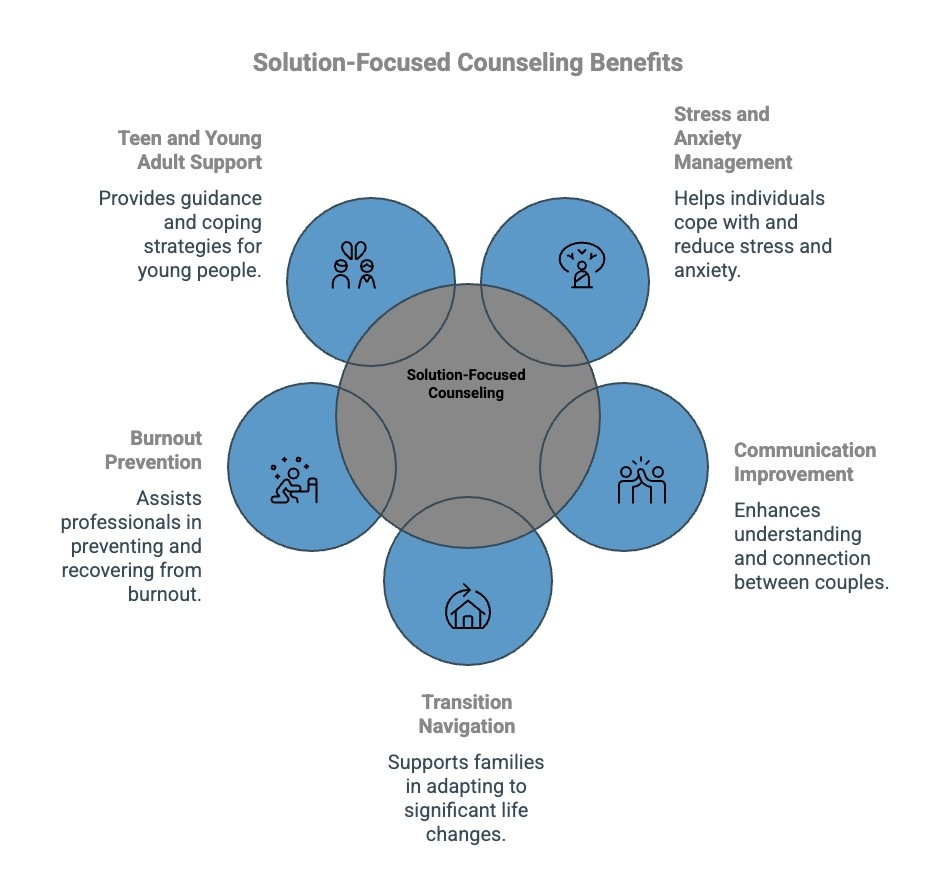
Solution-focused counseling can benefit individuals, couples, and families who want practical strategies and measurable progress rather than long-term problem analysis. It is especially helpful for people who prefer a structured, goal-driven approach to change.
- Individuals Managing Stress or Anxiety: Those seeking clear coping tools and short-term progress.
- Couples Improving Communication: Partners working toward specific relationship goals.
- Families Navigating Transitions: Parents and children adjusting to life changes or conflict.
- Professionals Facing Burnout: Goal-oriented individuals wanting actionable steps forward.
- Teens and Young Adults: Those building confidence and decision-making skills.
Because solution-focused counseling emphasizes strengths and achievable steps, it works well for people motivated to create forward movement in their lives.
How Can Total Life Counseling Help?
If you are feeling stuck, overwhelmed, or unsure about your next step, counseling can help you move forward with clarity and confidence. At Total Life Counseling, our therapists incorporate solution-focused techniques to help you set meaningful goals, recognize your strengths, and take practical steps toward measurable change.
Whether you are seeking individual support, solution-focused couples therapy, or family counseling, we are here to guide you with compassion and structure. You do not have to navigate challenges alone.
Contact us today to schedule your confidential consultation and take the first step toward lasting progress.
Conclusion
Solution-focused therapy is a strategic, outcome-driven approach that prioritizes progress over prolonged problem analysis. By identifying strengths, setting clear goals, and building on small successes, it creates measurable change in a focused timeframe. Whether used with individuals, couples, or families, this method delivers practical momentum and sustainable results.
For those seeking efficient, collaborative care, the SFBT approach offers a clear and empowering path toward lasting growth and resilience.
Frequently Asked Questions
Is solution-focused therapy an effective approach for treating addiction?
Solution-focused therapy can be an effective way to support addiction recovery, particularly when clients are motivated to set goals and improve their quality of life. While not a replacement for intensive treatment in severe cases, the SFBT approach strengthens coping skills and accountability.
What does research say about the effectiveness of solution-focused therapy?
Research, including randomized controlled trial findings in adult mental health research, shows promising outcomes for behavioral problems and relationship concerns. The effectiveness of SFBT is strongest in structured, short-term settings where clients actively participate and focus on measurable change.
What training do therapists need to practice solution-focused therapy?
Therapists usually complete graduate training in counseling, psychology, or social work, followed by specialized education in the SFBT approach. Many models originate from the Milwaukee Brief Family Therapy Center, founded by Insoo Kim Berg.
What are the main principles of solution-focused brief therapy?
Solution focused brief therapy emphasizes strengths, small improvements, and future goals instead of prolonged discussion of current problems. Clients collaborate with the therapist to set goals, create a perspective shift, and focus on what works.
How is solution-focused therapy different from other types of therapy?
Unlike traditional psychotherapy or cognitive behavioral therapy, solution-focused therapy does not concentrate heavily on past causes. This type of therapy prioritizes practical solutions, measurable progress, and forward movement over extended analysis.
What is solution focused brief therapy?
Solution focused brief therapy is a short-term, goal-oriented therapeutic intervention developed in the late 1970s at the Brief Family Therapy Center. The definition of solution focused therapy centers on strengths, solutions, and structured questioning techniques.
What is solution-focused family therapy?
Solution focused family therapy applies the SFBT approach to families dealing with relationship problems or behavioral problems. Many examples of solution focused therapy show improved communication, clearer goals, and stronger family functioning through collaborative sessions.
What are the three golden rules of solution-focused therapy?
The three golden rules are if it is not broken, do not fix it; once you know what works, do more of it; and if something does not work, try something different. These principles guide solution focused couples therapy and brief family therapy practice.
Filed in: Focused Therapy
Share This Story, Choose Your Platform!
Total Life Counseling Center consists of Licensed Counselors, masters level therapists, Español counselors, Licensed Mental Health Counselors, business coaches, and image enhancement coaches who provide counseling for emotional, mental, physical and spiritual care including marriage, individual, family, substance abuse and more. TLC’s family, trauma and marriage experts have been interviewed on National and Local TV/Radio over 200 times for their expert advice on Fox News, OWN, WETV, ABC’s Medical Minute and more. Our skilled counselors are relational, approachable and specialists providing therapy services in the Central Florida area including: Orlando, Winter Park, MetroWest, Windermere, Dr. Phillips, East Orlando, Lake Mary, and Clermont, Boca Raton Florida, and Dallas, TX.
About the Author: Jim West
