

What Are Toy Story 5 iPad Kids Really Telling Us About Screen Time?

Key Highlights
- Toy Story 5 has parents talking about “iPad kids,” but the real conversation is about children’s mental health, not the movie.
- Research links heavy, unbalanced screen time with associations, not certainties, around emotional regulation, attention, and behavior in some children.
- Screens tend to affect kids most through what they displace: sleep, imaginative play, face-to-face connection, and the chance to practice calming down without a device.
- Major health bodies like the AAP and WHO stress balance, quality, and protecting sleep and play over chasing a single “safe” number of minutes.
- Warning signs include meltdowns when the device is removed, lost interest in play and friends, and using screens as the only way to self-soothe.
- Total Life Counseling helps Orlando families support emotional well-being and build healthier screen habits without nightly battles.
Pixar’s Toy Story 5 has brought renewed attention to a concern many families already live with: a child drawn to a glowing screen more than the toys in the box. In the film, a frog-shaped tablet named Lilypad becomes young Bonnie’s new favorite, and her toys are left competing with a device for her attention.
It is a clever hook. But the more important story is not on screen. It is in living rooms, where parents quietly wonder what all that screen time is doing to their child’s developing mind.
Why Are Parents Talking About “iPad Kids” After Toy Story 5?
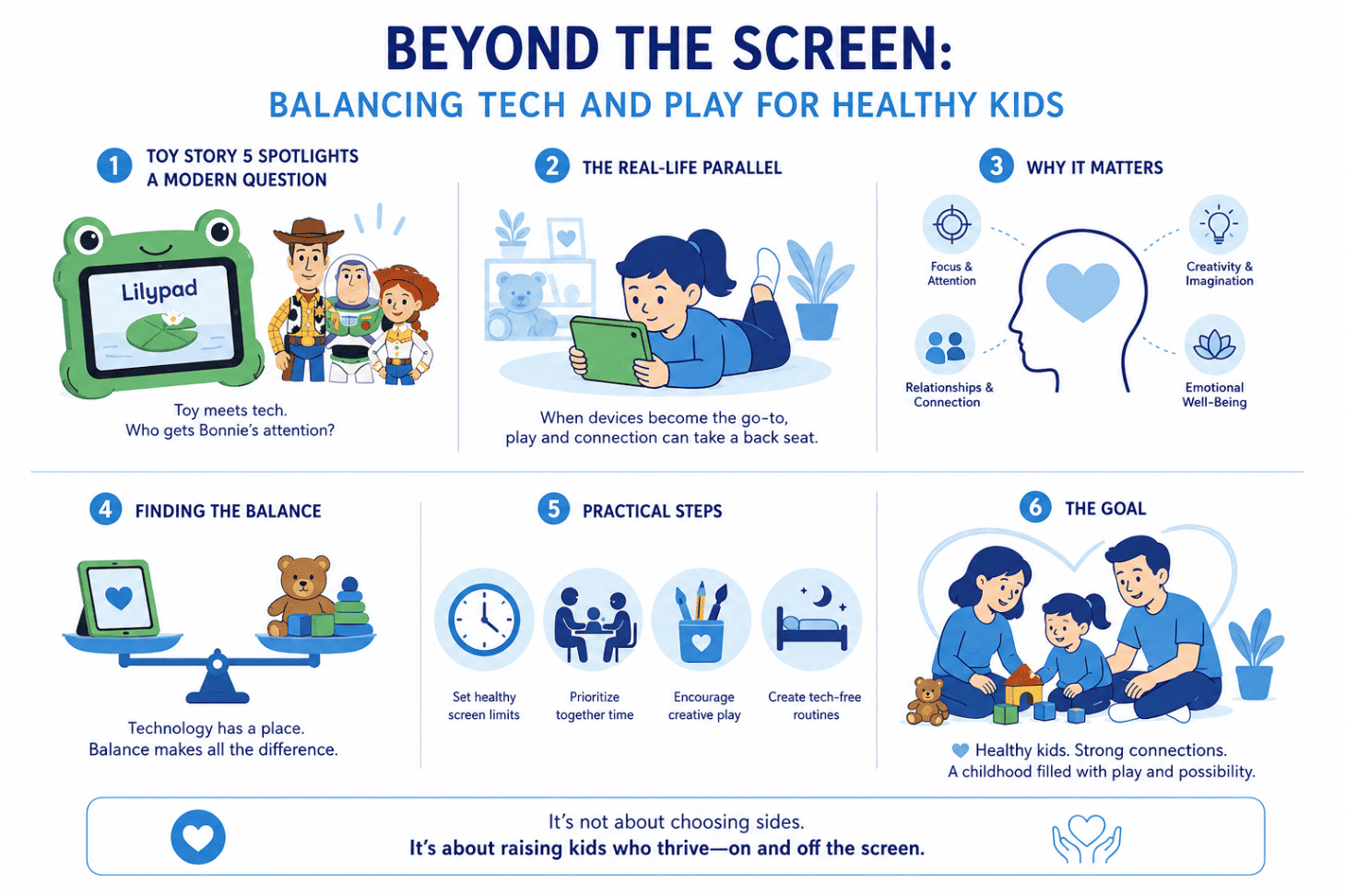
“iPad kid” has become shorthand for children who regularly turn to tablets for entertainment. Toy Story 5 brings that concern into the familiar form of a Pixar film. Pixar chief creative officer Pete doctor described the premise as “toy meets tech,” with Bonnie receiving Lilypad, a frog-shaped tablet that competes with Woody, Buzz, Jessie, and the other toys for her attention.
Director Andrew Stanton has also described the idea as exploring what happens when toys face technology that children are increasingly drawn to. Rather than simply making technology the villain, the premise reflects a question many kid’s parents already face: what happens when a device becomes a comfort blanket and begins taking time away from play and connection?
That makes the storyline more than a battle between Lilypad and an army of Buzz Lightyears. Bonnie’s attachment to technology mirrors a real mental health question about balance, attention, creativity, and relationships. It was perhaps only a matter of time before one of the Toy Story films explored how modern technology competes with traditional play.
How Are Parents and Fans Reacting to Toy Story 5’s “iPad Kid” Storyline?
The Toy Story 5 iPad kids storyline has connected with parents who recognise similar screen-time challenges at home. For many millennial parents, the fifth film brings a distinctly modern concern into the familiar world of the Toy Story films: what happens when digital entertainment begins taking up time once spent playing, creating, or connecting with a family member?
Reactions have not all been the same:
- Relatable for parents: Some viewers see Bonnie, the main character at the centre of the technology storyline, as reflecting everyday struggles around children and screens.
- More nuanced than anti-tech: Fans have appreciated discussions about balance rather than treating technology as the only thing causing concerns for children.
- A reminder about play: The storyline has also encouraged discussion about imaginative play, traditional toys, and family connection.
- Not everyone agrees: Some viewers consider the tough subject matter exaggerated or the screen-time message overly direct.
Searches such as is Toy Story 5 about iPad kids, Toy Story 5 iPad kid, and Toy Story 5 Bonnie iPad kid reflect the interest surrounding this theme.
Whether or not every parent agrees with the film’s message, it raises an important question that researchers and mental health professionals have been exploring for years: how does screen use affect children when it begins displacing other important experiences?
What Does Research Say About Children’s Screen Time?
Toy Story 5 uses Bonnie’s attachment to Lilypad to reflect a concern researchers have studied for years: what happens when screens become a digital nanny and begin replacing other childhood experiences?
Research points to associations rather than simple cause and effect. The reality of the danger of devices depends on how they are used, for how long, and what they replace. Rather than focusing on one per cent or a fixed limit, experts consider factors such as sleep, imaginative play, physical activity, and face-to-face connection.
What do the guidelines recommend?
|
Age |
American Academy of Pediatrics |
World Health Organization |
| Under 18 months | Avoid screens except for video chatting | No screen time |
| 18–24 months | High-quality content only, watched together | No screen time |
| 2–5 years | About 1 hour a day of quality programming, co-viewed | Ages 2–4: no more than 1 hour a day, and less is better |
| 6+ years | Consistent limits; protect sleep, activity, and play | Not covered by this under-five guideline |
Both the American Academy of Pediatrics and the World Health Organization emphasize protecting sleep, movement, play, and healthy routines, while the AAP also encourages families to weigh content, context, and co-use over a single magic number.
Research suggests that higher screen time in early childhood may be associated with later delays in communication and problem-solving, according to a JAMA Pediatrics cohort study. However, content and what screen time replaces also matter, and high screen use alone does not cause conditions such as ADHD or anxiety.
Clinical psychologist Dr. Catherine Steiner-Adair, author of The Big Disconnect, takes a similarly age-conscious approach to technology. She has expressed particular concern about screen use among infants and toddlers. For children ages three to five, she has said that around an hour of carefully chosen, age-appropriate educational content can be reasonable. As children enter elementary school, she encourages families to establish clear household policies around recreational screen use rather than allowing devices to become the default activity.
How Can Excessive Screen Time Affect Emotional Well-Being?
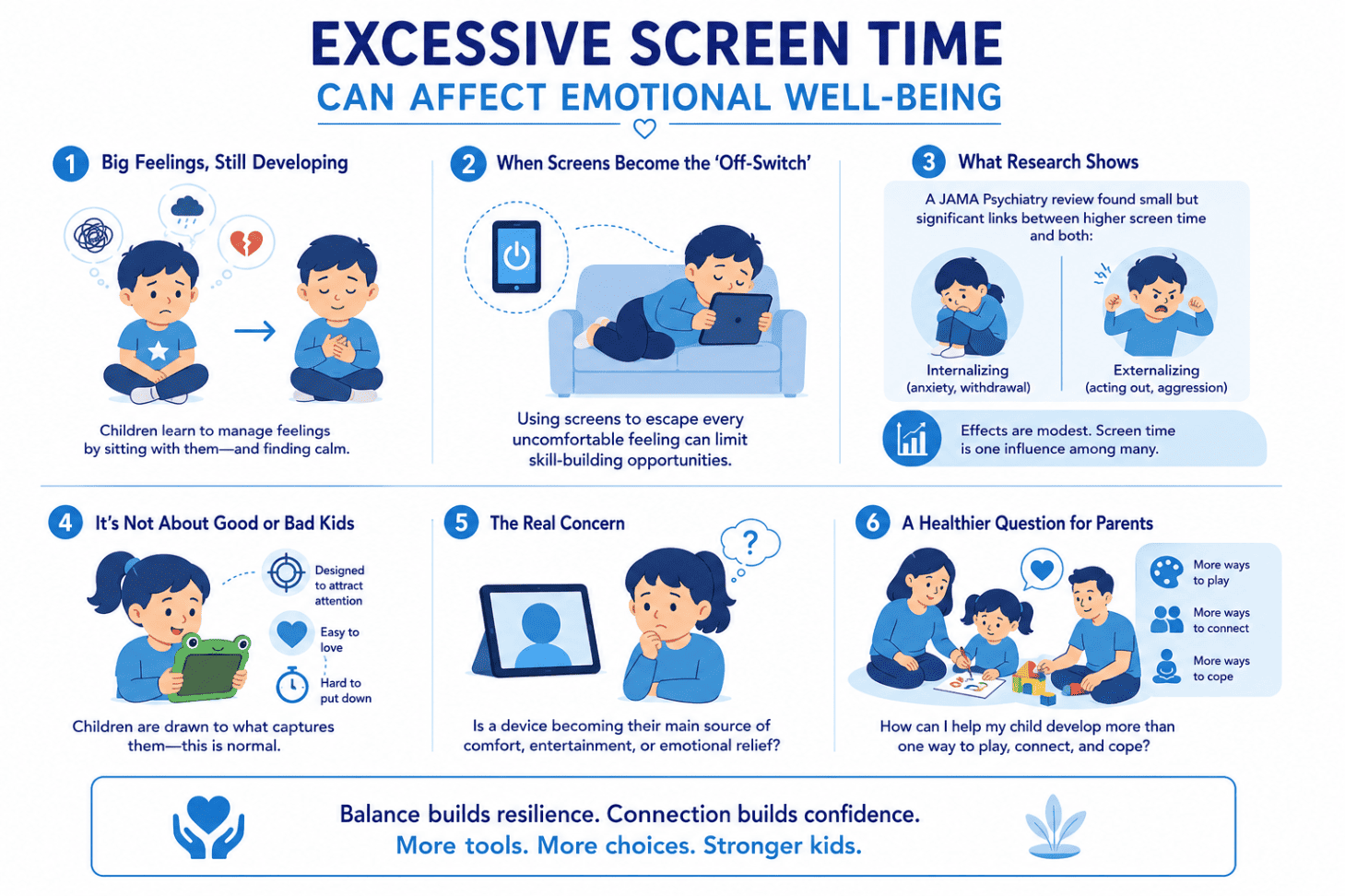
For young children, feelings are big and hard to manage. Learning to sit with boredom, frustration, and disappointment, and to find the way back to calm, is a core developmental task. When a screen becomes the automatic off-switch for every uncomfortable feeling, a child can miss chances to build those skills.
A systematic review and meta-analysis in JAMA Psychiatry found small but significant links between higher screen time and both internalizing problems, like anxiety and withdrawal, and externalizing problems, like acting out, in children twelve and younger. The effects were modest, and screen use is only one influence among many. But the pattern is worth watching, because a child who can only calm down with a device has fewer tools than a child who has several.
Bonnie is not presented as a “bad kid” for being interested in Lilypad. She is a child drawn toward something designed to hold her attention, which makes the storyline more relevant to real families. The concern is not that children enjoy technology. It is whether a device gradually becomes their main source of comfort, entertainment, or emotional relief.
For parents, including those supported by Total Life Counseling, the healthier question is not “How do I get rid of screens?” but “How do I help my child develop more than one way to play, connect, and cope?”
Can Too Much Screen Time Affect a Child’s Attention Span?
Bonnie’s growing interest in Lilypad gives Toy Story 5 a fictional way to explore a concern researchers have studied for years: what happens when highly engaging digital experiences take up more of a child’s attention and leave less time for slower, effortful activities?
A review of screen time and neurodevelopment in preschoolers, available through PubMed Central, describes associations between heavy exposure and attention-related difficulties, while stressing how much depends on content and context. These are associations, not proof. Fast, highly stimulating content sets a pace ordinary life cannot match, and children who spend a great deal of time there may find quieter, effortful tasks harder to settle into. If you are noticing focus struggles alongside heavy device use, that is a reason to look at the whole picture, not to panic.
How Does Screen Time Influence Creativity and Imaginative Play?
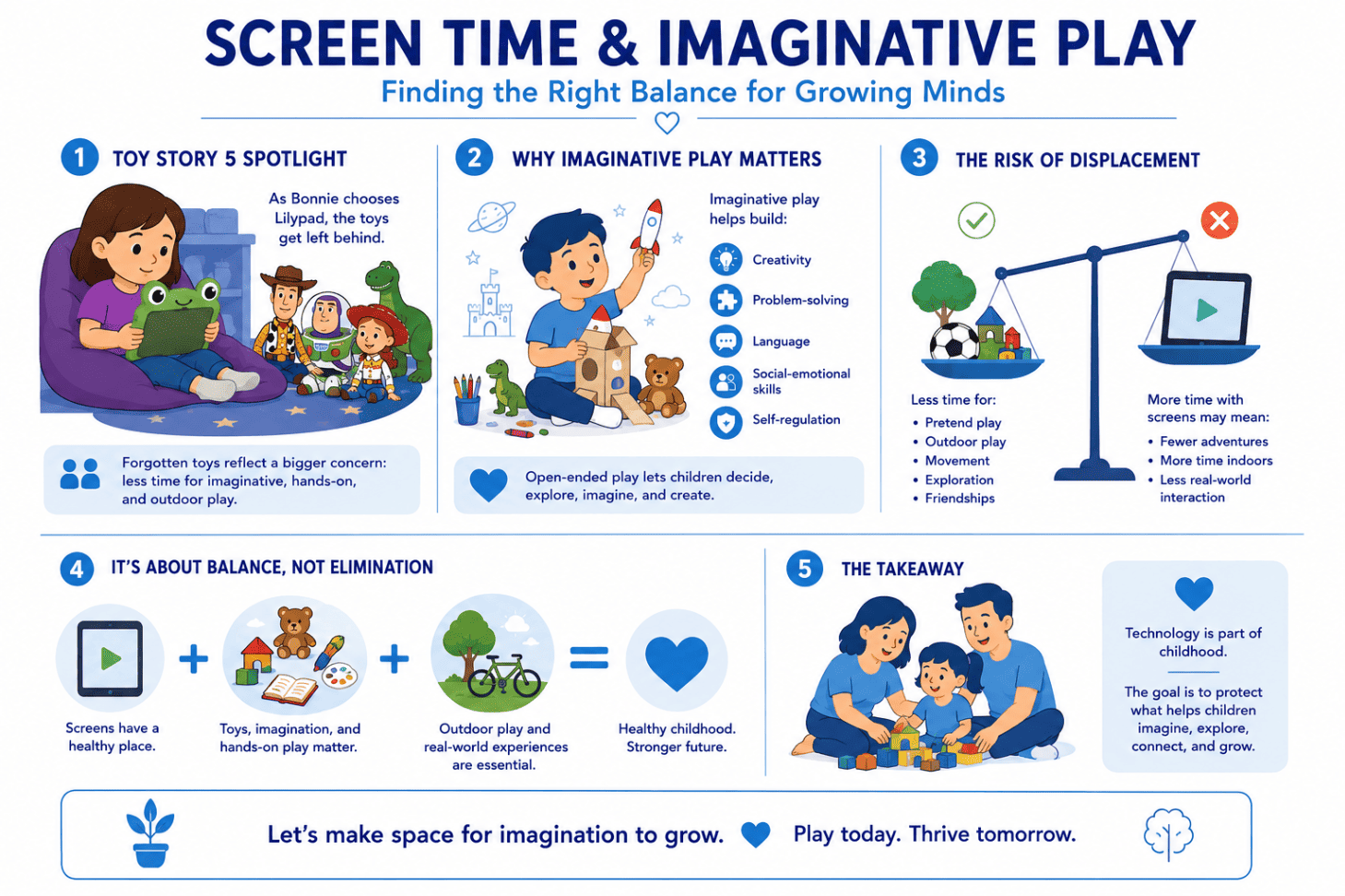
This is one of the concerns Toy Story 5 brings to life most clearly. As Bonnie becomes more interested in Lilypad, the forgotten toys represent something bigger than characters being left behind. They point to what can happen when screen time begins taking up space once used for imaginative, hands-on, and outdoor play.
Imaginative play helps children build creativity, problem-solving, language, social-emotional, and self-regulation skills, as highlighted in the American Academy of Pediatrics’ The Power of Play clinical report. Whether children are inventing adventures with toys, building imaginary worlds, or creating games outdoors, open-ended play gives them opportunities to decide what happens next.
Dr. Catherine Steiner-Adair makes a similar distinction in The Big Disconnect. Her work stresses the developmental value of hands-on, imaginative, and social experiences that screens can sometimes displace. For young children, that can mean making sure there is still plenty of room for building with blocks, creating pretend games, exploring outdoors, and interacting with other children rather than allowing digital entertainment to fill every free moment.
That contrast makes the Toy Story 5 storyline especially relevant. The concern is not that Lilypad exists or that Bonnie enjoys using technology. It is the possibility of imaginative play gradually disappearing when a device consistently becomes the easier choice. Forgotten toys can mean fewer pretend adventures, while more time indoors with screens may also leave less room for outdoor play, movement, exploration, and interaction with other children.
The issue is displacement, not technology itself. Screens can have a healthy place in childhood, while traditional toys, imagination, outdoor activities, and real-world experiences continue to have one, too.
How Does Device Dependence Affect Social Development?
Children develop social skills through everyday interactions, from reading facial expressions and taking turns to handling disagreements and simply talking with a family member. When devices regularly fill moments that once encouraged interaction, children may have fewer opportunities to practise these skills.
Research supports looking at what screen time replaces, rather than treating technology itself as harmful. The American Academy of Pediatrics encourages families to consider the quality and context of media use and protect time for sleep, physical activity, and other healthy experiences.
This connects directly to Toy Story 5. Bonnie’s growing interest in Lilypad represents a fictional version of that displacement: the concern is not that she enjoys a device, but that technology may begin competing with play and connection for her attention. The film’s particularly bold subject matter gives families a way to consider where devices fit into children’s relationships without portraying technology as the enemy.
At Total Life Counseling, counselors can help families look beyond screen-time numbers and understand how device habits may connect with communication, emotional regulation, and relationships. The goal is not to raise an upstanding member of society by eliminating screens, but to give children enough real-world opportunities to practise connecting with others.
Can Screen Time Become a Coping Mechanism for Children?
Often, yes, and this is one of the most important things for parents to understand. When a child is anxious, overwhelmed, or simply bored, a screen offers instant, reliable relief. Over time, it can quietly become the main way that a child manages hard feelings. The device stops being entertainment and becomes a coping strategy.
The goal is not to remove the comfort and leave nothing in its place. It is to help a child build a fuller toolkit, including movement, creative play, talking to a trusted adult, and simple ways to calm the body, so that a screen becomes one option among many rather than the only one that works.
What Healthy Screen Habits Can Parents Encourage?
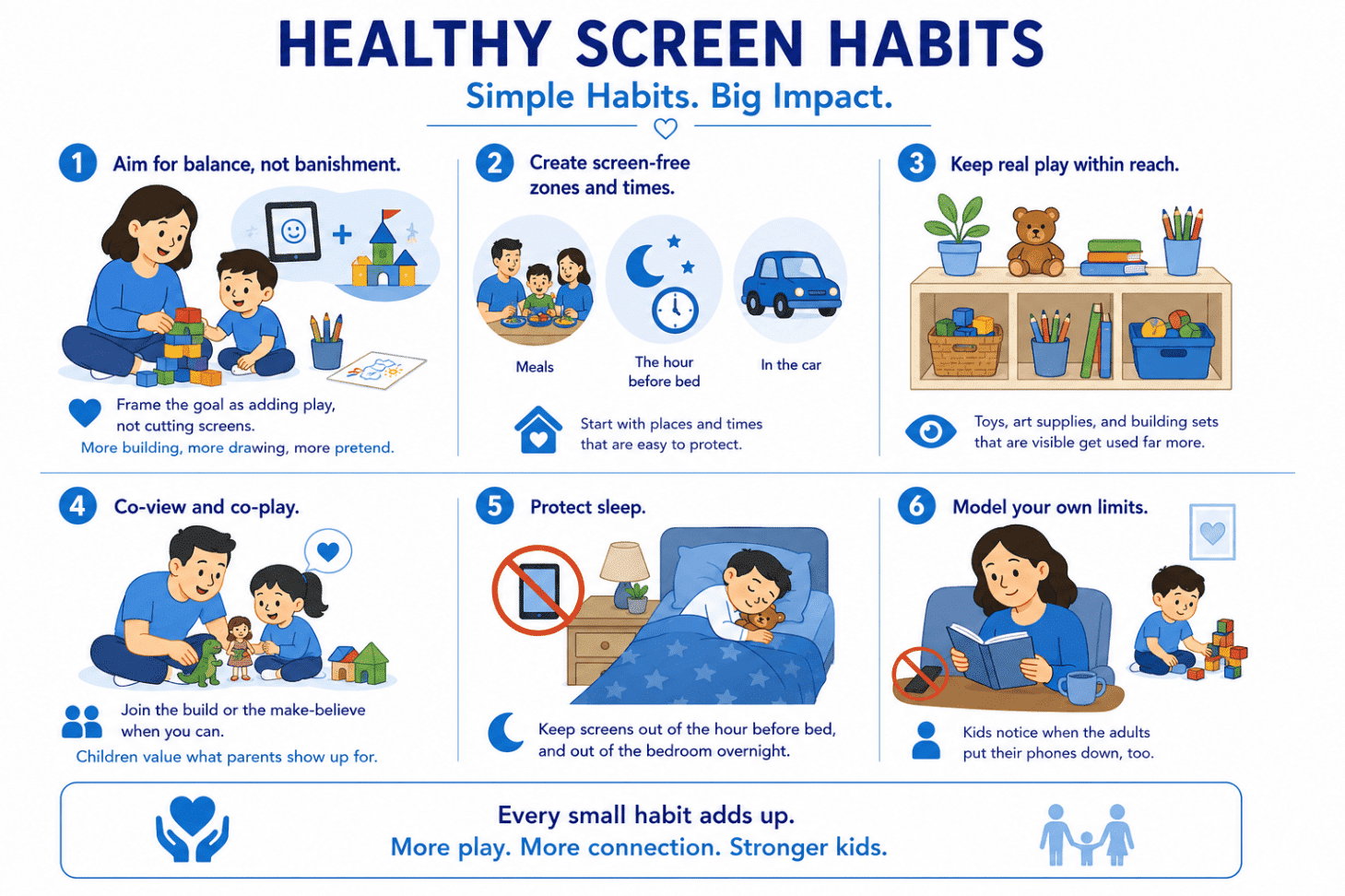
The aim is balance, not banishment. A film like Toy Story 5 can be a surprisingly good conversation starter, because it lets a child think about screens through a character rather than a rule. Build on that opening with a few steady habits.
Steiner-Adair’s approach also emphasises creating a family culture in which technology does not interrupt every opportunity for connection. Parents can establish predictable boundaries around devices while deliberately protecting time for conversation, play, creativity, and shared family experiences. The aim is not to make childhood technology-free, but to prevent digital habits from pushing those experiences aside.
- Frame the goal as adding play, not cutting screens. “More building, more drawing, more pretend” lands better than “less iPad.”
- Create screen-free zones and times. Meals, the hour before bed, and the car are easy places to start.
- Keep real play within reach. Toys, art supplies, and building sets that are visible get used far more.
- Co-view and co-play. Join the build or the make-believe when you can. Children value what parents show up for.
- Protect sleep. Keep screens out of the hour before bed, and out of the bedroom overnight.
- Model your own limits. Kids notice when the adults put their phones down, too.
It can also help to have a ready alternative for the moments you would normally hand over a device.
| Instead of reaching for… | Try… |
| A tablet to calm a meltdown | Naming the feeling, then a physical reset, such as a walk, a hug, or slow breaths |
| A phone at the dinner table | A quick round of “high and low” from everyone’s day |
| A show to fill downtime | An open bin of blocks or art supplies within easy reach |
| A device in the car | Music, “I spy,” or a simple made-up story game |
Consistency matters more than perfection. A few reliable rituals will do more than one dramatic crackdown that fizzles by the weekend.
Are There Any Educational Toys Inspired by Toy Story 5 for iPad Kids?
The Toy Story 5 iPad kids’ theme also draws attention to something easy to overlook: children need time to decide for themselves what happens next. Open-ended play gives them that opportunity.
- Build something: LEGO sets and building blocks encourage planning, experimentation, and problem-solving.
- Create something: Drawing, crafts, and makeup kits allow children to explore ideas without a predetermined outcome.
- Invent a world: Figures, dolls, and pretend-play sets encourage children to create characters, situations, and their own powerful stories.
- Make-up games: Storytelling and role-playing games let children set rules, solve problems, and adapt as play develops.
- Take play outdoors: Bikes, balls, nature activities, and playground games add movement, exploration, and interaction with other children.
These activities are not cheaper options or replacements for an iPad. Their value is that they exercise skills that digital entertainment may not always require, including imagination, independent thinking, problem-solving, and social interaction.
For the mental health of the children, the goal is variety. Technology can have its special place, while open-ended play gives children regular opportunities to create, move, explore, and connect.
How Parents Can Use Toy Story 5 to Start Meaningful Conversations About Technology?
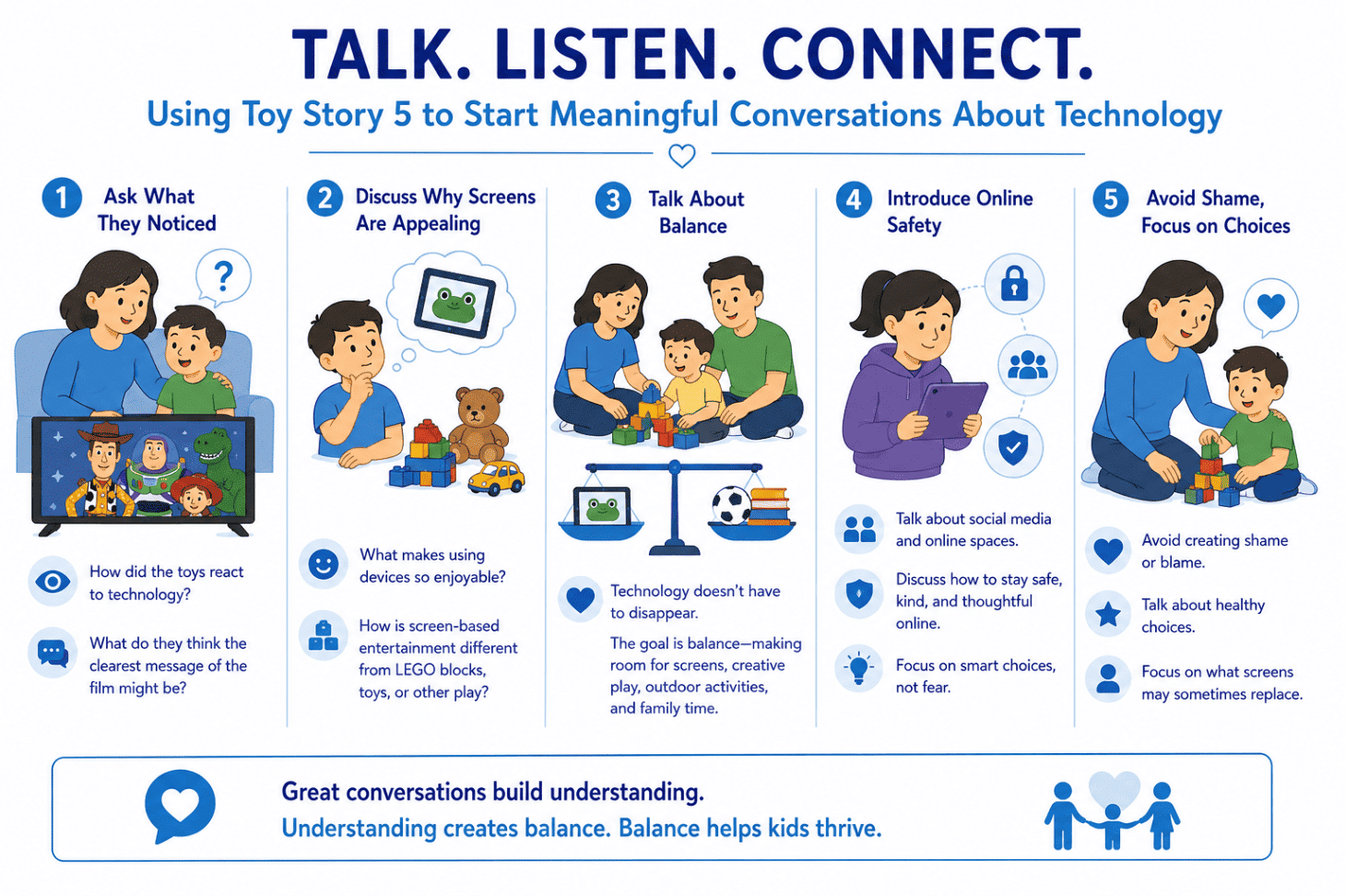
Toy Story 5 can give parents a natural way to talk about screen time use without making children feel judged. The film’s premise can help families explore the appeal of the device while encouraging a healthier balance between technology, traditional toys, and imaginary play.
- Ask what they noticed: Talk about how the group of toys reacts to technology and what children think the film’s clearest message might be.
- Discuss why screens are appealing: Ask what makes using devices so enjoyable and how screen-based entertainment differs from LEGO blocks, traditional toys, or other practical forms of play.
- Talk about balance: Explain that technology does not have to disappear. The goal is to make room for screens alongside creative play, outdoor activities, and family time.
- Introduce online safety: For older children, the story can lead naturally into conversations about social media and the dangers of modern technology without presenting the wide world of scary social media sites as something they should simply fear.
- Avoid shame: The best way to discuss screen habits is without creating a sense of shame. Focus on healthy choices and what screens may sometimes replace rather than treating technology itself as the problem.
When Should You Worry About Your Child’s Screen Time?
Most screen use is normal. It becomes a concern when the device stops being one activity among many and starts crowding out everything else, a pattern that hardens over time rather than one difficult afternoon.
Signs it may be worth seeking support include:
- Intense distress or meltdowns when the device is taken away
- Loss of interest in friends, hobbies, or imaginative play
- Sleep problems, irritability, or trouble focusing at school
- Using the screen as the only reliable way to self-soothe
- Family conflict that increasingly centers on the device
If several of these sound familiar, it does not mean something is broken. It means your child and you could use some support in building healthier habits.
How Total Life Counseling Helps Families Navigating Screen Time?
Screen time is rarely just about screens. It usually connects to anxiety, focus, sleep, or how a child is learning to manage big feelings. At Total Life Counseling, we help families look at the whole picture instead of fighting the same nightly battle over a device.
Our counselors work with children, teens, and parents together, using practical, evidence-based approaches that fit your family’s real routines. We help kids build healthier coping skills, support parents in setting limits that hold, and address underlying concerns like anxiety, attention struggles, or emotional regulation along the way.
If Toy Story 5 started a conversation in your home, we can help you carry it forward. Call (407) 248-0030 to speak with our team and find the right support for your family.
Conclusion
Like the earlier Toy Storys, Toy Story 5 uses a changing childhood to tell a bigger story. This time, Bonnie’s growing interest in Lilypad reflects a challenge many families recognise: finding space for technology without letting imaginative play, outdoor activities, and real-world connection fade into the background.
The reality of the dangers of devices is not that every screen harms children. What matters is balance. Parents can make room for technology while ensuring toys, creativity, movement, and relationships continue to hold a meaningful place in the hearts of children. Small, consistent changes can lead to a good outcome, helping children enjoy digital experiences without losing the real-world experiences that support healthy development.
Frequently Asked Questions
Is screen time actually bad for a child’s mental health?
Not on its own. Research points to associations, not simple cause and effect. What matters most is balance, the content itself, and what screen time replaces. Screens become a concern when they crowd out sleep, play, real connection, or even time spent being a book worm. Parents can do a good job supporting their child’s mental health by encouraging a healthy balance between screens and offline activities.
How can too much screen time affect a child’s emotional well-being?
When a screen becomes the first place a child turns to manage difficult feelings, they get less practice developing healthy coping skills in an emotional way. Studies link heavier screen use with more emotional and behavioral difficulties in some children, though the effects are modest and rarely the only factor.
Can screen time affect a child’s attention span?
Some research associates heavy screen exposure with attention-related difficulties in certain children, but these are associations, not proof. Fast, stimulating content can make slower, effortful activities feel harder. High screen use does not, by itself, cause conditions like ADHD.
What happens when screens replace imaginative play?
Imaginative play builds creativity, language, patience, and problem-solving all at once, while many passive or highly directed apps provide the story and pace for the child. A little screen time is fine; the concern is displacement, when device use leaves little room for open-ended, hands-on play.
Can screen time become a coping mechanism for children?
Yes. A screen offers instant relief from boredom, anxiety, or overwhelm, and can quietly become a child’s main way of managing hard feelings. The goal is to build a fuller toolkit so a device becomes one option among many, not the only one.
How can parents set screen limits without constant conflict?
Frame the change as adding play rather than taking screens away, create simple screen-free zones like meals and bedtime, keep toys within easy reach, and model your own limits. Consistency matters more than one dramatic crackdown.
What does Toy Story 5 have to do with children’s mental health?
The film is a hook, not the subject. Its “iPad kid” storyline reflects a real parenting worry about balance, which opens the door to the bigger conversation: how unbalanced screen time can affect a child’s emotions, attention, creativity, and relationships.
When should I talk to a counselor about my child’s screen use?
Consider support if your child has intense meltdowns when the device is removed, has lost interest in friends or play, struggles with sleep or focus, or relies on screens as their only way to calm down. A counselor can help your family reset.
Filed in: Jim West, screen time
Share This Story, Choose Your Platform!
Total Life Counseling Center consists of Licensed Counselors, masters level therapists, Español counselors, Licensed Mental Health Counselors, business coaches, and image enhancement coaches who provide counseling for emotional, mental, physical and spiritual care including marriage, individual, family, substance abuse and more. TLC’s family, trauma and marriage experts have been interviewed on National and Local TV/Radio over 200 times for their expert advice on Fox News, OWN, WETV, ABC’s Medical Minute and more. Our skilled counselors are relational, approachable and specialists providing therapy services in the Central Florida area including: Orlando, Winter Park, MetroWest, Windermere, Dr. Phillips, East Orlando, Lake Mary, and Clermont, Boca Raton Florida, and Dallas, TX.
About the Author: Jim West