

What Are the Effects of Screen Time on Children’s Mental Health?
Key Highlights
- The effects of screen time on children’s mental health include higher anxiety, depression symptoms, and attention problems when use becomes excessive and starts crowding out sleep, movement, and real-life connections.
- In a recent Spectrum News 13 interview, Total Life Counseling shared what screen addiction looks like in real cases, from kids quitting sports to teens losing college scholarships.
- In the interview, Jim West described how heavy screen use can “rewire” a child’s brain to treat the device as the only source of fun, and how firm boundaries can help it reset in about two weeks.
- Screen time is not automatically harmful. The amount of screen time, the type of screen, and the content all shape the outcome.
- Replacing screen hours with in-person activities like camps, team sports, or martial arts helps children rebuild the social and emotional skills screens can displace.
- Total Life Counseling helps Orlando families set boundaries that protect the mental health of their children without daily battles.
In a recent Spectrum News 13 interview, TLC’s licensed mental health counselor Jim West shared what he is seeing among children and teens struggling with excessive screen use. Some are losing interest in sports and family activities, while others are becoming increasingly absorbed in gaming, videos, and their phones.
For parents already wondering where to set screen-time limits, these observations raise an important question: how does screen time affect children’s mental health? With screens now part of school, entertainment, and everyday life, understanding what is normal, what may be harmful, and when to step in has become increasingly important.
What Are the Mental Health Effects of Excessive Screen Time on Children?
The main effects of screen time on children include increased anxiety, low mood, irritability, weaker emotional regulation, and trouble focusing. These show up most when screen use becomes excessive and starts replacing sleep, movement, and face-to-face connection.
What often surprises parents is how much this can look like a genuine addiction. As West explained in the Spectrum News 13 interview, many of the teens he treats are hooked on the rush they get from playing games, watching videos, and chatting on their phones. In the most serious cases, he warned, “we’re seeing kids go to college and lose their scholarships because they’re just in their rooms playing online or video games.” That is how powerful the pull can become when it goes unchecked. If screen use in your home has reached this point, Total Life Counseling’s electronic and video game addiction counseling team can help.
Call (407) 248-0030 to schedule a complimentary 15-minute phone consultation and learn how our electronic and video game addiction counseling team can support your family.
Moderate, purposeful screen use is rarely harmful on its own. Concerns arise when screens become a child’s main way to escape boredom or manage difficult emotions, replacing opportunities to develop healthier coping skills. That is why the same two hours can look completely different in two homes. Context, content, and what the screen is replacing matter as much as the clock.
How Does Screen Time Impact Children’s Emotional Wellbeing?
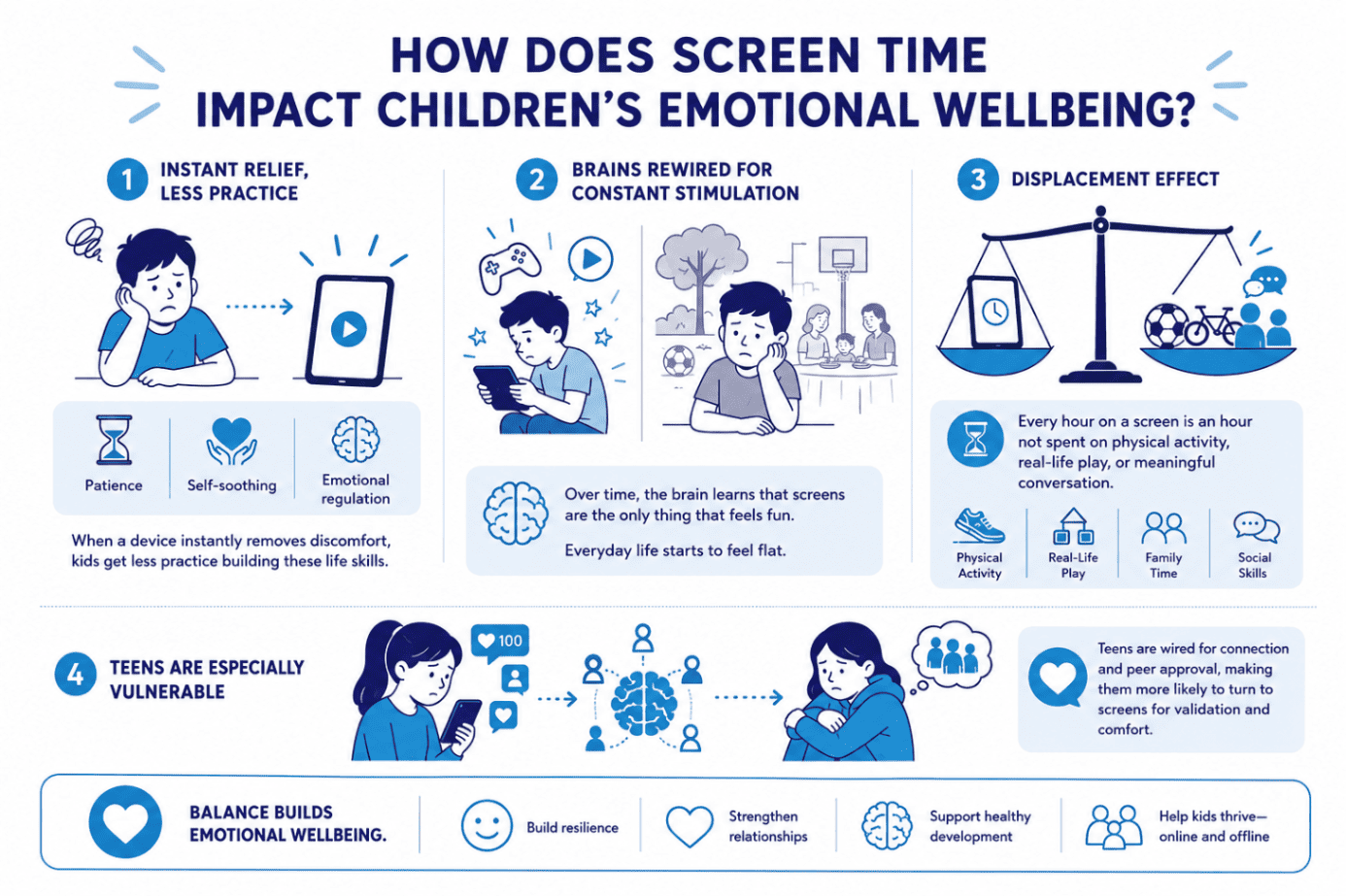
Screen time affects emotional well-being largely by shaping how a child learns to handle discomfort. When a device instantly erases every moment of boredom or frustration, children get less practice building patience, self-soothing, and emotional regulation on their own.
West has seen how far this can go. He described children who stop playing sports and lose interest in doing things with their families, because, as he put it in the interview, “their brain has been rewired to think the only thing fun is to be on their device.” Once that happens, ordinary life- playing outside, sitting down to dinner, hanging out with friends- starts to feel flat compared to the constant stimulation of a screen.
There is also a displacement effect. Every hour in front of a screen is an hour not spent on physical activity, real-life play, or conversation with a family member. Those offline moments are where kids develop social skills, read facial expressions, and learn to sit with feelings. This concern also connects with Dr. Janie Lacy’s point in the interview that teens are especially vulnerable because they are seeking peer validation and connection.
What Mental Health Concerns Are Counselors Seeing Alongside Excessive Screen Use?
At Total Life Counseling, we see how unhealthy screen habits can overlap with changes in mood, sleep, relationships, and everyday behavior. Research is also continuing to examine this connection. A systematic review and meta-analysis available through the National Library of Medicine found small but consistent associations between screen time and increased depression and anxiety across dozens of studies. Problematic or excessive screen use showed a stronger association with anxiety than typical screen use.
That does not mean screens alone cause depression or anxiety. A child’s mental health is influenced by many factors, including sleep, family stress, relationships, genetics, and their broader environment. However, excessive screen use can sometimes add to existing challenges by disrupting sleep, replacing physical or social activities, and making it harder for children to disconnect from constantly stimulating content.
This also reflects what licensed mental health counselor Jim West described in the interview. In his practice, he has seen children withdraw from sports and family activities as devices and gaming become increasingly central to how they spend their time.
For families, the goal does not have to be eliminating screens. At Total Life Counseling, we encourage parents to look at the bigger picture: what children are doing online, how much time screens are taking up, and what important activities or connections they may be replacing. Creating healthier boundaries can be a practical first step toward restoring balance.
What Changes Happen in a Child’s Brain Due to High Screen Usage?
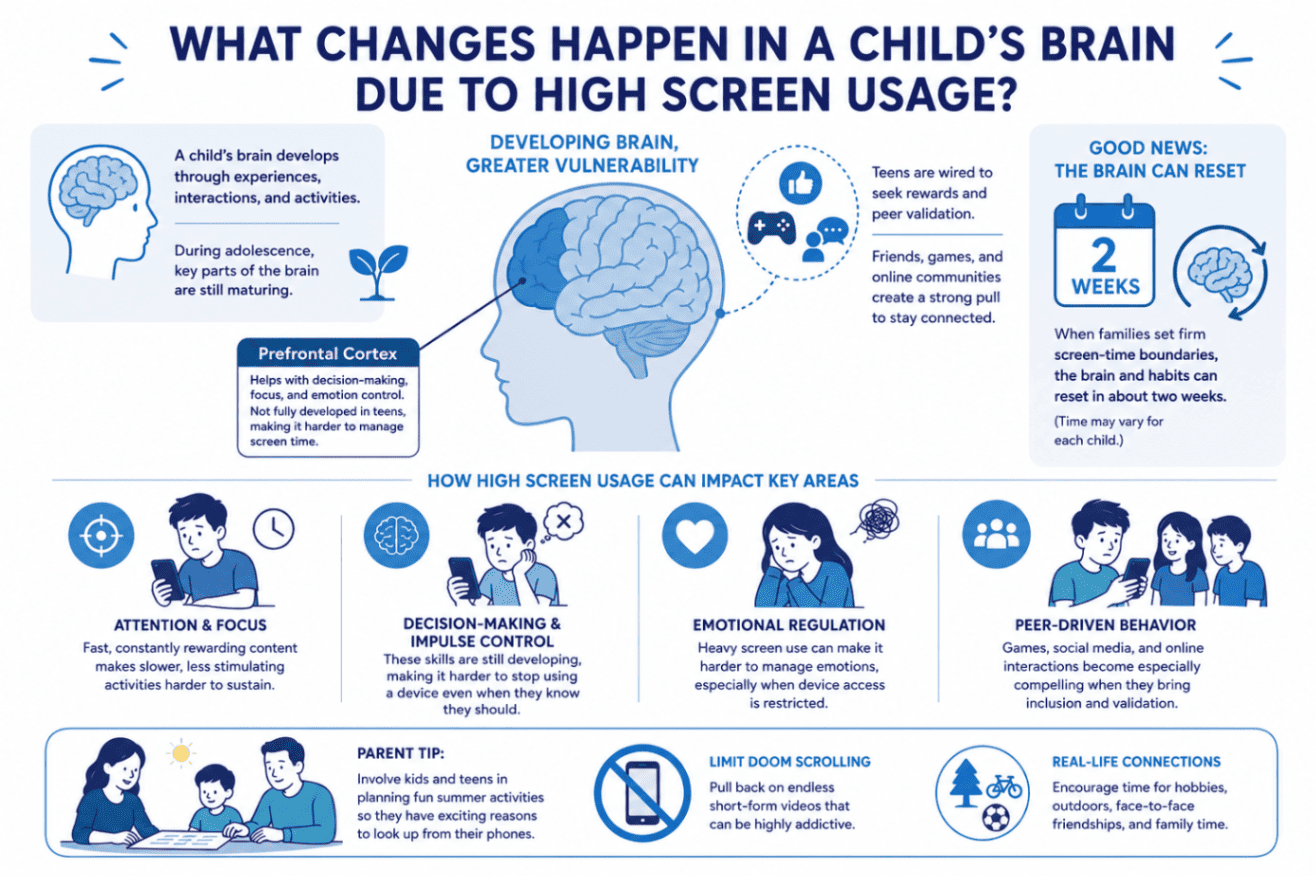
A child’s brain develops through everyday experiences, interactions, and activities. During adolescence, however, some parts of the brain are still maturing, which can make managing screen habits particularly challenging.
As Dr. Janie Lacy explained in the interview, the prefrontal cortex in a teen’s brain, which helps control decision-making and emotions, is not yet fully developed. This can make it harder for teens to recognise when they have had enough screen time and make the decision to put their phones down.
She also explained that teens are naturally wired to seek rewards and validation from their peers. When friends are playing certain games or spending time online, teens may feel a strong desire to participate so they are not left out.
This combination of a developing prefrontal cortex and sensitivity to rewards can influence several areas:
- Attention and focus: Fast, constantly rewarding content can make slower, less stimulating activities more difficult to sustain.
- Decision-making and impulse control: Because these abilities are still developing during adolescence, teens may struggle to stop using a device even when they know they should.
- Emotional regulation: Heavy screen use may make it harder for some children and teens to manage emotions, particularly when access to a device is restricted.
- Peer-driven behavior: Games, social media, and other online activities can become especially compelling when they provide the social inclusion and validation Dr. Lacy described.
Dr. Lacy also encouraged parents to involve children and teens in planning their summer activities so they have enjoyable reasons to spend time away from their phones. She specifically recommended pulling back on the potentially addictive habit of “doom scrolling” through short-form videos.
Jim West added another hopeful perspective. He observed that when families establish firm screen-time boundaries, “the brain resets and the addiction oftentimes resets in about two weeks.” While this should not be treated as a universal timeline, his experience reinforces the value of creating consistent boundaries around technology use.
How Does Screen Time Affect Child Development Compared to Other Activities?
Screen time is not neutral because time is finite. Every block spent on video games or streaming is time not spent on the activities that drive healthy social development, physical health, and motor skills.
This is exactly the pattern West described in the interview, where children who once loved sports and family time slowly withdraw from both as the device takes over. Building, drawing, and pretend play develop fine motor skills and imagination. Running and climbing support physical activity and coordination. Talking and playing with others builds social skills and empathy that no app can fully replace. When the amount of time on devices grows, that developmental practice shrinks, sometimes showing up later as weaker academic performance or behavioral problems.
None of this makes technology the enemy. Educational content and well-chosen tools genuinely help kids learn. The difference lies in whether screens add to a rich childhood or quietly replace it.
Do Teens Experience Different Mental Health Effects Than Younger Children?
Yes. The effects of screen time on teens differ from those on younger children, mostly because of social media and independence. While a young child is shaped by content and displaced play, a teenager is also navigating identity, peer approval, and online comparison.
Parents often ask how screen time affects teens’ mental health, and for this age group, the answer usually centers on social platforms rather than cartoons. The interview highlighted a specific pressure: when a teen’s friends are all playing the same games, that teen desperately wants to be included, which makes limits feel like social exile. Combine that with a still-developing prefrontal cortex and a brain wired for peer validation, and you can see why teens get pulled in so deeply.
One habit worth reining in first, especially given how addictive it is, is the endless doom scrolling of short-form videos, which is engineered to be almost impossible to stop. Younger children, by contrast, are more affected by total screen exposure, content quality, and lost time for hands-on learning. Both age groups benefit from limits, but the specific risks shift as kids grow.
Are There Warning Signs Screen Time Is Affecting My Child’s Mental Health?
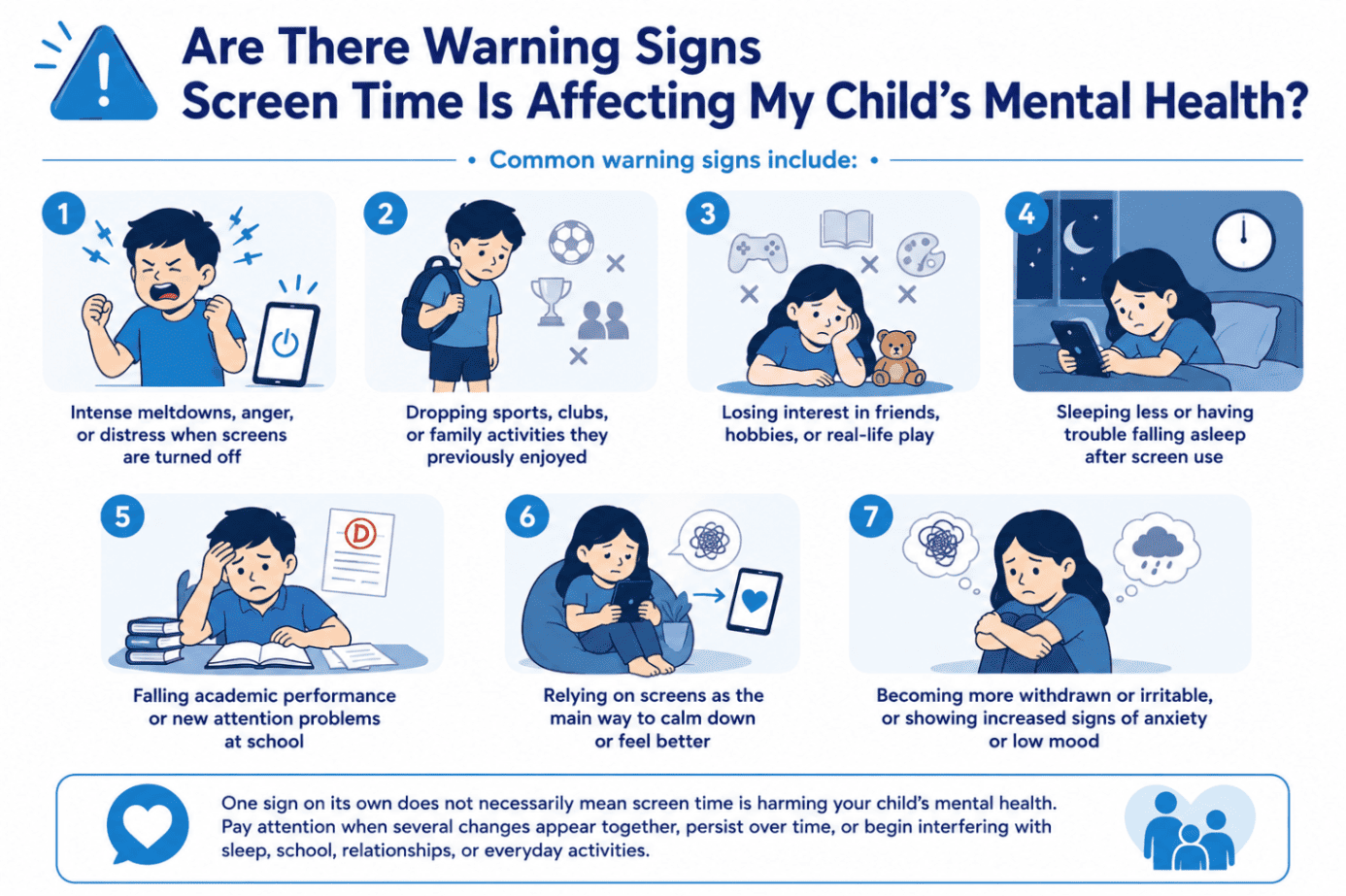
Most screen use is normal. It becomes a concern when it starts changing your child’s mood, sleep, or behavior in lasting ways. Watch for patterns rather than one-off bad days.
Common warning signs include:
- Intense meltdowns, anger, or distress when screens are turned off
- Dropping sports, clubs, or family activities they used to enjoy
- Loss of interest in friends, hobbies, or real-life play
- Less sleep or trouble falling asleep after screen use
- Falling academic performance or new attention problems at school
- Using screens as the only way to calm down or feel better
- Withdrawal, irritability, or rising anxiety and depression symptoms
Several of these warning signs mirror what Jim West described seeing in his practice, including children losing interest in sports and family activities because being on a device has become their main source of fun. He also shared more serious examples of young people reaching college and losing scholarships because they were spending so much time alone in their rooms playing online or video games.
West’s observations highlight why changes in a child’s offline interests and relationships are worth paying attention to. When screens begin replacing sports, family time, friendships, or other activities a child once enjoyed, setting clearer boundaries and seeking additional support may help them rebuild a healthier balance.
How Can Parents Help Reduce the Negative Effects of Screen Time?
The good news, and the core message of the interview, is that screen habits are highly changeable. Small, consistent adjustments usually work far better than a single dramatic ban. Here is a practical starting point drawn from the interview and Total Life Counseling’s work with families.
- Set boundaries together: Agree on clear limits for how much time and which type of screen, and explain the why, not just the rule. West notes that with steady boundaries, the dependence he sees in his clients often eases within about two weeks.
- Replace screens with in-person activities: Sign children up for Total Life Counselling summer skills camp, team sports, or martial arts, so they socialize face to face and rediscover fun off the device.
- Give kids a voice and a goal: As one parent in the interview described, a child who helps make the plan and sets their own goals, with agreed limits, is far more likely to manage their own screen time.
- Watch the content, not just the clock: Pay close attention to what your children are actually watching, and pull back hardest on the most addictive formats like short-video doom scrolling.
- Protect sleep: Keep devices out of bedrooms and stop screens an hour before bed to support natural melatonin production.
- Model it yourself: Kids copy adults, so your own technology use sets the tone for the household.
Consistency is what makes these stick. A few reliable, screen-free routines will protect your child’s wellbeing more than any short-term crackdown.
Why Is Total Life Counseling a Trusted Choice for Families Navigating Screen Time?
Screen time is rarely just about screens. It usually connects to anxiety, sleep, focus, or how a child learns to manage big emotions. At Total Life Counseling, we help families look at the whole picture rather than fighting the same nightly battle over a device.
Our counselors work with children, teens, and parents together, using practical, evidence-based approaches that fit your family’s real routines. We help kids build emotional regulation and healthier coping skills, support parents in setting limits that last, and address any underlying concerns like ADHD, anxiety, or depression along the way.
If screens have become a source of stress in your home, you do not have to sort it out alone. Book a call with our team today to discuss your family’s needs and find the right support to help your child.
Conclusion
The effects of screen time on children’s mental health are real, but as the interview made clear, they are not a life sentence. What matters most is balance: how much time children spend on screens, what they are watching, and what those screens might be replacing.
You do not need a screen-free home to raise a healthy, resilient child. Consistent limits, appropriate content, protected sleep, and plenty of real-world play and connection can all help. Start with one change, such as keeping screens away from the dinner table or turning devices off an hour before bed, and build from there.
If you are worried about your child’s mood, sleep, or behavior, changes in screen habits paired with the right support can make a meaningful difference. As Jim West shared, creating boundaries around technology can help children rediscover activities, relationships, and interests beyond the screen.
Frequently Asked Questions
What did Jim West say about screen addiction in children?
Jim West said screen addiction can cause children to lose interest in sports, family activities, and other offline experiences. He explained that their brains may become conditioned to see devices, online games, and videos as their main source of fun.
Why is screen time bad for kids when it is too much?
Too much screen time is linked to anxiety, depression symptoms, attention problems, and lost sleep. It can also crowd out the physical activity, social skills, and real-life experiences that children need for healthy development, and in some cases it becomes a genuine addiction.
What are the effects of too much screen time for kids under five?
For younger children, the bad effects of screen time for kids include delays in language development, weaker social development, and reduced motor skills when devices replace hands-on play. The American Academy of Pediatrics suggests about one hour of high-quality content a day for ages two to five.
How does screen time affect children’s sleep?
Screens, especially at night, expose children to blue light that suppresses melatonin, the hormone that signals sleep. This leads to less and poorer sleep, which in turn worsens mood, focus, and behavior the next day.
How does screen time affect teens’ mental health specifically?
For teens, social media and peer pressure are the biggest factors. A brain still developing impulse control, plus the urge to be included when friends are gaming, can fuel comparison, anxiety, and late-night sleep loss. Short-video doom scrolling is especially hard to stop.
What is the recommended screen time for children by age?
The American Academy of Pediatrics recommends no screens under 18 months except video chat, high-quality co-viewed content from 18 to 24 months, about one hour daily for ages two to five, and consistent limits for older children that protect sleep and activity.
Can reducing screen time improve my child’s behavior?
Often, yes. Many families notice better sleep, calmer moods, and fewer behavioral problems within a few weeks of reducing high screen time. In Jim West’s clinical experience, the dependence often eases in about two weeks once the brain adjusts to new boundaries. Pairing lower screen use with more activity, play, and connection produces the strongest improvement.
When should I seek professional help about my child’s screen use?
Consider help if screens trigger extreme distress, disrupt sleep or school, or come with rising anxiety, depression, or withdrawal from sports and family. A counselor can help identify whether screens are the core issue or a symptom of something deeper, then guide your family forward.
Filed in: Jim West, screen time
Share This Story, Choose Your Platform!
Total Life Counseling Center consists of Licensed Counselors, masters level therapists, Español counselors, Licensed Mental Health Counselors, business coaches, and image enhancement coaches who provide counseling for emotional, mental, physical and spiritual care including marriage, individual, family, substance abuse and more. TLC’s family, trauma and marriage experts have been interviewed on National and Local TV/Radio over 200 times for their expert advice on Fox News, OWN, WETV, ABC’s Medical Minute and more. Our skilled counselors are relational, approachable and specialists providing therapy services in the Central Florida area including: Orlando, Winter Park, MetroWest, Windermere, Dr. Phillips, East Orlando, Lake Mary, and Clermont, Boca Raton Florida, and Dallas, TX.
About the Author: Jim West