

Mark Zuckerberg Instagram Court Case: What Parents Should Know About Teen Social Media Addiction

Key Highlights
- Meta is facing a federal youth-safety trial over allegations that Instagram and Facebook used features designed to encourage prolonged engagement and contributed to harms among young users.
- Meta disclosed potential damages of up to $1.4 trillion, while the states are also seeking changes to addictive design features and deletion of data collected from children.
- Internal research cited in related cases found that some teens continued compulsive use despite parental intervention, with vulnerable teens facing greater risks of overuse.
- Features such as infinite scroll and autoplay are at the center of concerns about engagement-driven design, alongside reported effects involving sleep, mood, self-esteem, bullying, and harmful content.
- Meta disputes that its platforms caused the alleged harms and argues that “social media addiction” is not a recognized psychiatric diagnosis.
- Total Life Counseling supports teens and families dealing with social media dependency through assessment, therapy, parental guidance, self-esteem support, and strategies for rebuilding healthier offline connections.
A single number sums up what’s at stake in Mark Zuckerberg’s latest court case: $1.4 trillion. That’s the amount Meta itself says it could owe if a federal jury sides against the company in a trial that began Tuesday, August 18, 2026, in Oakland, California.
At the center of the case is a question millions of parents have already asked at home: were Instagram and Facebook built to hook teenagers, and did Meta know it? Over the next several weeks, that question will play out in a Mark Zuckerberg court case, with Zuckerberg himself expected to take the stand.
Why Is Mark Zuckerberg in Court?
The case landed in federal court before Judge Yvonne Gonzalez Rogers, capping a consolidated action originally filed back in 2023 by 29 state attorneys general. Four of those states, California, Colorado, Kentucky, and New Jersey, are the lead plaintiffs at this trial, with the remaining 25 states expected to have their own trials later.
The lawsuit stems from a multistate investigation into Meta’s safety practices, which officials said revealed serious harms to children and teens. The states allege two main things:
- Meta intentionally built addictive features into Instagram and Facebook, including infinite scroll, autoplay, push notifications, and “like” counters, then misled the public about the risks.
- Meta violated the Children’s Online Privacy Protection Act (COPPA) by knowingly allowing children under 13 onto its platforms and collecting their personal data without parental consent.
Meta has denied the allegations and lost a last-minute bid to get the case dismissed before opening arguments began.
How Much Money Is Meta Facing?
Meta has disclosed in a legal filing that potential damages could reach as high as $1.4 trillion if the states prevail in the case.
The states are also seeking changes to Meta’s practices, including remedies related to data allegedly collected from children under 13 and changes to features they argue encourage prolonged engagement.
The case therefore involves more than potential financial damages. It could also affect how Meta approaches youth safety and platform design going forward.
What Does Meta Say About the Allegations?
Meta’s position is that “social media addiction” isn’t a recognized psychiatric diagnosis, and that will likely be a central argument at trial.
The company says it has invested heavily in teen safety tools and disputes that its products caused the harms described by the states, characterizing the case as an attempt to extract an “outlandish payout” over what it calls unproven claims.
If you’re considering professional support, finding the right addiction therapist can make the next step feel more manageable. Explore addiction therapists in Orlando.
What Do the Allegations Mean for Teenagers?
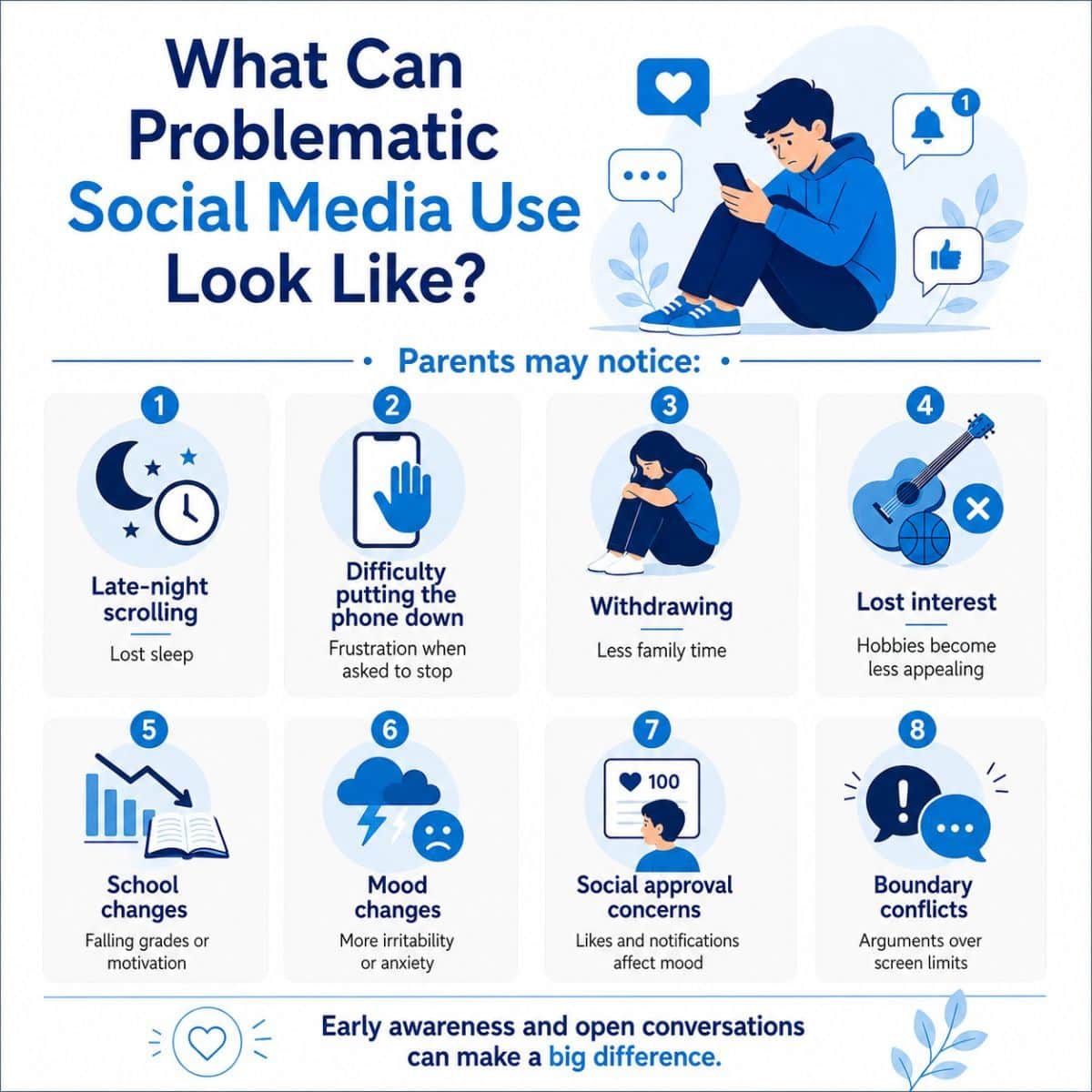
The allegations in the trial focus on how social media platforms may encourage prolonged and repeated use. For parents, the more immediate question is what that kind of use can look like in everyday life.
Compulsive social media use does not always look like a teenager openly saying they cannot stop. It can show up through gradual changes in routines, relationships, schoolwork, and mood.
Parents may notice:
- Staying up late scrolling: A teen regularly loses sleep because they continue checking feeds, messages, or notifications.
- Difficulty putting the phone down: They become frustrated or distressed when asked to stop, even when they know they need to.
- Withdrawing from family activities: Time spent online begins replacing meals, conversations, outings, or other family activities.
- Losing interest in hobbies: Activities they once enjoyed may become less appealing compared with time spent online.
- Changes at school: Motivation, concentration, attendance, or grades may begin to decline.
- Mood changes: Parents may notice increased irritability, anxiety, low mood, or emotional reactions connected to social media use.
- Anxiety around social approval: Likes, comments, messages, or notifications may begin to have an outsized effect on how a teen feels about themselves.
- Conflict around boundaries: Attempts to establish reasonable limits can lead to repeated arguments, secrecy, or intense emotional reactions.
These signs do not automatically mean a teenager has an addiction or a mental health disorder. But when social media use consistently interferes with daily life, it is worth looking more closely at what may be happening underneath the behavior.
Wondering how screen time is shaping today’s kids? See what Toy Story 5 can teach us about “iPad kids” and screen habits.
What Can Parents Do If Social Media Is Becoming a Problem?
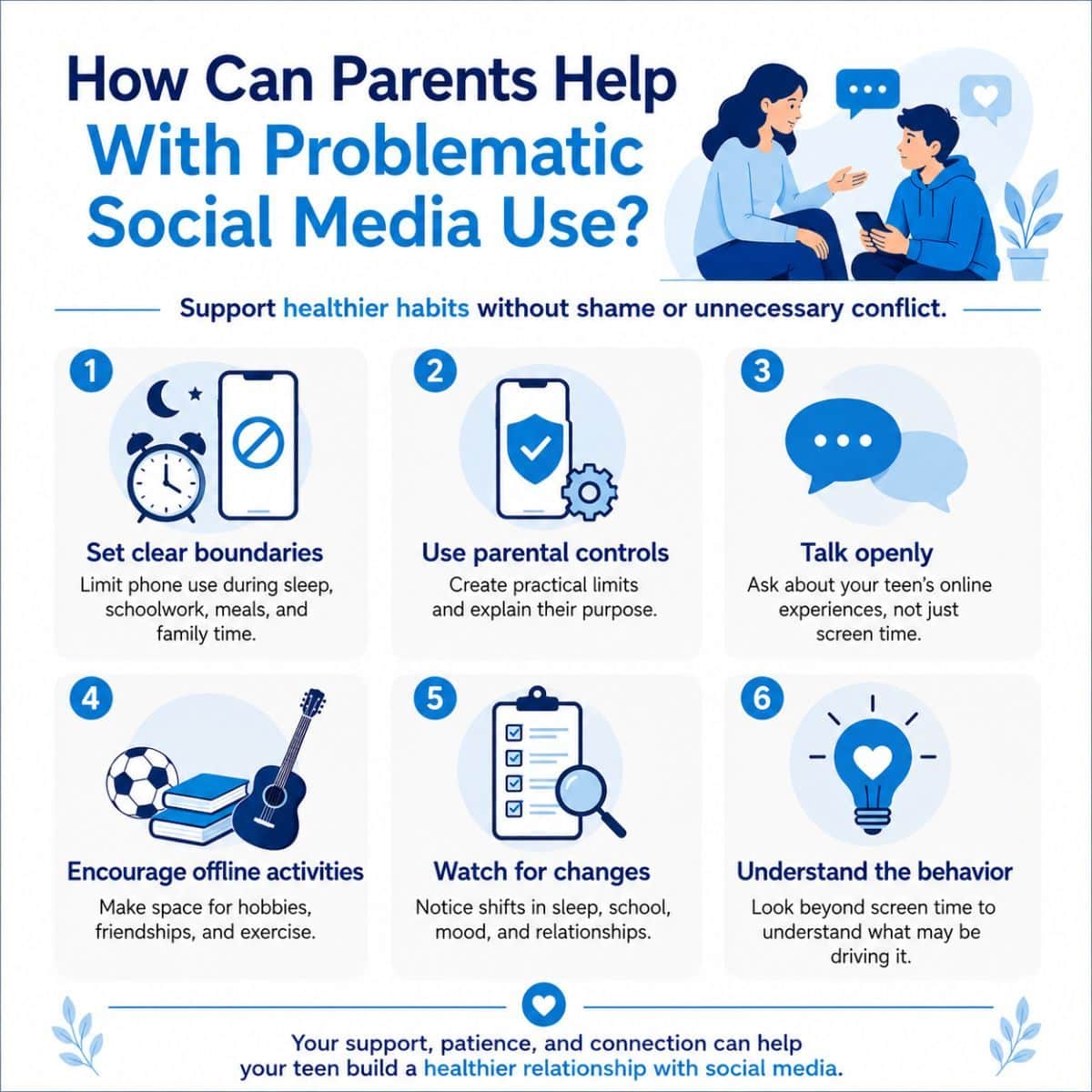
The goal does not have to be eliminating social media completely. Parents can start by looking at how their teen’s use is affecting everyday life and establishing boundaries that are practical and consistent.
Helpful steps may include:
- Set clear expectations around phones, especially during sleep, schoolwork, meals, and family time.
- Use parental controls when appropriate, while explaining the purpose behind the limits.
- Talk with your teen about what they are experiencing online rather than focusing only on how much time they spend on their phone.
- Encourage hobbies, friendships, exercise, and other offline activities that give them opportunities to connect and recharge.
- Pay attention to changes in sleep, school performance, mood, relationships, and family interactions.
- Avoid turning every conversation about social media into a punishment or argument. Understanding what is driving the behavior can make it easier to create boundaries that actually work.
Not sure where to start when screen-time limits become a daily battle? These practical strategies can help parents create healthier technology boundaries.
How Can Total Life Counseling Help With Social Media Addiction?
If any of this sounds familiar- the slipping grades, the withdrawn mood, the phone that never seems to leave your teen’s hand- please know you’re not alone, and neither is your child.
The behaviors at the center of this case may sound familiar to parents who have experienced repeated arguments over screen time, difficulty getting a teen to put down a phone, or growing withdrawal from offline activities.
These behaviors do not establish that a teen is addicted to social media. But when they become persistent or begin affecting sleep, school, relationships, mood, or daily routines, they may be signs that a closer look is needed.
That exhaustion is real, and it doesn’t make you a bad parent. It makes you someone who’s paying attention.
You don’t have to wait for a verdict in a courtroom to get help. At Total Life Counseling, we walk alongside children, teens, and families across Central Florida and Dallas-Fort Worth who are living with exactly this kind of screen and social media dependency.
We know it rarely shows up alone. It can bring anxiety, low self-esteem, family tension, or a teen who feels more comfortable behind a screen than in the room with you. Our approach treats the whole person, not just the behavior, because healing usually asks for more than a rule about screen time.
Here’s what that support can look like:
- A gentle, thorough assessment. We take the time to understand what your teen is going through and why, so the plan we build together actually fits your family, not a generic script.
- Guidance on parental controls. We help you put practical tools in place, without turning your home into a battleground over the phone.
- Rebuilding self-esteem and real-world connection. We help teens rediscover hobbies, friendships, and activities that give them the sense of worth an app can only imitate.
- Getting back on track academically. When motivation and grades have slipped, we help teens reconnect with their goals and understand, without shame, how the pull of social media has been affecting them.
- Individual and group therapy. In a caring, judgment-free space, teens can explore what’s really driving the dependency, while also learning they’re not the only ones going through it.
- Support for what comes with it. We’re also here for the anger, the grief of letting go of old habits, the family strain, and the stress that so often travels alongside this struggle.
If you’re worried about a teen in your life, you don’t have to figure this out on your own. We offer a free 15-minute phone consultation to talk through what you’re seeing and what support could look like.
We also have in-person appointments at our Orlando, Winter Park, Clermont, Lake Mary, Boca Raton, and Dallas offices, plus teletherapy if meeting virtually feels easier right now.
Contact us today at: 407-248-0030
Want to Start Learning Today? Try Our StressLess Addictions MasterClass
Not every family is ready to begin counseling right away. The StressLess Addictions MasterClass offers practical guidance you can explore from home, including:
- Understanding social media dependency and electronics addiction
- Setting healthier parental boundaries around phones, devices, and screen time
- Learning practical strategies to support healthier habits at home
It’s a simple way to start understanding what may be behind your teen’s technology use and have more productive conversations as a family.
Conclusion
Whatever the outcome of the trial, the conversation it has sparked matters for families. When social media begins to interfere with sleep, school, relationships, or a teen’s ability to disconnect, it may be time to look beyond the screen-time argument and understand what is happening beneath the behavior.
For parents, that can mean paying attention to changes in mood, routines, academic performance, relationships, and everyday functioning rather than focusing only on how many hours a teen spends on their phone.
If social media use is becoming a source of ongoing conflict or affecting your teen’s well-being, support can help you understand what may be driving the behavior and find healthier ways forward together.
| This article is based on reporting from The Washington Post, Reuters, Fortune, Engadget, Fox Business, TechCrunch, and CBC News on the Meta federal youth-safety trial that began August 18, 2026. |
|---|
Frequently Asked Questions
What strategies did Meta reportedly use to attract younger users, according to the trial?
According to trial evidence, Meta platforms pursued younger users through teen-focused growth strategies, engagement goals, retention efforts, beauty filters, and other features. Internal document evidence suggested attention to youth usage of Instagram in recent years.
What questions did Mark Zuckerberg face regarding underage Instagram use during the trial?
Zuckerberg’s testimony faced questions about underage users, age verification, and whether Meta adequately enforced its under-13 policy. Mark Lanier pressed him over internal complaints, congressional statements, and evidence that children used Instagram.
How did the media cover Mark Zuckerberg’s appearance in federal court for the Instagram case?
Media coverage portrayed Zuckerberg’s first time before a jury as a closely watched moment in the social media trial. Reports highlighted his testimony, courtroom exchanges, media training, gold chain, and scrutiny inside the Los Angeles courtroom.
What are the most important outcomes expected from the court case involving Mark Zuckerberg and Instagram?
The most important outcomes could include damages, stronger child safety requirements, age verification, restrictions on platform design, and precedents affecting school districts and similar lawsuits nationwide. The landmark trial may influence social media companies and youth safety policies.
What was the main argument Mark Zuckerberg made in court regarding Instagram’s impact on youth mental health?
Zuckerberg argued that Instagram was not deliberately designed to harm people and that Meta had improved youth safety. He emphasized enforcement challenges, denied targeting underage users, and defended Meta’s efforts to address harmful consequences.
What role did former Meta employees play in the trial?
Former Meta employees provided evidence about Meta’s approach to youth safety and the harmful consequences of compulsive use on young people. Their accounts added context to claims examined in the initial trial and Los Angeles case.
How could the case affect other tech companies?
The case could influence how tech companies address youth safety, social media apps, and platform design. Its outcome may affect Big Tech, including companies such as Google’s YouTube, and shape future expectations around protecting younger users.
How does Total Life Counseling help teens struggling with social media dependency?
Total Life Counseling starts with a thorough assessment to understand what’s driving the dependency. Treatment can include individual or group therapy, parental guidance, self-esteem support, and strategies to rebuild healthier offline connections.
What is the Mark Zuckerberg Instagram court case about?
The Meta CEO Mark Zuckerberg case examines allegations that Meta designed social media platforms to encourage prolonged teen engagement and knowingly allowed underage users while collecting children’s data without proper parental consent.
What does the Meta trial allege about social media addiction in teens?
The trial alleges that engagement features such as infinite scroll, autoplay, and notifications may encourage problematic use among teens. States argue these designs contribute to concerns involving sleep, mood, self-esteem, bullying, and harmful content.
How can compulsive social media use affect teenagers?
Compulsive social media use can disrupt sleep, lower mood, increase anxiety, reduce self-esteem, affect academic performance, and increase exposure to bullying or harmful content, contributing to body image issues. These concerns may worsen existing mental health issues among vulnerable teens.
Why can teens have difficulty putting their phones down?
Teens can struggle to put phones down because engagement-driven features continually encourage attention and repeated use. Trial evidence suggests parental supervision alone may not stop compulsive behavior, particularly among vulnerable teenagers.
What social media habits should parents be concerned about?
Parents should watch for persistent compulsive use, slipping grades, disrupted sleep, withdrawal from offline activities, family conflict, and difficulty stopping. Frequent exposure to bullying, harmful content, or social comparison can also signal concerning patterns.
When does social media use become a problem for a teenager?
Social media use becomes a problem when it repeatedly interferes with sleep, school, relationships, mood, self-esteem, or everyday responsibilities. A teenager may need support when using social media feels compulsive or consistently causes meaningful difficulties.
How can parents help a teen reduce social media use?
Parents can help by setting practical boundaries, using parental controls, encouraging offline hobbies and friendships, discussing online experiences without shame, and seeking support when social media use begins affecting school, relationships, mood, or family life.
Can counseling help with social media dependency?
Yes. Counseling can help identify what drives dependency and address related concerns through individual or group therapy, parental guidance, self-esteem support, academic support, and strategies for rebuilding healthier offline connections while supporting healthier family routines.
Filed in: Jim West, Social media
Share This Story, Choose Your Platform!
Total Life Counseling Center consists of Licensed Counselors, masters level therapists, Español counselors, Licensed Mental Health Counselors, business coaches, and image enhancement coaches who provide counseling for emotional, mental, physical and spiritual care including marriage, individual, family, substance abuse and more. TLC’s family, trauma and marriage experts have been interviewed on National and Local TV/Radio over 200 times for their expert advice on Fox News, OWN, WETV, ABC’s Medical Minute and more. Our skilled counselors are relational, approachable and specialists providing therapy services in the Central Florida area including: Orlando, Winter Park, MetroWest, Windermere, Dr. Phillips, East Orlando, Lake Mary, and Clermont, Boca Raton Florida, and Dallas, TX.
About the Author: Jim West