

The ADHD Effect on Marriage: What Are 10 Common Struggles?

Key Highlights
- The ADHD effect on marriage is real about 38% of individuals with ADHD report that their marriage nearly ended in divorce.
- Symptoms like distractibility, forgetfulness, and impulsivity can strain communication and emotional connection.
- Signs of inattention or forgetfulness are often mistaken for a lack of love or concern, damaging trust over time.
- Understanding how the ADHD effect on marriage shapes behavior helps both partners respond with patience instead of blame.
- Total Life Counseling provides couples with practical tools to rediscover trust, rebuild balance, and reconnect with each other on a deeper level.
When ADHD enters a marriage, one partner often feels overburdened while the other feels constantly criticized, a cycle that can quietly erode love over time. If your partner has ADHD, you might feel invisible, carrying the weight of the relationship alone. If you’re the one with ADHD, you might feel constantly criticized, no matter how hard you try.
But here’s the truth: ADHD doesn’t have to be the villain in your marriage. When you understand how ADHD affects your daily life, you gain clarity and compassion for each other.
In this blog, you’ll discover 10 more hidden ways ADHD strains relationships, and how you can turn everyday struggles into meaningful opportunities for growth and deeper connection.
What Makes ADHD Relationships So Challenging?
Loving someone with Attention Deficit Hyperactivity Disorder (ADHD), or living with it yourself, can be both beautiful and difficult. ADHD isn’t a flaw or a lack of effort; it’s a neurodevelopmental condition that affects how the brain manages attention, emotions, and organization. While it’s often first noticed in childhood, it usually continues into adulthood in quieter, more subtle ways.
In relationships, ADHD doesn’t just impact one person; it affects both. Forgetfulness, impulsive decisions, emotional outbursts, or constant distraction can make one partner feel unseen or unimportant. Meanwhile, the person with ADHD often feels misunderstood or criticized for things they never intended to do wrong.
If this sounds familiar, please know you’re not alone. Research from the National Institutes of Health shows that over 6% of adults in the U.S. have ADHD, meaning millions of couples face these same struggles every day. The good news is that awareness changes everything. When you begin to understand how ADHD affects your relationship, you can move from blame and frustration toward compassion, teamwork, and healing.
Why does ADHD make good intentions look like bad behavior?
One of the hardest parts of the ADHD effect on marriage is that good intentions do not always feel like good intentions to the other partner. A forgotten promise can feel like a lack of care. Missing an important date can feel intentional. Walking away during an argument can feel dismissive.
For many ADHD couples, these moments are often linked to challenges with memory, emotional regulation, time management, or follow-through rather than a lack of love or commitment. Some people with ADHD also experience Rejection Sensitive Dysphoria (RSD), an intense emotional response to perceived criticism or disappointment. Even gentle feedback can sometimes feel overwhelming, making conflict resolution more difficult for both partners.
Understanding these patterns can help couples recognize that they may be dealing with ADHD symptoms rather than a lack of love, effort, or commitment, making it easier to approach the problem together rather than blame each other.
What are 10 Reasons ADHD Leads to Relationship Breakdowns or Divorce?
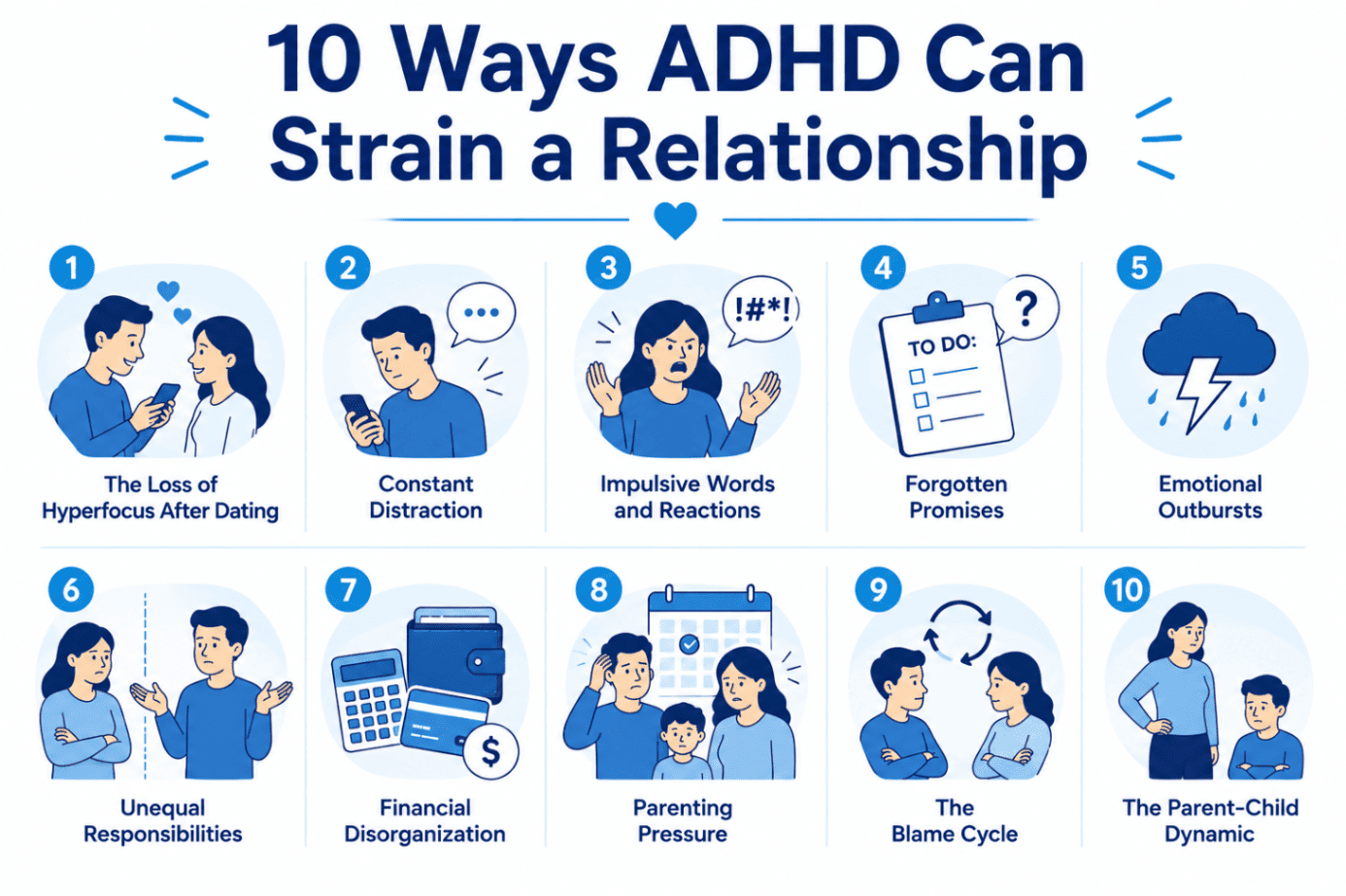
ADHD doesn’t destroy relationships; misunderstanding does. When symptoms go unmanaged, couples often get caught in painful cycles that leave both partners feeling unseen, unheard, and unloved. But when you finally recognize that ADHD might be the root of your struggles, it can shift everything. Here are ten ways ADHD can quietly strain a relationship, and how awareness can open the door to healing.
1. The Loss of Hyperfocus After Dating
In the early days, your ADHD partner may have made you feel like the center of their world, texting constantly, planning surprises, hanging on every word. But once that intense hyperfocus fades, you might feel like you suddenly disappeared. It’s heartbreaking, especially when it feels personal.
The truth? It’s not a lack of love. It’s a shift in how the ADHD brain manages focus. Rebuilding connection means creating new ways to stay engaged, shared routines, regular check-ins, and even small moments of undivided attention that say, “You still matter.”
2. Constant Distraction
You’re talking about your day, and halfway through, your partner picks up their phone or zones out. You feel invisible. They feel terrible, but can’t seem to help it. ADHD makes attention inconsistent, not affection.
Try saying, “I need your full attention for a few minutes” rather than, “You never listen.” That one small shift helps your partner tune in with awareness instead of shame.
3. Impulsive Words and Reactions
Ever had your partner blurt out something thoughtless, only to regret it seconds later? ADHD impulsivity can make words slip before they’re filtered. Those moments sting and often lead to defensive arguments.
The goal isn’t perfection, but pause. Practicing a breath before reacting, or even using a “time-out” word, can prevent an impulsive moment from becoming a lasting wound.
4. Forgotten Promises
You asked them to pick up groceries. They agreed… and completely forgot. You feel dismissed, even though they meant well. For the ADHD brain, memory gaps aren’t carelessness; they’re wiring.
Visual cues, shared reminders, or phone alerts can save more than just errands; they protect trust. Try tackling the problem together instead of making it personal: “How can we make this easier to remember next time?”
5. Emotional Outbursts
Some days, it feels like you’re walking on eggshells, never knowing what might trigger anger or tears. Emotional regulation is tough for people with ADHD, and reactions can come out bigger than intended. It’s not fair to either partner.
Creating a “pause and name it” practice helps: “I’m feeling overwhelmed, can we talk in a few minutes?” gives emotions room to cool and compassion space to grow.
6. Unequal Responsibilities
You might find yourself juggling the bills, the chores, the schedules, and resentment builds quietly over time. You didn’t sign up to be the manager of everything.
But your ADHD partner often feels terrible about falling short. Instead of saying, “You never help,” try, “Can we split this in a way that works better for both of us?” When both partners take ownership, even imperfectly, balance slowly returns.
7. Financial Disorganization
Missed due dates. Impulsive buys. A shared account that never quite balances. Money fights are brutal, and with ADHD, they can spiral fast.
Instead of arguing over mistakes, try creating systems, automatic payments, shared budgeting apps, or separate spending allowances. This reduces pressure and removes shame. Remember, financial teamwork builds emotional safety too.
8. Parenting Can Magnify Existing Challenges
School forms, appointments, extracurricular schedules, forgotten permission slips, and daily routines can increase stress for both partners.
Many couples find that parenting responsibilities magnify ADHD symptoms that previously felt manageable, creating frustration around planning, consistency, and division of responsibilities.
The goal is not perfection but creating systems that reduce the burden on both partners.
9. The Blame Cycle
“Everything falls on me.” “You’re always angry.” Sound familiar? This cycle is exhausting, and no one wins. ADHD creates real misunderstandings that fuel resentment on both sides.
Breaking it starts with empathy: “I know this is hard for you too.” Once both partners drop their defenses, solutions start to appear. It’s not about being right, it’s about being connected.
10. The Parent-Child Dynamic
This one hurts the most. You start feeling like the responsible “parent,” and your partner feels like the “child” who can’t get it right. It kills attraction, equality, and trust. But this pattern can change.
The ADHD partner can rebuild reliability through treatment and structure, while the non-ADHD partner can step back from control. When both share responsibility, the relationship shifts from caretaking back to companionship, where love feels lighter again.
When you understand that these struggles aren’t character flaws but symptoms, the resentment begins to fade. ADHD doesn’t have to define your love story, it can be the reason you both learn to grow closer, with grace, humor, and empathy leading the way.
How does ADHD affect intimacy and attraction in marriage?
The ADHD effect on marriage often extends beyond chores, schedules, and communication problems. Many couples describe feeling more like roommates, coworkers, or parent and child than romantic partners.
ADHD can affect intimacy and attraction in practical ways that slowly build up over time:
- Conversations may feel one-sided because one partner becomes distracted, interrupts, or appears mentally elsewhere.
- Plans for date nights or quality time may repeatedly get forgotten, delayed, or replaced by other priorities.
- One partner may stop initiating affection because they feel more like a manager of responsibilities than an equal partner.
- Small moments of connection, such as asking about each other’s day or spending uninterrupted time together, can become less frequent as daily stress takes over.
- Physical intimacy may decline after repeated arguments, resentment, or feelings of being criticized or misunderstood.
Some ADHD couples also struggle with the loss of the intense hyperfocus that existed during dating, leading one partner to wonder what changed after marriage.
Addressing intimacy problems often starts with addressing the underlying ADHD and marriage issues that created distance in the first place. When couples improve teamwork, communication, and understanding, emotional and physical closeness often becomes easier to rebuild.
How Does Undiagnosed or Untreated ADHD Create Relationship Problems?
You remind them again. They nod, promise they’ll do it, and then they forget. It seems small, but after the tenth time, it doesn’t feel small anymore. You stop asking. They stop noticing.
The person with ADHD may not even realize how their symptoms affect those around them.
They might truly care, but their distractions, forgetfulness, and impulsivity make it hard to show it. The partner without ADHD often internalizes this as rejection, which leads to resentment and emotional distance.
Left unchecked, these misunderstandings grow into bigger conflicts. But when ADHD is identified, everything changes. It gives couples a shared language to understand each other’s struggles, and from there, healing can finally begin.
The Hidden Struggles Before Diagnosis
Before diagnosis, many couples feel trapped in a cycle of blame and guilt. They love each other deeply but can’t seem to stop fighting over the same issues, chores left undone, forgotten plans, missed cues.
The non-ADHD partner feels unseen, while the ADHD partner feels like they’re always letting their loved one down. It’s exhausting and lonely for both.
Often, it’s only when someone, a doctor, therapist, or even a friend, suggests that ADHD might be a factor that the pieces start to fit together.
That realization can feel like a mix of relief and grief, but it’s also the moment where understanding replaces blame, and hope begins to grow again.
What Can Couples Do to Manage ADHD and Rebuild Their Relationship?
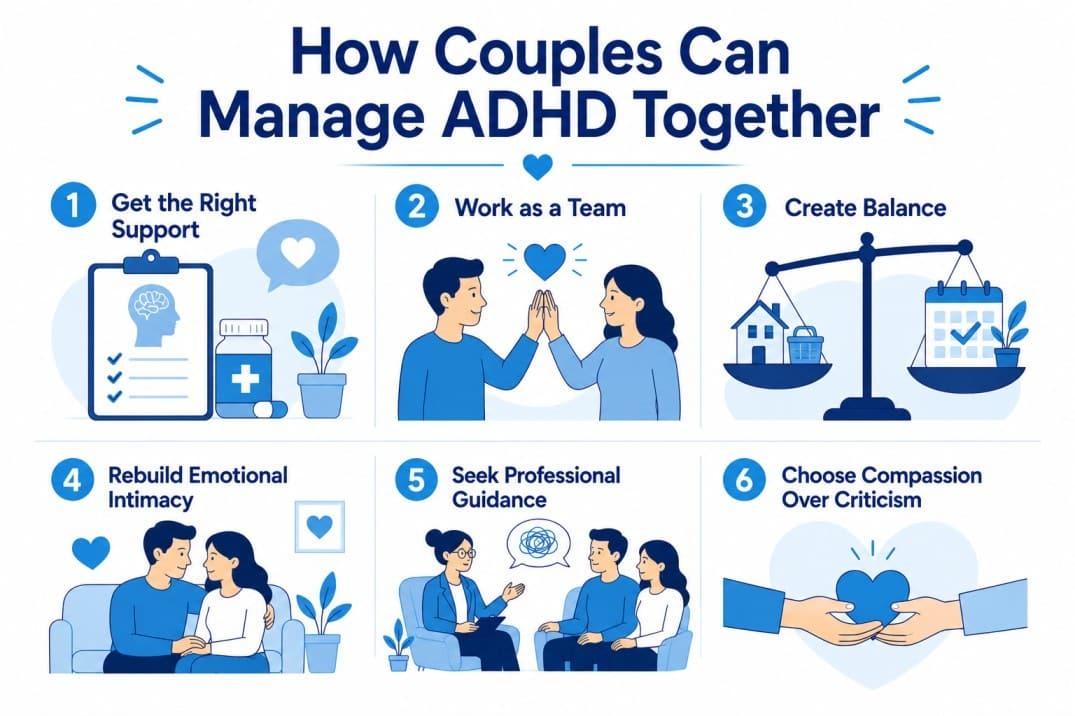
Healing a relationship affected by ADHD starts with one simple shift, from blame to understanding. ADHD isn’t a flaw; it’s a challenge that asks for structure, compassion, and teamwork. With awareness and consistent effort, couples can rebuild trust and reconnect in deeper, more meaningful ways.
1. Get the Right Treatment and Build Supportive Habits
Therapy, medication, or ADHD coaching can make daily life easier, but progress comes from consistent action.
- Use shared calendars, reminders, or visual checklists to stay on track.
- Practice new organization habits together.
- Celebrate small wins; they build momentum and confidence.
2. Work as Teammates, Not Opponents
ADHD can tilt relationships out of balance, leaving one partner overwhelmed and the other defensive. The goal is partnership, not perfection.
- Split responsibilities in ways that feel fair to both.
- Replace “you never” with “how can we.”
- Keep communication clear, calm, and kind.
3. Create Balance and Mutual Respect
Healthy relationships thrive when both people feel seen and valued. Recognize that ADHD changes how your partner functions, not how much they care.
- Accept that your systems may look different.
- Find creative routines that support both of you.
- Focus on progress, not perfection.
4. Rebuild Emotional Intimacy
Once ADHD is managed with empathy and structure, connection often grows stronger than before.
- Be present in small moments, a touch, a laugh, a kind word.
- Practice listening without fixing.
- Make space for play and affection again.
5. Seek Professional Guidance
An ADHD-informed couples therapist can help you break long-standing patterns and rebuild emotional safety. Therapy provides the tools to communicate openly and rediscover the friendship at the heart of your relationship.
6. Choose Compassion Over Criticism
The path forward isn’t about eliminating challenges; it’s about facing them together. When both partners approach ADHD with understanding and kindness, love becomes lighter, steadier, and more resilient.
Thinking about marriage counseling for an ADHD-affected relationship? Learn more in our post. What Is Marriage Counseling And How Does It Work?
Why doesn’t traditional marriage advice work for ADHD couples?
Advice such as “communicate better,” “try harder,” or “be more organized” often leaves ADHD couples feeling even more frustrated.
The problem is not usually a lack of effort. It is that ADHD affects attention, memory, emotional regulation, and follow-through in ways that traditional relationship advice rarely considers.
Traditional advice often falls short because it assumes that both partners can:
- Remember responsibilities without external reminders.
- Consistently follow through on intentions.
- Manage emotions during difficult conversations in the same way.
- Rely on verbal agreements without additional systems or structure.
For example, “just remember to do it” may not work when working memory challenges are involved, while “just communicate better” can fall apart if conversations quickly become emotionally overwhelming.
Many ADHD couples spend years arguing about chores, finances, lateness, or communication without realizing they are actually arguing about ADHD symptoms. Identifying the real problem often changes the entire conversation.
How do you know if your relationship needs ADHD marriage counseling?
If the same relationship problems keep returning despite both partners trying to improve things, it may be time to consider ADHD marriage counseling.
Some common signs include:
- The arguments change, but the pattern stays the same: The topic shifts from chores to finances to parenting, but the cycle repeats.
- One partner has become the reminder system: Managing appointments, deadlines, and responsibilities falls heavily on one person.
- You argue about effort rather than the issue: One partner feels unsupported, while the other feels misunderstood and unfairly judged.
- Small issues turn into major conflicts: A missed errand or forgotten task quickly becomes an argument about reliability or commitment.
- The parent-child dynamic has taken over: One partner feels responsible for managing, while the other feels constantly criticized.
For example, repeated arguments about lateness may be less about respect and more about time blindness, while conflicts over forgotten tasks may be rooted in working memory challenges rather than a lack of care.
ADHD couples counseling and couples therapy for ADHD help couples understand these patterns and build strategies that work with ADHD rather than against it.
Which Types of Therapy Work Best for ADHD-Affected Marriages?
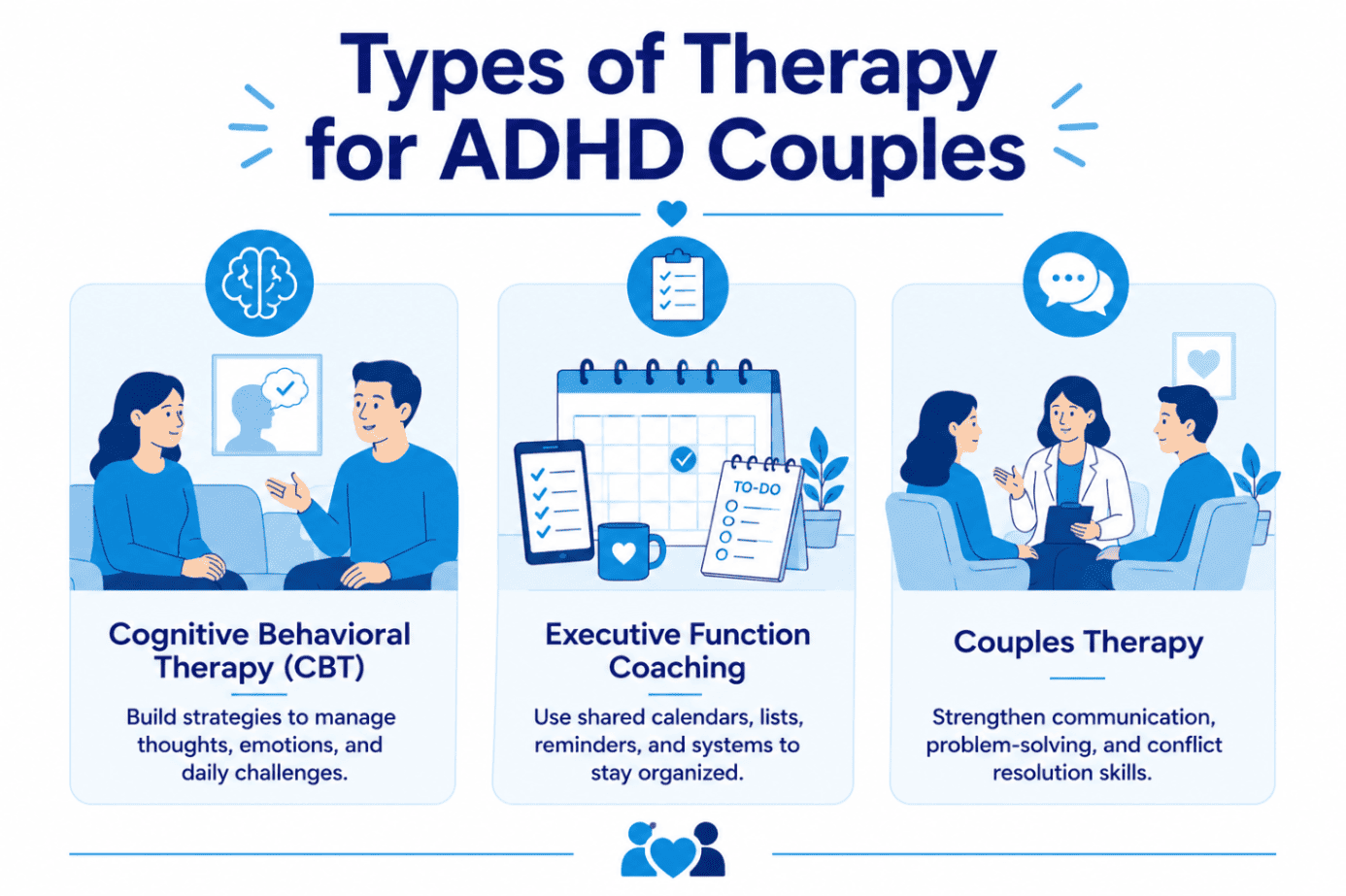
Therapists use a combination of approaches to address both ADHD symptoms and the couple’s relationship dynamic. The goal is not only to manage ADHD symptoms but also to heal the relationship through understanding and behavior change.
Types of Therapy for ADHD Couples
Therapists use several effective models of psychotherapy to help couples impacted by ADHD.
- Cognitive Behavioral Therapy (CBT) is one of the most common. CBT helps the partner with ADHD identify and change the negative thought patterns and behaviors associated with their symptoms. For example, it can provide strategies for managing procrastination or emotional outbursts.
- Executive Functioning Coaching includes helping couples use networked Calendar lists, Grocery Lists, Chore lists, and more to help with completion of tasks.
- Couples therapy is another essential component. This focuses on the relationship dynamic, teaching both partners skills for effective communication, conflict resolution, and problem-solving. The therapist acts as a neutral mediator, helping you break out of the blame-defensiveness cycle.
Often, the most effective ADHD therapy combines these approaches. It may include psychoeducation, helping both partners understand the science behind ADHD. This knowledge allows the non-ADHD partner to depersonalize symptoms and respond with empathy. Shared understanding creates unity and stability in the marriage.
Can ADHD actually strengthen a marriage?
Although much of the conversation around ADHD and marriage focuses on challenges, many couples also discover strengths that become some of the most meaningful parts of their relationship.
Creativity, humour, curiosity, spontaneity, and the ability to see problems differently can bring energy and flexibility into a partnership. Many partners describe their relationship as exciting, deeply engaging, and full of moments that feel anything but predictable.
Living with ADHD also often requires couples to develop stronger communication, clearer expectations, and better teamwork than they might have otherwise developed. The goal is not to remove every challenge or change who someone is. It is to reduce the challenges that prevent both people from experiencing the strengths that already exist within the relationship.
Many couples find that once they understand the ADHD effect on marriage and learn how to support each other’s needs, the relationship begins to feel less like a cycle of frustration and more like two people learning how to work with each other’s brains rather than against them.
How Total Life Counseling Helps Couples Build Stronger, Healthier Connections?
At Total Life Counseling, we understand that the ADHD effect on marriage requires a specialized approach. Our team of therapists is trained to recognize the unique and often frustrating dynamics that ADHD can create in a relationship. We know that the challenges you face are not about a lack of love but are rooted in difficulties with executive functioning and emotional regulation.
We provide compassionate, evidence-based ADHD therapy to help you and your partner navigate these complexities.
- Expert care: Our therapists understand how ADHD affects relationships, from communication struggles to emotional stress.
- Empathetic approach: We recognize your challenges come from ADHD-related difficulties, not a lack of love.
- Proven methods: Using evidence-based therapy, we help couples rebuild trust, cooperation, and connection.
- Healthier dynamics: We guide you past blame and frustration toward teamwork and empathy.
- Practical solutions: Together, we’ll improve communication, add structure, and restore intimacy.
- Lasting growth: Let Total Life Counseling help you build a stronger, more connected partnership.
Whether you’re seeking help for yourself, your partner, or your relationship, Total Life Counseling offers the guidance you need. Book your free 15-minute consultation today, and begin restoring the trust, communication, and closeness you both deserve.
Conclusion
Navigating marriage when ADHD is part of the picture isn’t easy, but it’s far from hopeless. The key lies in awareness, compassion, and teamwork. With the right support, you can break old patterns and rebuild trust. Together, you can rediscover the partnership you once dreamed of.
Every small effort matters, and every step forward brings you closer to a stronger, more fulfilling relationship built on trust, balance, and love.
Frequently Asked Questions
How can couples recognize ADHD as the cause of marital conflicts?
Couples can recognize ADHD as a potential cause of marital conflicts by looking for chronic patterns. See if your conflicts consistently revolve around forgetfulness, disorganization, distraction, or impulsivity. If one partner feels constantly nagged and the other feels misunderstood, it’s a strong indicator of the the adhd effect on marriage.
Are there counseling options for couples, and where can I find ADHD therapy near me?
Yes, there are excellent counseling options available. Look for therapists who specialize in both couples counseling and adult ADHD. You can find ADHD therapy near you by searching online, checking directories, or exploring teletherapy options, which offer ADHD counseling for couples.
What steps can non-ADHD spouses take to avoid burnout?
To avoid burnout, non-ADHD spouses must prioritize self-care. Ensure you get adequate sleep, rest, and personal time to prevent burnout. It is crucial to set firm, loving boundaries, to maintain balance without resentment or control. Seeking your own support through individual therapy or counseling can also be very beneficial.
How does ADHD typically affect communication in a marriage?
ADHD affects communication by creating frequent misunderstandings. Inattention may make one partner seem distracted or uninterested in listening. Impulsivity can cause frequent interruptions or insensitive remarks. These patterns lead to a breakdown in communication, preventing healthy conflict resolution.
How can non-ADHD spouses cope with feelings of burnout in their marriage?
Coping with burnout requires prioritizing your own mental health. Practice self-care, set clear boundaries to avoid over-functioning. Actively educate yourself about ADHD to depersonalize symptoms. Connecting with a therapist can provide a crucial outlet and equip you with better coping strategies.
What practical strategies can help after ADHD destroyed my marriage?
Practical strategies include working as a team to create structure. Use shared calendars and reminders to manage time and commitments. Practice active listening and schedule regular check-ins to stay connected. Dividing chores and fostering empathy can help build a more balanced and thriving marriage as well.
How does ADHD affect marital satisfaction and adjustment?
ADHD can affect marital satisfaction when symptoms create repeated stress, misunderstandings, or uneven responsibilities. Recognizing the role ADHD plays in these patterns often helps couples make sense of behaviors that previously felt personal or intentional.
How do ADHD symptoms contribute to frequent misunderstandings between married partners?
Forgotten tasks, distractions, or emotional reactions can make good intentions appear careless or uncaring. Many ADHD and marriage problems develop when behaviors are interpreted as a lack of effort rather than symptoms.
What strategies can couples use to address ADHD-related challenges in their relationship?
Shared calendars, written reminders, clear expectations, and regular check-ins can help. Some couples also benefit from ADHD couples therapy to build systems that address the ADHD effect on marriage more effectively.
Is being married to someone with ADHD hard?
It can be challenging, especially when symptoms go unrecognized or unsupported. However, understanding the ADHD effect on marriage often helps couples move from blame and frustration toward teamwork and solutions.
Filed in: ADHD, Blog, Marriage Counseling, Matthew Martin
Share This Story, Choose Your Platform!
Total Life Counseling Center consists of Licensed Counselors, masters level therapists, Español counselors, Licensed Mental Health Counselors, business coaches, and image enhancement coaches who provide counseling for emotional, mental, physical and spiritual care including marriage, individual, family, substance abuse and more. TLC’s family, trauma and marriage experts have been interviewed on National and Local TV/Radio over 200 times for their expert advice on Fox News, OWN, WETV, ABC’s Medical Minute and more. Our skilled counselors are relational, approachable and specialists providing therapy services in the Central Florida area including: Orlando, Winter Park, MetroWest, Windermere, Dr. Phillips, East Orlando, Lake Mary, and Clermont, Boca Raton Florida, and Dallas, TX.
About the Author: Matthew Martin