

What Is the Facebook Addiction Lawsuit in 2026?

Key Highlights
- Tiger Woods’ case highlights how prescription drug dependency often begins with legitimate medical treatment, not misuse
- Incidents like the 2017 DUI arrest and 2026 crash show how a mix of medications can impair judgment and reaction
- Long-term injuries and repeated surgeries increase reliance on prescription medications and pain management strategies
- Dependency develops gradually, often without clear warning, making early signs easy to overlook
- Drug addiction therapy involves detox, rehab, and ongoing support, not a one-time solution
- With the right guidance and professional help from centres like Total Life Counseling (TLC), recovery is possible and sustainable
Tiger Woods is widely regarded as one of the greatest golfers of all time. 15 major championships. 82 PGA Tour wins. A career that changed the sport forever. Yet alongside those achievements, his story has also brought attention to a quieter, more difficult conversation about prescription drug dependency.
When Woods was found asleep at the wheel in 2017 and later involved in another incident in 2026, it raised questions that go far beyond headlines. Not about blame, but about something many people experience in silence. How does treatment for real pain slowly become something harder to manage?
For many, dependency does not begin with misuse. It often starts with a legitimate prescription, a real injury, and the need for relief. Over time, that line can become harder to see.
This article looks at his story with empathy, while helping you understand the risks, signs, and support available.
What Does Tiger Woods’ Drug Abuse Actually Mean?
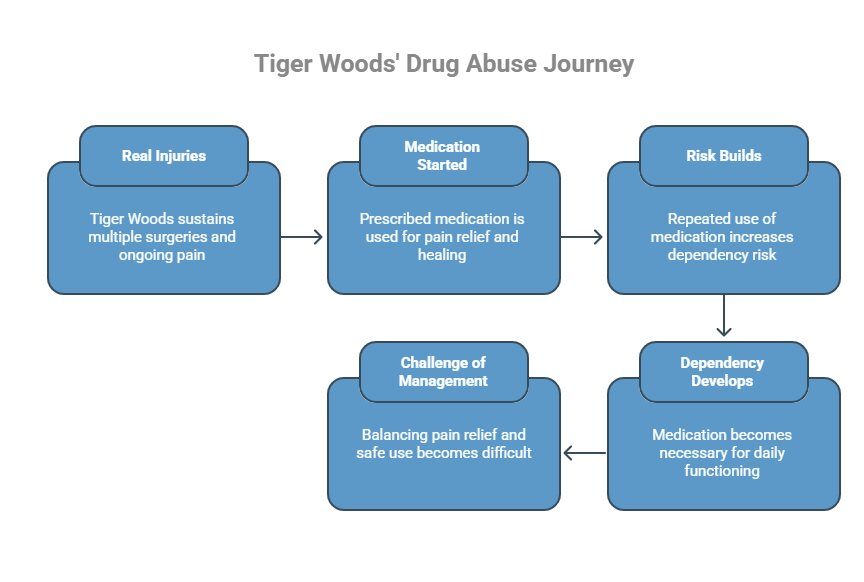
When people search for Tiger Woods’ drug abuse, it often comes from a place of curiosity, sometimes concern. But to really understand Tiger Woods and drugs, it helps to move past the headlines and look at what this kind of situation often looks like in real life.
Because for many people, this is not about poor choices or lack of discipline. It is about pain, recovery, and trying to get back to a version of life that once felt normal. And in that process, the line between relief and reliance can quietly shift.
What the Full Story Shows
When you look at Tiger Woods’ journey with a bit more context, it starts to reflect something much more human and familiar than most headlines suggest.
A Long History of Real Injuries
Over the years, Tiger Woods has gone through multiple surgeries involving his knees, back, ankle, and Achilles. These are not minor injuries. They come with real, ongoing pain that does not simply go away after a few weeks.
For anyone dealing with that level of physical strain, managing pain becomes part of everyday life, not just recovery.
Medication Started as Medical Care
After surgeries like these, medications such as painkillers or sleep aids are often prescribed. And in most cases, they are prescribed for the right reasons. To help the body heal, to reduce discomfort, and to make rest possible. At that point, there is no intention of misuse. There is just a need to feel better.
A Risk That Builds Over Time
But healing is not always linear, especially when injuries keep returning. Studies show that repeated use of prescription pain medication, particularly opioids, can gradually increase the risk of dependency. Not suddenly, but slowly, over time.
For athletes, the cycle can feel relentless:
- Recover
- Return
- Re-injure
- Repeat
And with each cycle, medication often becomes a more consistent part of the process.
Dependency Does Not Always Feel Obvious
This is where things can become difficult to recognise. Dependency rarely announces itself clearly. It can feel like:
- Needing medication just to get through the day
- Feeling uneasy or uncomfortable without it
- Extending use beyond what was originally planned
For many, it still feels like treatment, not a problem. And that is what makes it so easy to overlook.
The Challenge Is Managing Long-Term Use
Over time, what started as support can become harder to manage alone. Balancing pain relief while staying within safe limits is not easy, especially without consistent guidance. Many people find themselves unsure of where that line is, or when they may have crossed it.
At its heart, this is not just Tiger Woods’ story. It reflects something many people go through quietly. Prescription dependency often begins with real pain and the right intentions, which is why it deserves understanding, not judgment, and support when it is needed most.
Worried about rising drug risks among teens? Learn how substances like Flakka impact young minds and how parents can take early, practical steps to prevent drug abuse.
What Did Tiger Woods on Drugs Look Like in the 2017 Arrest?
On 29th May, 2017, Tiger Woods was found asleep in his car on the side of a Florida highway, engine running. When officers approached, he appeared disoriented, had difficulty standing, and could not complete field sobriety tests. A breathalyser confirmed zero alcohol.
Toxicology reports identified multiple substances in his system:
- Hydrocodone (Vicodin)
- Hydromorphone (Dilaudid)
- Alprazolam (Xanax)
- Zolpidem (Ambien)
- THC
Individually, these can cause sedation. In combination, they can significantly impair:
- Awareness and focus
- Motor coordination
- Reaction time
In his statement, Woods said he had been trying to manage back pain and insomnia on his own. This reflects a common pattern: self-managing prescribed medications without close supervision, which increases the risk of impairment.
What Is Tiger Woods’ Drug Rehab? His First Treatment Experience
In June 2017, Woods entered an inpatient rehabilitation programme focused on prescription drug dependency.
Core elements of treatment included:
- Medical monitoring and stabilisation
- Medication management
- Therapy addressing pain and sleep issues
He completed the programme and returned to competitive golf, winning the 2019 Masters. This outcome highlights a key point: structured treatment can support long-term recovery.
What This Means Beyond the Headlines
Cases like this often raise questions about responsibility. In practice, dependency tends to develop gradually.
Common progression:
- Treatment begins with a valid prescription
- Usage increases over time
- Multiple medications are combined
- Impairment becomes noticeable
This is not uncommon in individuals managing chronic pain. Early recognition and medical guidance are critical to preventing escalation.
Call for a Complimentary 15 Minute Phone Consultation
Se Habla Español: We have Portuguese and Spanish speaking counselors as well.
What Did Tiger Woods on Drugs Look Like in the 2017 Arrest?
On 29th May, 2017, Tiger Woods was found asleep in his car on the side of a Florida highway, engine running. When officers approached, he appeared disoriented, had difficulty standing, and could not complete field sobriety tests. A breathalyser confirmed zero alcohol.
Toxicology reports identified multiple substances in his system:
- Hydrocodone (Vicodin)
- Hydromorphone (Dilaudid)
- Alprazolam (Xanax)
- Zolpidem (Ambien)
- THC
Individually, these can cause sedation. In combination, they can significantly impair:
- Awareness and focus
- Motor coordination
- Reaction time
In his statement, Woods said he had been trying to manage back pain and insomnia on his own. This reflects a common pattern: self-managing prescribed medications without close supervision, which increases the risk of impairment.
What Is Tiger Woods’ Drug Rehab? His First Treatment Experience
In June 2017, Woods entered an inpatient rehabilitation programme focused on prescription drug dependency.
Core elements of treatment included:
- Medical monitoring and stabilisation
- Medication management
- Therapy addressing pain and sleep issues
He completed the programme and returned to competitive golf, winning the 2019 Masters. This outcome highlights a key point: structured treatment can support long-term recovery.
What This Means Beyond the Headlines
Cases like this often raise questions about responsibility. In practice, dependency tends to develop gradually.
Common progression:
- Treatment begins with a valid prescription
- Usage increases over time
- Multiple medications are combined
- Impairment becomes noticeable
This is not uncommon in individuals managing chronic pain. Early recognition and medical guidance are critical to preventing escalation.
What Happened at the Tiger Woods Car Accident and What Did Drugs Have to Do With It?
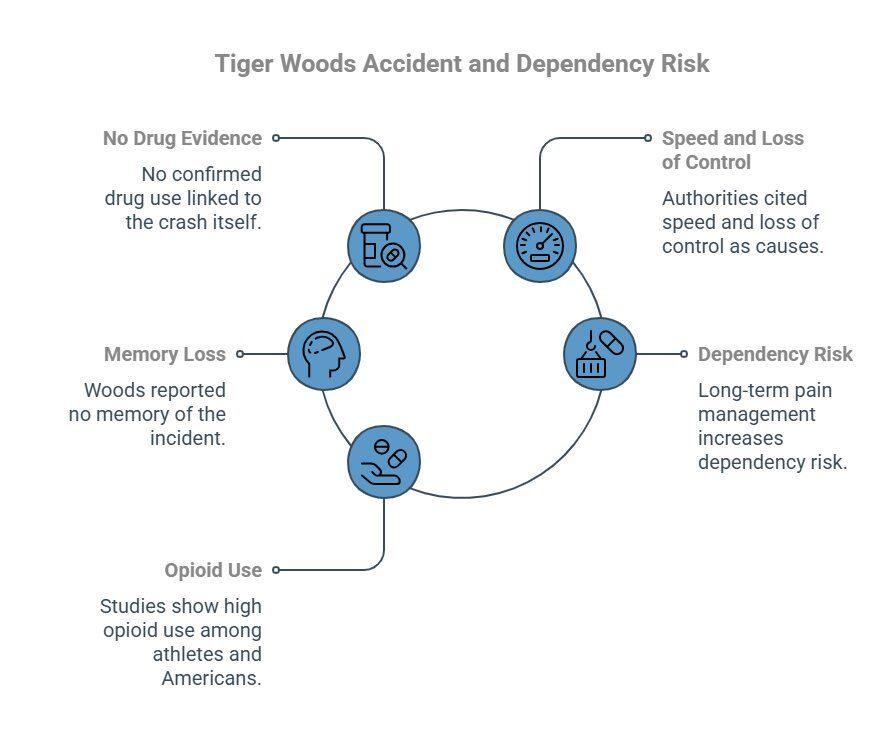
The 2021 Tiger Woods car accident is often linked to questions about drug use. To understand it clearly, it helps to separate facts from assumptions and look at what followed after the crash.
There is no confirmed evidence that drugs caused the 2021 crash. However, the injuries that followed required prolonged pain management, which can increase the risk of prescription dependency over time.
On February 23, 2021, Woods crashed his SUV in Rancho Palos Verdes, California, after driving above the speed limit. The vehicle rolled over, leaving him with serious leg injuries that required emergency surgery.
What the records confirm:
- No toxicology report was released
- No drug or DUI charges were filed
- Authorities cited speed and loss of control
- Woods reported no memory of the incident
While the crash itself was not linked to drugs, the recovery phase is where the risk becomes more relevant.
What this accident reveals about dependency risk:
- Severe injuries often require long-term pain management
- Multiple prescriptions increase the risk of dependency
- Chronic pain makes continued medication use more likely
- Long recovery periods can lead to gradual reliance
- A 2020 Sports Health study found that over half of NFL players used opioids
- The 2024 survey reported 3.4 million Americans misused hydrocodone
The crash was not about confirmed drug use. It highlights how dependency can begin during recovery, when necessary treatment slowly becomes harder to manage.
What Happened in the 2026 Crash and Arrest Involving Tiger Woods and Drugs?
The conversation around Tiger Woods’ drug addiction resurfaced in March 2026 after a serious incident in Florida. On March 27, Woods was involved in a rollover crash near Jupiter Island. His vehicle clipped a truck and flipped onto its side. He was not physically injured, but officers observed signs of impairment. He appeared lethargic, slow to respond, with bloodshot eyes and dilated pupils. A breathalyzer confirmed zero alcohol.
During the search, police found two hydrocodone pills, a prescription opioid commonly used for pain relief. Woods declined a urine test and was charged with DUI.
Shortly after, he shared that he would step away from golf to focus on treatment and recovery. Reports indicate he entered an inpatient programme abroad.
This incident shifts the conversation beyond one event. It raises a broader question many people relate to: When does prescribed medication begin to affect judgment, safety, and control?
Is Tiger Woods Addicted to Drugs, or Is It Prescription Drug Dependency?
To answer this, the terminology matters. “Drug addict” is not a clinical diagnosis. Medical professionals use the term opioid use disorder, which focuses on behaviour, impact, and patterns of use.
It is typically identified by:
- Difficulty controlling medication use
- Continued use despite harmful outcomes
- Physical dependence, such as tolerance and withdrawal
- Impact on daily life, safety, or decision-making
There is no confirmed public diagnosis for Tiger Woods. However, available information points to a pattern where prescription drug use has led to serious consequences, including DUI incidents and rehabilitation. This context is critical. Many cases begin with legitimate treatment, not misuse.
What Is Prescription Drug Addiction and How Does It Relate to Tiger Woods?
Prescription drug addiction, or opioid use disorder, occurs when the body and brain begin to rely on medication to function normally.
It often develops gradually:
- Begins with a legitimate prescription
- Continues with repeated exposure
- Progresses into physical and psychological dependence
It does not require intent or misuse. In many cases, it is the result of how the body adapts over time.
How Does Prescription Opioid Dependency Develop Over Time?
Opioids like hydrocodone are effective for pain relief, but long-term use changes brain function.
Over time:
- The body builds tolerance, requiring higher doses
- Natural pain regulation weakens
- Stopping leads to withdrawal symptoms
Common withdrawal effects include:
- Muscle pain and restlessness
- Anxiety and irritability
- Sleep disturbances
- Nausea and fatigue
This is a physiological response, not a lack of discipline. That is why stopping without structured support can be difficult.
How Does Emotional Pain Contribute to Drug Dependency?
Prescription opioids do more than reduce physical pain. They can also create a sense of emotional relief.
For many individuals, they provide:
- Temporary calm
- Relief from stress or anxiety
- Distance from emotional pressure
Over time, medication may begin to serve two purposes:
- Managing physical pain
- Regulating emotional distress
This overlap is what makes dependency harder to recognise and treat.
When Should You Be Concerned About Prescription Drug Use?
The shift from use to dependency is often subtle.
It may help to reflect on these signs:
- Taking more medication than prescribed
- Feeling anxious about running out
- Difficulty reducing or stopping use
- Using medication beyond its intended purpose
These are not diagnoses. They are early indicators. Recognising them early allows for timely support and better outcomes.
What Does Drug Addiction Therapy Look Like for Opioid Dependency?
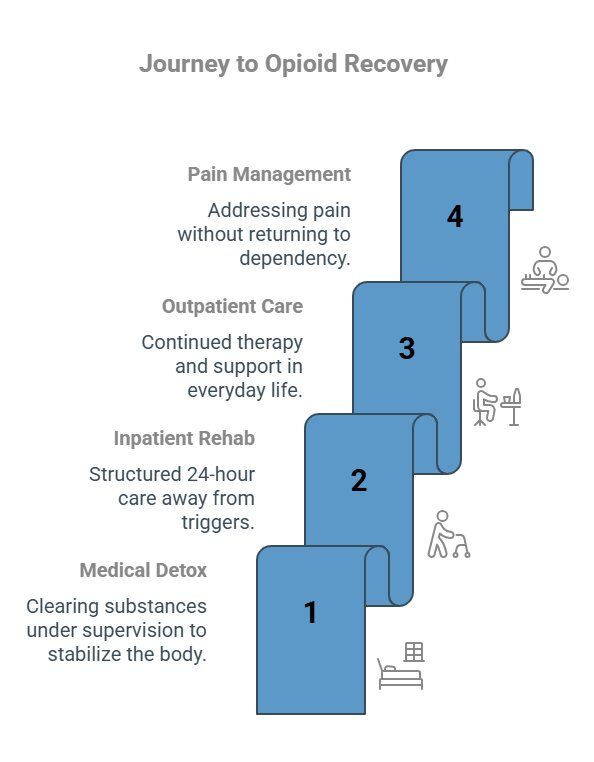
When stories about Tiger Woods’ drug addiction surface, they often focus on a DUI arrest or moments like being found on the side of the road in his Mercedes. But the real story begins when someone takes full responsibility and seeks professional help.
Stage 1: What Is Medical Detox?
Medical detox is the first step, where the body clears substances under supervision.
In cases involving a mix of medications, including prescription medications and medical marijuana, the body may react unpredictably due to overlapping active ingredients. Detox provides medical assistance to stabilise patients and reduce withdrawal discomfort safely.
Stage 2: How Does Inpatient Rehab Help?
Inpatient rehab provides structured, 24-hour care away from triggers.
After incidents involving reckless driving and reports from the Palm Beach County Sheriff’s office or Martin County Sheriff’s office, inpatient care helps manage sleep disorders, monitor medications, and build recovery routines in a controlled, supportive environment.
Stage 3: What Happens After Rehab?
Outpatient care supports recovery in everyday life.
After inpatient treatment, individuals continue therapy while managing real-life triggers. This stage often addresses chronic pain from injuries like a fourth back surgery, alongside emotional challenges, helping individuals make steady and significant progress over time.
Stage 4: How Is Pain Managed Without Opioids?
Recovery includes managing pain without returning to dependency.
Instead of relying on a generic form of a painkiller, treatment focuses on physical therapy, behavioural approaches, and safer alternatives. This helps prevent relapse while still addressing ongoing pain in a sustainable, medically guided way.
What Can Tiger Woods’ Drug Story Teach Us?
Tiger Woods’ situation became widely known through a DUI arrest, failed breathalyzer test, and police dashboard camera video showing him disoriented on the side of the road. But beyond these moments, his story reflects how dependency can develop quietly over time and might make us think about our own challenges or a friend or family member.
Why Does Prescription Drug Dependency Keep Recurring?
Even after seeking professional help, recovery can be ongoing.
From his last win to more recent incidents reported last month, cases like Woods’ show how prescription medications, physical injuries, and stress overlap. Many remain under active criminal investigation, reinforcing the need for continuous care and support.
What Role Does Mental Health Play in Recovery?
Recovery is not just physical.
Moments like being found in the driver’s side seat or incidents involving a fire hydrant often reflect deeper struggles. Mental health challenges, including stress, identity shifts, and even alcohol addiction or sex addiction, play a significant role in long-term recovery.
A Simple Way to Understand Recovery
Tiger Woods’ story is not just about marijuana, medications, or a single arrest. With amazing support and timely medical assistance, individuals can rebuild stability. Recovery is not linear, but with the right help, meaningful and lasting change is always possible.
Substance abuse does not follow a pattern or profile. This real story breaks down how addiction can affect anyone, and why early support matters more than assumptions.
Where Can You Get Professional Help for Prescription Drug Dependency?
If Tiger Woods’ story feels familiar in any way, it may be time to consider professional help, not as a last step, but as a supportive one. Prescription drug dependency often develops quietly, and early medical assistance can make recovery more manageable and sustainable.
At Total Life Counseling, treatment focuses on the full picture, not just the medication, but the pain, stress, and underlying challenges that come with it. Support includes therapy for dependency, guidance through recovery stages, and care for related concerns like anxiety, sleep disorders, or emotional strain.
Recovery does not have to be faced alone. With the right support system and consistent care, individuals can make significant progress and regain stability in their daily lives.
If you or someone you know may be struggling, reaching out today can be the first step toward real, lasting change.
Conclusion
Tiger Woods’ story reminds us that prescription drug dependency is rarely about poor choices. It often begins with real pain, real treatment, and the need to function. What matters is recognising when that line starts to shift.
If any part of this feels familiar, seeking professional help early can make a meaningful difference. With the right medical assistance, ongoing support, and awareness, recovery is possible, even after setbacks.
Jim West
MA, LICENSED MENTAL HEALTH COUNSELOR, national certified counselor
President, Counselor, Guest Speaker, Author, Social Skills, ADHD, ODD, ASD, children, teens, and more!

Dana West
MSW, Licensed clinical social worker
Vice President, Counselor, Guest Speaker, Addictions, Trauma, Couples, Abuse, and more!

Mathew Martin
MS, LICENSED MENTAL HEALTH COUNSELOR
Counselor, Coach, Guest Speaker, Marriage, Individual Males, Substance Abuse and more!
Brandon Feinberg
MS, LICENSED MENTAL HEALTH COUNSELOR
Male Counselor, Licensed Mental Health Counselor specializing in ADHD, Asperger Syndrome, Autism Spectrum Disorders, and more!

Lyris Steuber
MS, licesned marriage & family therapist
Counselor, Coach, Marriage & Family, Play Therapy, Divorce, Adolescent and more!

Valerie Ware
Licensed Psychologist and Behavioral Specialist
Psychological Evaluator, Autism, ADHD, Learning Disabilities, Anxiety, Gifted, Career Pathways, and emotional assessments.

Gemima McMahon
MA, LICENSED MENTAL HEALTH COUNSELOR
Licensed Mental Health Counselor specializing in Women’s issues, Trauma, Anxiety, Depression, Cutting, Couples, Children and Teenagers and more!

Audrey DeBruler
MS, LMHC, Licensed Mental Health Counselor
Children, Adolescents, Young Adults, Faith Based Counseling, Trauma Recovery, Anxiety and more!
David Duany
MA, LICENSED MENTAL HEALTH COUNSELOR
Licensed Mental Health Counselor specializing in ADHD, Social Skills, and Anger Management counseling for children, young adults, and families.

Katherine Waldheim
MS, Registered Mental Health Counseling Intern
Trauma, anxiety, couples counseling, and child & adolescent counseling services and more!

Sarah Dornas Albuquerque
MS – Registered Mental Health Counselor Intern
EMDR, Anxiety, Depression, Children, Teens, Young Adults, English, Spanish and Portugues and Adult Counseling

Julissa Gonzalez
MS – Candidate Mental Health Counselor Intern
Children & teens, anxiety, women, and family counseling.
Licensed Counselors & Therapists
Meet Our Team of Certified & Experienced Professionals
Total Life Counseling Center consists of Licensed Counselors, Masters Level Therapists, Espanol Counselors, Licensed Mental Health Counselors, Business Coaches, Image Enhancement Coaches who provide counseling for emotional, mental, physical and spiritual care including marriage, individual, family, substance abuse and more. Our team of certified and experienced professionals, dedicated to serving a comprehensive spectrum of mental health and relationship issues such as couples, women and men’s issues, children and teens with oppositional defiance, video game addiction, ADHD, ASD, anxiety, depression, and trauma survivors, is here to support and guide you through your journey towards healing and navigating life transitions. This approach not only enhances the effectiveness of the counseling provided but also builds trust within the community and among potential clients, who may be seeking support.
We offer next level counselors specialized in areas such as relationships, video game & drug/alcohol addictions, abuse, trauma, depression, and ADHD. Our Therapists are EMDR (eye movement desensitization) trauma therapy trained, cognitive behavioral therapy, specialize in ADHD and Oppositional Defiant Children, and are also professional Gottman method marriage couples counselors to give the best results to couples and to provide the best comprehensive spectrum of mental health and relationship care for our clients.
Struggling with Anger? We offer 8 hour anger management group therapy!
Discounted Rates and the president of Total Life Counseling Center Jim West does not want to turn people away and we have counselors at various levels of experience at a discounted rate that are trained by our next level counselors!
Frequently Asked Questions
What happened in Tiger Woods’ car accident case?
Tiger Woods was found unconscious in his car in 2017 and later stated he had taken prescription medications. The incident brought attention to the risks of mixing medications and how impaired judgment can affect even high-performing individuals. More recent in 2026 his SUV rolled and was Oxycodon (pain medication) was found in his pocket.
What prescription drugs were associated with Tiger Woods’ case?
Reports mentioned Oxycodone a pain medication. These are commonly prescribed and can be highly addictive and can become dangerous when combined or misused, especially without proper monitoring or awareness of side effects.
How did Tiger Woods’ situation highlight the risks of prescription opioids?
His case showed how dependence can develop gradually, even with legal medications. It highlighted how easily routine use can turn into reliance, especially when dealing with pain, stress, or ongoing health challenges.
Has Tiger Woods spoken about his recovery process?
Yes, Tiger Woods has publicly acknowledged his struggles and completed a treatment program. His recovery journey emphasised accountability, professional support, and the importance of addressing both physical and emotional factors behind addiction.
What therapy is commonly used for drug addiction recovery?
Cognitive Behavioral Therapy (CBT) is widely used to identify triggers and change harmful patterns. Other approaches include group therapy, medical support, and personalised treatment plans based on individual needs and the severity of addiction.
What can people learn from high-profile addiction cases like Tiger Woods?
Such cases highlight that addiction can affect anyone. They show the importance of early intervention, professional help, and recognising warning signs before situations escalate into serious health or legal consequences.
Filed in: Blog, Drug Addiction, Jim West
Share This Story, Choose Your Platform!
Total Life Counseling Center consists of Licensed Counselors, masters level therapists, Español counselors, Licensed Mental Health Counselors, business coaches, and image enhancement coaches who provide counseling for emotional, mental, physical and spiritual care including marriage, individual, family, substance abuse and more. TLC’s family, trauma and marriage experts have been interviewed on National and Local TV/Radio over 200 times for their expert advice on Fox News, OWN, WETV, ABC’s Medical Minute and more. Our skilled counselors are relational, approachable and specialists providing therapy services in the Central Florida area including: Orlando, Winter Park, MetroWest, Windermere, Dr. Phillips, East Orlando, Lake Mary, and Clermont, Boca Raton Florida, and Dallas, TX.
About the Author: Jim West