

Social Media Safety for Teens: What Should Parents Know?

Key Highlights
- Teens spend hours daily on social media, shaped by algorithms, peer pressure, and constant validation loops
- Risks like cyberbullying, online predators, and oversharing often build gradually, not suddenly
- Social media can impact self-esteem, body image, sleep, and overall youth mental health over time
- Simple steps like private accounts and disabling location sharing improve online safety significantly
- Open conversations and trust work better than strict monitoring or control-based approaches
- Early signs of stress should not be ignored; timely support, like teen counseling, can make a real difference
- When concerns persist, support from experts like Total Life Counseling (TLC) can help teens build resilience and navigate online challenges safely
There is a particular kind of worry that settles in late at night, when everything is quiet, and you start wondering what your teen is really seeing on their phone, who they are talking to, and whether they are safe. It is not about control. It is about navigating a digital world that moves faster than most parents can keep up with.
Understanding social media safety for teens today is less about restricting apps and more about staying connected in the right way. Teens are spending hours online, often influenced by algorithms, peer pressure, and content that shapes how they think and feel. The goal is not to eliminate risk completely, but to recognize it early and respond in a way that builds trust, not resistance.
In this guide, you will understand how social media affects teens, the real risks to watch for, practical safety tips, and when teen counseling may be the right next step.
What’s Actually Going On With Teens And Social Media Right Now?
Before deciding what to change, it helps to understand what your teen is actually navigating.
For most teens, social media is not just entertainment. It is where friendships, identity, and validation play out daily. That is why social media safety for teens is less about limiting usage and more about understanding impact.
How Much Time Are Teens Really Spending Online?
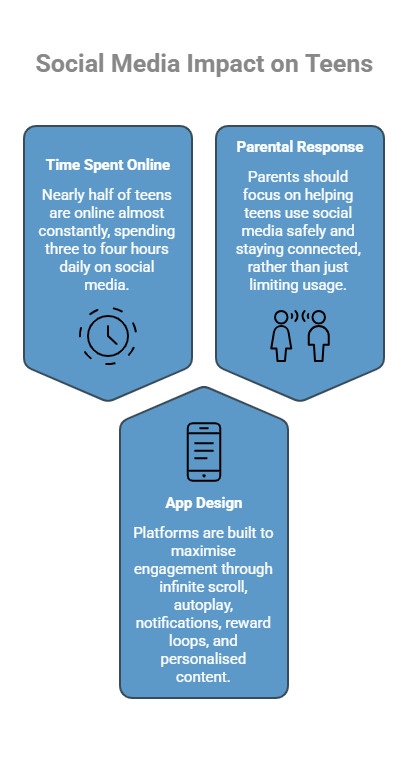
According to a Pew Research Center study, nearly half of teens say they are online almost constantly. Many spend around three to four hours daily on social media, though usage varies.
In practice, this means:
- Social media often becomes a primary social space
- Constant exposure to peer opinions and trends
- Less time available for offline connection and mental reset
This is why social media and internet safety for teens directly affects emotional well-being, not just screen habits.
Are The Apps Themselves Designed To Keep Teens Scrolling?
Yes, and this is important to understand.
Platforms are built to maximize engagement through:
- Infinite scroll and autoplay
- Notifications that pull users back
- Likes and comments as reward loops
- Highly personalized content feeds
At the same time, research from the National Library of Medicine shows teens are more sensitive to social approval, while impulse control is still developing.
This can lead to:
- Difficulty logging off
- Strong emotional reactions to feedback
- Increased comparison and pressure
What Does This Mean For Parents?
This is not just about discipline or screen time.
It is about recognising that your teen is interacting with systems designed to hold attention.
So instead of asking, “Why can’t they stop?”, a better starting point is:
- How can we help them use it safely?
- How do we stay connected while they navigate this space?
That shift makes the conversation more effective and far less stressful for both of you.
What Are The Real Risks Teens Face On Social Media?
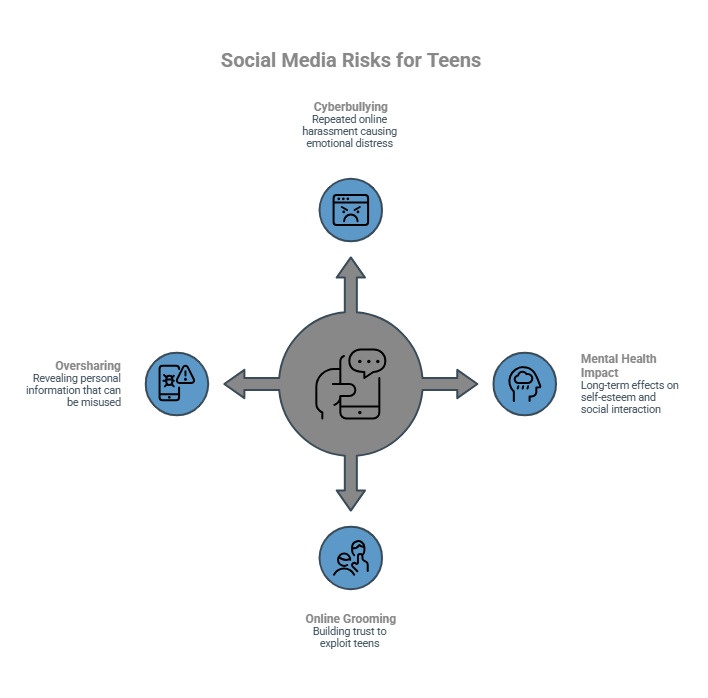
Most teens use social media every day. On the surface, everything seems fine. That is what makes this tricky. The risks are not always obvious or immediate. They often build slowly, through small moments that your teen may not even realise are affecting them.
Understanding social media safety for teens is not about expecting the worst. It is about noticing when something feels off and creating space for your teen to talk without fear or judgment.
What Is Cyberbullying, And How Do You Know If It’s Happening?
Cyberbullying is repeated hurt or harassment that happens online, and it can feel harder to escape than face-to-face conflict.
It might look like mean comments, exclusion, rumours, or messages that do not stop. Because it happens on a screen, it follows your teen everywhere, even into what should be their safe space.
You may not see it directly. But you might notice:
- Your teen is getting quiet after being on their phone
- Sudden mood changes
- Avoiding certain apps or people
- Losing interest in things they used to enjoy
These are not answers, just gentle signals. Sometimes, the most helpful thing is simply asking, “Hey, you seem a bit off. Want to talk about it?”
How Does Social Media Affect A Teen’s Mental Health Over Time?
This is where things can shift quietly. Social media often becomes a place where teens compare themselves, seek approval, and measure their worth without even realizing it.
Over time, this can lead to:
- Feeling “not enough.”
- Worrying about how they look or fit in
- Needing constant validation
- Pulling away from real-life interactions
Not every teen will struggle in the same way. But if you have noticed a slow change in their confidence or mood, it is worth paying attention. The impact is often gradual, not sudden.
What Does Online Grooming And Predatory Behaviour Look Like?
Online grooming is when someone builds trust with a teen to take advantage of them, and it rarely looks dangerous at the start. It often begins with friendly conversations. Someone who seems kind, interested, and easy to talk to. Over time, they may ask for more attention, more privacy, or things that feel slightly uncomfortable.
Teens do not always recognise when a line is being crossed. That is why it helps to remind them: “If something feels even a little strange, you can always tell me. You are not in trouble.” Creating that safety matters more than trying to monitor everything.
Why is Oversharing Personal Information a Bigger Risk Than Teens realize?
For teens, sharing feels normal. Posting where they are, who they are with, or what they are doing is part of how they connect.
But small details can add up quickly. Things like:
- School name
- Daily routine
- Location tags
- Personal photos
Individually, they seem harmless. Together, they can reveal more than your teen intends.
Instead of framing it as “do not post,” it helps to shift the conversation to awareness. Asking simple questions like, “Would you be okay if anyone could see this?” can help teens pause and think without feeling restricted.
This is not about making your teen afraid of social media. It is about helping them move through it with a little more awareness and knowing they are not navigating it alone.
Call for a Complimentary 15 Minute Phone Consultation
Se Habla Español: We have Portuguese and Spanish speaking counselors as well.

What Privacy Settings Actually Make A Difference?
Most social media safety tips for teens do not start with new tools or strict rules. They start with settings that already exist but are often left untouched. A few small changes can significantly reduce exposure to strangers, unwanted contact, and privacy risks, without making teens feel restricted.
The key is to approach this together. Instead of taking control of the device, sit with your teen and review settings as a shared activity. This builds awareness, not resistance.
How Do You Set A Teen’s Profile To Private On Major Platforms?
Setting accounts to private is one of the simplest and most effective steps. It ensures that only approved people can view posts, stories, and interactions.
Here is where to check:
| Platform | Where to Find Privacy Settings | Key Setting to Enable |
|---|---|---|
| Settings > Privacy > Account Privacy | Private Account ON | |
| TikTok | Settings > Privacy > Discoverability | Private Account ON |
| Snapchat | Settings > Privacy Controls | Friends Only (Contact + Story) |
| YouTube | YouTube Studio > Visibility (per video) | Unlisted or Private |
Most platforms are designed for visibility by default. That means if you have never checked these settings, your teen’s profile is likely more public than intended. Reviewing this together creates both safety and understanding.
Should Location Services Be Turned Off On Social Media Apps?
Yes, and this is one of the most important changes you can make immediately.
Many apps request access to location data, and photos can carry hidden location details that reveal exactly where they were taken. This can unintentionally expose your teen’s routine, school, or home.
A safer approach includes:
- Turning off location access in phone settings, not just within apps
- Avoiding real-time posting from specific locations
- Sharing trips or events only after leaving the location
These small habits reduce real-world risks that are often overlooked, even by adults.
How Often Should Privacy Settings Be Reviewed?
Privacy settings are not something you set once and forget. Apps update frequently, and settings can change without clear notice. A practical approach is to review settings every three to four months. This keeps everything up to date and gives your teen space to ask questions as platforms evolve.
More importantly, make it a conversation, not a check. When teens understand why a setting matters, they are far more likely to maintain it on their own.
A simple rule: if you have not reviewed privacy settings since the account was created, it is worth revisiting them now, together.
How Can Parents Talk To Their Teens About Social Media Without It Turning Into An Argument?
When it comes to social media safety for teens, rules alone rarely stick. What works is connection. If your teen feels judged or controlled, they will shut down. If they feel understood, they are far more likely to open up when something goes wrong.
What’s The Difference Between Monitoring And Spying, And Why Does It Matter?
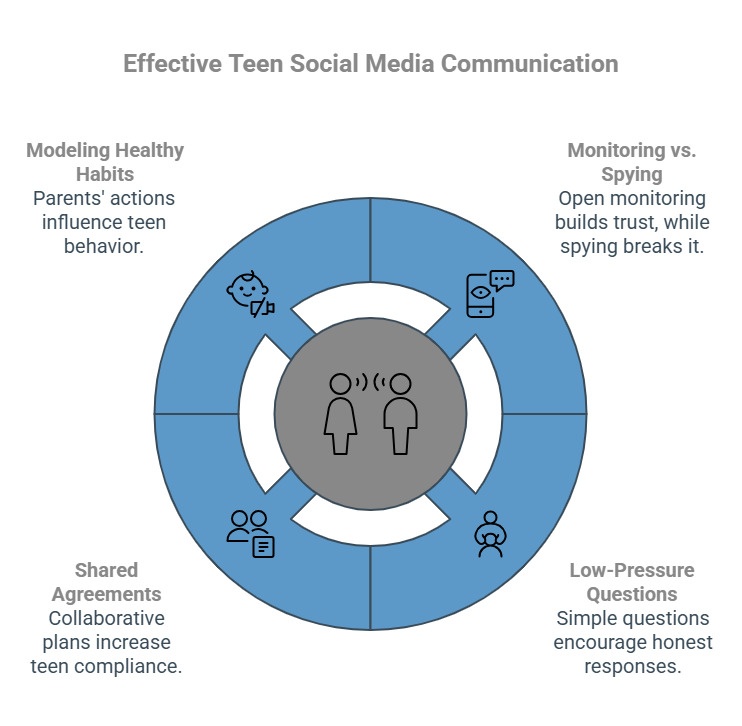
Monitoring is open and agreed upon. Spying is hidden and breaks trust. Teens are usually okay with some level of involvement if it feels respectful. Simple things like following their public accounts or having occasional check-ins can help.
But reading messages secretly often backfires. Once trust is broken, the focus shifts away from safety and becomes about why you did it. That makes future conversations harder.
How Do You Start A Conversation About What Your Teen Is Seeing Online?
The tone matters more than the question.
Keep it simple and low-pressure:
- “What have you been watching lately?”
- “Did anything online feel off this week?”
- “What would you do if a stranger messaged you?”
These small conversations build trust over time. You are not trying to solve everything in one go. You are keeping the door open.
What Should A Family’s Social Media Agreement Actually Include?
Think of this as a shared plan, not a rulebook.
Keep it practical:
- Clear screen time boundaries
- Device-free times like meals or bedtime
- A plan for what to do if something feels uncomfortable
- An agreement to be honest about online activity
When teens are part of the decision, they are more likely to follow through.
How Can Parents Model Healthy Social Media Habits For Their Teens?
Teens notice what you do more than what you say. If phones are always present, that becomes normal. If you put your phone away during conversations or family time, that becomes normal, too.
It is not about being perfect. It is about showing what balance actually looks like in everyday life.
If you have been wondering whether your teen’s habits are just “normal use” or something more concerning, this guide breaks it down clearly. Explore the real signs, emotional impact, and when to step in: Social Media Addiction Effects: What Parents Should Watch For
What Tools Can Help Keep Teens Safer Online?
No tool replaces conversation, but the right tools can support it and make social media safety for teens more manageable. They help set boundaries, reduce exposure to risks, and guide behaviour, but they work best when combined with trust, awareness, and ongoing communication.
Which Parental Control Tools Are Actually Useful For Teen Safety?
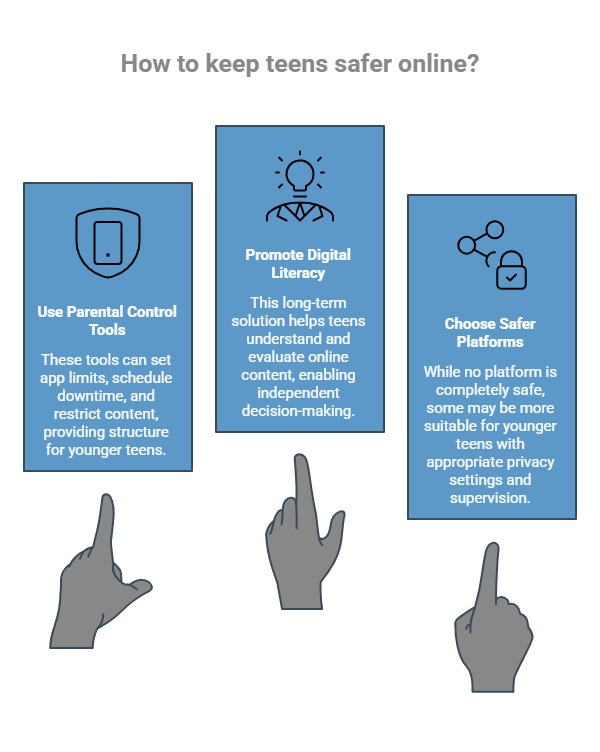
Most smartphones already offer built-in tools like Apple Screen Time and Android Digital Wellbeing. These allow you to:
- Set app limits
- Schedule downtime
- Restrict certain content
They are not foolproof, but they create structure, especially for younger teens. Content filtering and family safety apps can block certain websites or contacts. However, they are less effective inside social media platforms, where most interactions happen.
Tools work best when used openly with your teen, not installed without their knowledge.
What Is Digital Literacy, And Why Is It The Long-Term Solution?
Digital literacy means helping teens understand and evaluate what they see online.
It helps them:
- Recognise misleading or harmful content
- Understand how algorithms shape their feed
- Spot comparison triggers and unrealistic standards
- Identify unsafe or manipulative interactions
Tools can limit exposure. Digital literacy helps teens make safe decisions independently, making it the most reliable long-term protection.
Are There Social Media Platforms That Are Safer For Younger Teens?
No platform is completely safe by default. Experts emphasise that safety depends more on:
- Privacy settings
- Who the teen interacts with
- The type of content they engage with
Most platforms set a minimum age of 13, but enforcement varies.
Some families delay access or start with supervised use. There is no fixed “right” age. What matters is your teen’s readiness and ability to handle online interactions responsibly.
In the end, tools can support safety, but trust, awareness, and communication are what actually protect teens.
How Do You Know When Social Media Stress Has Become Something More Serious?
Most families manage teens and social media with communication and boundaries. But repeated exposure to cyberbullying, harmful content, or public social conflict can go beyond a normal rough phase. The key is recognising when patterns, not isolated moments, start affecting your teen’s well-being.
What Are The Signs That Social Media Is Affecting Your Teen’s Mental Health?
Look for consistent changes such as:
- Mood drops after social media use
- Withdrawal from hobbies or friends
- Changes in sleep or appetite
- Avoiding conversations about online activity
- Increased comparison or negative self-talk
A single sign is not enough. Patterns over time matter.
When Does A Family Conversation Stop Being Enough?
Open conversations help, but they may not always be enough. If distress continues, teen counseling can provide a safe space for your teen to process emotions and build coping skills.
If you are noticing ongoing changes, exploring teen counseling near you can be a proactive step toward supporting your teen’s mental health.
Struggling with constant scrolling or feeling like social media is taking over your teen’s routine? This practical guide on how to stop social media addiction walks you through simple, realistic steps to regain balance without turning it into a battle at home.
When You Need Support Beyond Home: Total Life Counseling
Sometimes, even with open conversations, your teen may need support beyond what you can provide at home. Ongoing stress from social media, anxiety, or cyberbullying can be difficult for teens to process on their own.
At Total Life Counseling, licensed therapists help teens navigate these challenges in a safe, non-judgmental space. The focus is on building emotional resilience, improving self-esteem, and helping teens handle online pressures more confidently.
If you are noticing ongoing changes, exploring teen counseling near you can be a proactive step. Connect with Total Life Counseling today to support your teen’s mental well-being.
Conclusion
Social media is not going away, and for teens, it is part of how they connect, learn, and grow. The focus is not on control, but on staying involved in a way that builds trust and awareness.
Start small. Keep conversations open, review safety settings together, and notice patterns early. If something feels off, trust that instinct. Whether through guidance at home or support like teen counseling near you, taking action early can make a meaningful difference.
Licensed Counselors & Therapists
Meet Our Team of Certified & Experienced Professionals
Total Life Counseling Center consists of Licensed Counselors, Masters Level Therapists, Espanol Counselors, Licensed Mental Health Counselors, Business Coaches, Image Enhancement Coaches who provide counseling for emotional, mental, physical and spiritual care including marriage, individual, family, substance abuse and more. Our team of certified and experienced professionals, dedicated to serving a comprehensive spectrum of mental health and relationship issues such as couples, women and men’s issues, children and teens with oppositional defiance, video game addiction, ADHD, ASD, anxiety, depression, and trauma survivors, is here to support and guide you through your journey towards healing and navigating life transitions. This approach not only enhances the effectiveness of the counseling provided but also builds trust within the community and among potential clients, who may be seeking support.
We offer next level counselors specialized in areas such as relationships, video game & drug/alcohol addictions, abuse, trauma, depression, and ADHD. Our Therapists are EMDR (eye movement desensitization) trauma therapy trained, cognitive behavioral therapy, specialize in ADHD and Oppositional Defiant Children, and are also professional Gottman method marriage couples counselors to give the best results to couples and to provide the best comprehensive spectrum of mental health and relationship care for our clients.
Struggling with Anger? We offer 8 hour anger management group therapy!
Discounted Rates and the president of Total Life Counseling Center Jim West does not want to turn people away and we have counselors at various levels of experience at a discounted rate that are trained by our next level counselors!

Jim West
MA, LICENSED MENTAL HEALTH COUNSELOR, national certified counselor
President, Counselor, Guest Speaker, Author, Social Skills, ADHD, ODD, ASD, children, teens, and more!

Dana West
MSW, Licensed clinical social worker
Vice President, Counselor, Guest Speaker, Addictions, Trauma, Couples, Abuse, and more!

Mathew Martin
MS, LICENSED MENTAL HEALTH COUNSELOR
Counselor, Coach, Guest Speaker, Marriage, Individual Males, Substance Abuse and more!

Brandon Feinberg
MS, LICENSED MENTAL HEALTH COUNSELOR
Male Counselor, Licensed Mental Health Counselor specializing in ADHD, Asperger Syndrome, Autism Spectrum Disorders, and more!

Lyris Steuber
MS, licesned marriage & family therapist
Counselor, Coach, Marriage & Family, Play Therapy, Divorce, Adolescent and more!

Valerie Ware
Licensed Psychologist and Behavioral Specialist
Psychological Evaluator, Autism, ADHD, Learning Disabilities, Anxiety, Gifted, Career Pathways, and emotional assessments.

Gemima McMahon
MA, LICENSED MENTAL HEALTH COUNSELOR
Licensed Mental Health Counselor specializing in Women’s issues, Trauma, Anxiety, Depression, Cutting, Couples, Children and Teenagers and more!

Audrey DeBruler
MS, LMHC, Licensed Mental Health Counselor
Children, Adolescents, Young Adults, Faith Based Counseling, Trauma Recovery, Anxiety and more!

David Duany
MA, LICENSED MENTAL HEALTH COUNSELOR
Licensed Mental Health Counselor specializing in ADHD, Social Skills, and Anger Management counseling for children, young adults, and families.

Katherine Waldheim
MS, Registered Mental Health Counseling Intern
Trauma, anxiety, couples counseling, and child & adolescent counseling services and more!

Sarah Dornas Albuquerque
MS – Registered Mental Health Counselor Intern
EMDR, Anxiety, Depression, Children, Teens, Young Adults, English, Spanish and Portugues and Adult Counseling

Frequently Asked Questions
How can I keep my teenager safe on social media?
Focus on online safety by keeping a strong line of communication and guiding healthy social media use. Teach teens not to share sensitive information like phone numbers or a social security number, and encourage them to speak to a trusted adult if something feels wrong.
At what age is it safe for teens to use social media?
Most platforms suggest 13, but readiness depends on maturity, brain development, and awareness of potential risks. In today’s digital age, gradual exposure with guidance from a family member helps young people build safer habits around the use of social media.
What are the biggest dangers of social media for teenagers?
Key risks include online predators, cyberbullying, exposure to inappropriate content, and identity theft. Teens may also connect with unknown online friends or accept risky friend requests, increasing the overall risk of harm without fully understanding the consequences.
How do I talk to my teen about social media without them shutting down?
Start with curiosity, not control. Keep a calm tone and build a strong line of communication. Being a positive role model in your own social media behavior helps teens feel understood and more open to discussing their experiences.
Should parents monitor their teenagers’ social media?
Monitoring can support online safety, but it should be transparent. Hidden tracking can damage trust. When teens understand boundaries and risks, they are more likely to engage responsibly and involve a trusted adult when facing uncomfortable situations.
What are good social media rules for teenagers?
Encourage healthy social media use by setting limits on screen time, protecting social media accounts, and avoiding sharing sensitive information. Include device-free time to support physical activity and better hours of sleep, reducing the chances of poor sleep.
How does social media affect teens’ self-esteem?
The use of social media can influence body image and self-worth. Constant comparison and validation cycles may lead to negative effects on confidence, especially among young people who are still forming their identity and emotional resilience.
Can social media cause anxiety in teenagers?
Yes, research from the American Psychological Association links excessive social media use to anxiety and stress. Pressure from peers, fear of missing out, and constant engagement can overwhelm young adults, especially when combined with poor sleep habits.
What is the importance of teen social media safety?
According to the Surgeon General and the American Academy of Pediatrics, protecting youth mental health is critical. Social media safety reduces exposure to risks, supports positive experiences, and helps teens navigate the digital world with awareness and confidence.
What is digital literacy for teens?
Digital literacy helps teens understand social media behavior, recognise potential risks, and avoid threats like identity theft or unsafe interactions in online games. It equips young people to make safer decisions independently in today’s digital age.
How can teens create strong passwords for their social media accounts?
Teens should create strong passwords using a unique combination of letters, numbers, and symbols. Avoid personal details like names or phone numbers. Each of their social media accounts should have a different password, and sharing it with online friends should always be avoided.
Filed in: Blog, Jim West, Social media
Share This Story, Choose Your Platform!
Total Life Counseling Center consists of Licensed Counselors, masters level therapists, Español counselors, Licensed Mental Health Counselors, business coaches, and image enhancement coaches who provide counseling for emotional, mental, physical and spiritual care including marriage, individual, family, substance abuse and more. TLC’s family, trauma and marriage experts have been interviewed on National and Local TV/Radio over 200 times for their expert advice on Fox News, OWN, WETV, ABC’s Medical Minute and more. Our skilled counselors are relational, approachable and specialists providing therapy services in the Central Florida area including: Orlando, Winter Park, MetroWest, Windermere, Dr. Phillips, East Orlando, Lake Mary, and Clermont, Boca Raton Florida, and Dallas, TX.
About the Author: Jim West