

What Phrases Emotionally Intelligent People Use to Stay Mentally and Emotionally Radiant?

Key Highlights
- Emotionally intelligent communication often sounds simple: “Can you help me understand?”, “I hear you,” or “What do you think?”
- Asking “Can you help me understand?” when something is unclear encourages clarification instead of assumptions.
- Saying “I need a moment to think” during a tense conversation can create space to manage emotions before responding.
- Phrases such as “I hear you” or “That makes sense” can validate another person’s feelings without necessarily agreeing with them.
- Saying “I was wrong, and I’m sorry” after making a mistake demonstrates accountability rather than defensiveness.
- Clear, respectful language can help people communicate boundaries and needs while remaining considerate of others.
- Asking “What do you think?” can invite another perspective and encourage collaborative problem-solving.
- Total Life Counseling’s social skills groups provide opportunities for children, teens, and young adults ages 6–29 to practise these communication, listening, emotional regulation, and relationship skills with peers.
The words we choose during awkward, frustrating, or emotional conversations can show what emotionally intelligent communication looks like in real life. These phrases are not simply vocabulary. They reflect how someone responds when they feel misunderstood, disagree with another person, make a mistake, or need to set a boundary.
A child might ask, “Can you explain what you mean?” rather than assuming a classmate was being unkind. A teenager might say, “I need a minute before I respond,” instead of continuing an argument when emotions are high. These are examples of phrases emotionally intelligent people use to demonstrate curiosity, empathy, self-awareness, emotional regulation, and active listening.
Being mentally and emotionally radiant does not mean responding perfectly every time. It means developing skills for navigating challenging interactions thoughtfully. This guide explores seven useful phrases, situations where they can help, and examples of emotionally and socially skilled responses for young people ages 6–29.
What Does It Mean When People Have High Emotional Intelligence?
Emotional intelligence involves recognizing and understanding your emotions and the emotions of others, then using that awareness to guide how you respond.
Being emotionally intelligent also does not mean avoiding anger, embarrassment, anxiety, frustration, or other negative feelings. Instead, it can mean noticing those emotions and choosing how to respond.
In everyday interactions, emotionally intelligent responses may involve:
- Pausing before reacting.
- Asking questions instead of making assumptions.
- Listening to another person’s perspective.
- Communicating boundaries respectfully.
- Taking responsibility for mistakes.
These are the underlying skills that shape many of the phrases emotionally intelligent people use in challenging social situations.
Wondering what your teen may need but struggling to put it into words? Explore 3 Things Your Teen Wants But Will Not Tell You for insights into strengthening communication and connection.
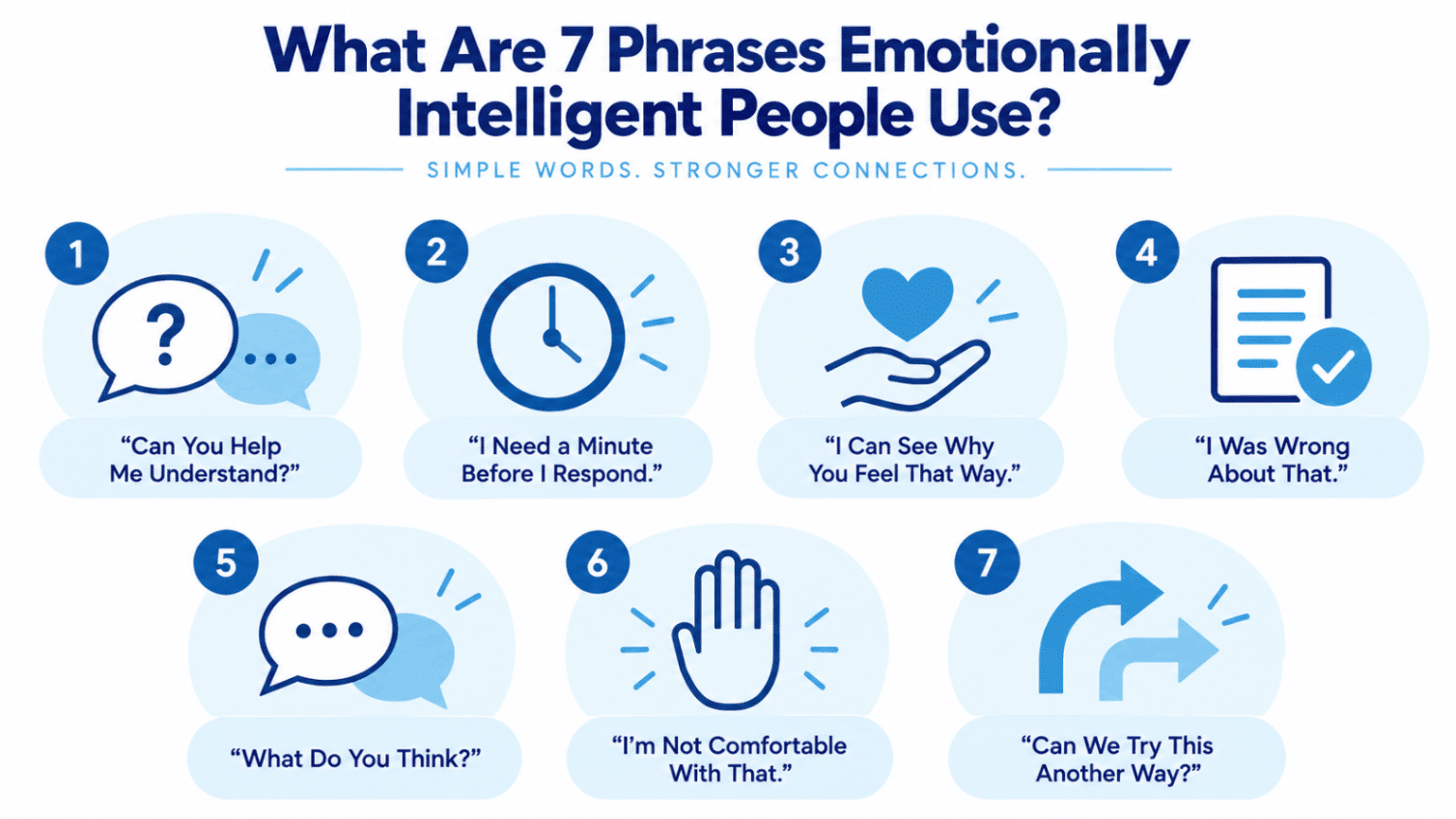
What Are 7 Phrases Emotionally Intelligent People Use?
#image_title
Emotionally intelligent communication does not need to sound polished or rehearsed. Often, it comes down to knowing how to respond in the moment. Mentally and emotionally radiant people can still feel frustrated, hurt, embarrassed, or misunderstood, but they try to respond in ways that encourage understanding, respect, and connection.
Here are seven phrases and situations that show what these skills can sound like in everyday life.
1. “Can You Help Me Understand?”
Emotionally intelligent response: Ask before assuming.
Emotionally intelligent people do not automatically assume they know what another person meant. They stay curious and ask for clarification before reacting.
Imagine a teenager receives a short text from a friend and assumes the friend is angry. Instead of immediately responding defensively, they might ask, “Can you help me understand what you meant?”
The phrase can change with age:
- Child: “What did you mean?”
- Teen: “Why did you say that?”
- Young adult: “I understood that differently. Can you explain what you meant?”
This gives the other person an opportunity to explain and can prevent a misunderstanding from becoming an unnecessary argument.
2. “I Need a Minute Before I Respond.”
Emotionally intelligent response: Pause when emotions are running high.
Emotionally intelligent people can recognize when anger, embarrassment, or frustration may affect how they respond. Rather than saying something immediately and regretting it later, they may create space before continuing the conversation.
For example, a teen arguing with a parent might notice they are becoming increasingly angry and say, “I’m really upset. Can we talk about this in a few minutes?”
Depending on age:
- Child: “I need a break.”
- Teen: “I’m really upset. Can we talk in a few minutes?”
- Young adult: “I want to talk about this, but I need some time to think first.”
The goal is not to avoid the conversation. It is to return to it when they can communicate more thoughtfully.
3. “I Can See Why You Feel That Way.”
Emotionally intelligent response: Acknowledge feelings without automatically agreeing.
Mentally and emotionally radiant people can make others feel heard even when they see a situation differently. Validation does not require agreement.
For example, two friends may disagree about why one was excluded from a group activity. Instead of arguing about whose version is correct, one might say, “We remember it differently, but I can see why you felt left out.”
The wording might sound like:
- Child: “I get why you’re sad.”
- Teen: “I understand why that embarrassed you.”
- Young adult: “We see it differently, but I understand why you were frustrated.”
This response makes room for another person’s feelings without requiring someone to abandon their own perspective.
4. “I Was Wrong About That.”
Emotionally intelligent response: Take responsibility without becoming defensive.
Emotionally intelligent people make mistakes too. The difference can be in how they respond after recognizing one. Instead of immediately offering an excuse or shifting blame, they can acknowledge what happened.
For example, a teenager who wrongly assumed a friend intentionally excluded them might say, “I thought you left me out on purpose, but I was wrong about that.”
Depending on age:
- Child: “I shouldn’t have done that. I’m sorry.”
- Teen: “I misunderstood what happened. I was wrong.”
- Young adult: “I reacted before I knew the whole situation. I’m sorry.”
Accountability can help repair a conversation by showing the other person that their experience has been recognized.
5. “What Do You Think?”
Emotionally intelligent response: Make room for other people.
People who make others feel comfortable do not need to dominate every conversation. They show interest in other people’s ideas, experiences, and preferences.
Imagine a teenager planning an activity with friends. Rather than deciding for everyone, they might ask a quieter friend, “What do you think we should do?”
This can also sound like:
- Child: “What do you want to play?”
- Teen: “What do you think about it?”
- Young adult: “That’s how I see it. What’s your perspective?”
Asking is only part of the skill. Emotionally intelligent communication also involves listening to the answer, asking relevant follow-up questions, and giving the other person space to speak.
6. “I’m Not Comfortable With That.”
Emotionally intelligent response: Communicate boundaries clearly and respectfully.
Being considerate of other people’s feelings does not mean ignoring your own needs. Emotionally intelligent people can communicate a boundary without unnecessarily attacking or insulting the other person.
For example, if a teenager is being pressured by friends to do something they do not want to do, they might say, “No, I’m not comfortable with that.”
Depending on age:
- Child: “Please don’t do that.”
- Teen: “No, I don’t want to do that.”
- Young adult: “I’m not comfortable with that, so I’m going to say no.”
If someone repeatedly ignores a boundary or makes a young person feel unsafe, they should know they can involve a parent, trusted adult, or another appropriate source of support.
7. “Can We Try This Another Way?”
Emotionally intelligent response: Look for a way forward instead of trying to win.
Rather than treating every disagreement as a win-or-lose situation, emotionally skilled people can recognize when an approach is not working and look for another solution.
For example, two students may disagree about how to divide a group project. Instead of continuing the same argument, one might say, “This isn’t working. Can we split the project another way?”
Depending on age:
- Child: “Can we take turns?”
- Teen: “What if we split it differently?”
- Young adult: “This isn’t working for either of us. Can we come up with another plan?”
The goal is not always to give in or agree. It is to stay flexible enough to consider another way forward when the current approach is creating more conflict.
Feeling mentally or emotionally drained? Explore 10 simple ways to reset your mental health and discover practical strategies to recharge and support your well-being.
Can Children, Teens, and Young Adults Learn These Skills?
Yes. Social-emotional skills can develop through modeling, instruction, practice, feedback, and everyday interactions. Knowing what to say, however, is different from being able to use the skill in the moment.
For example:
- A child may know how to ask to join a game but feel nervous approaching other children.
- A teen may understand emotional regulation but struggle to pause during an argument.
- A college student may know how to set a boundary but worry about disappointing a friend.
- A young adult may know how to begin conversations but have difficulty maintaining them.
Practice helps close the gap between understanding a skill and using it independently.
Parents and caregivers can help every step of the way by modeling the same skills. Saying “I was wrong,” “I need a minute,” or “Help me understand” shows that these strategies are not rules only for children.
They are communication skills people can continue developing throughout life.
Worried that your child may be struggling emotionally? Learn what you can do if you suspect your child is experiencing anxiety or depression and how to offer support.
How Can Parents Practice These Phrases at Home?
Parents can reinforce social-emotional skills without turning every conversation into a formal lesson. One of the simplest approaches is modeling the language yourself:
- “I misunderstood. Can you explain?”
- “I’m frustrated, so I need a few minutes.”
- “I understand why you’re disappointed.”
- “I was wrong. I’m sorry.”
- “What do you think we should do?”
Role-playing can also help when the same social situation repeatedly causes difficulty.
For example, a child who feels nervous about joining other children can practice:
“Hey, what are you playing? Can I join?”
A teenager dealing with peer pressure can practice:
“No, I’m not comfortable with that.”
The goal is not memorizing a response for every possible scenario. It is developing enough social tools to approach new situations with greater flexibility and confidence.
Call for a Complimentary 15 Minute Phone Consultation
Se Habla Español: We have Portuguese and Spanish speaking counselors as well.

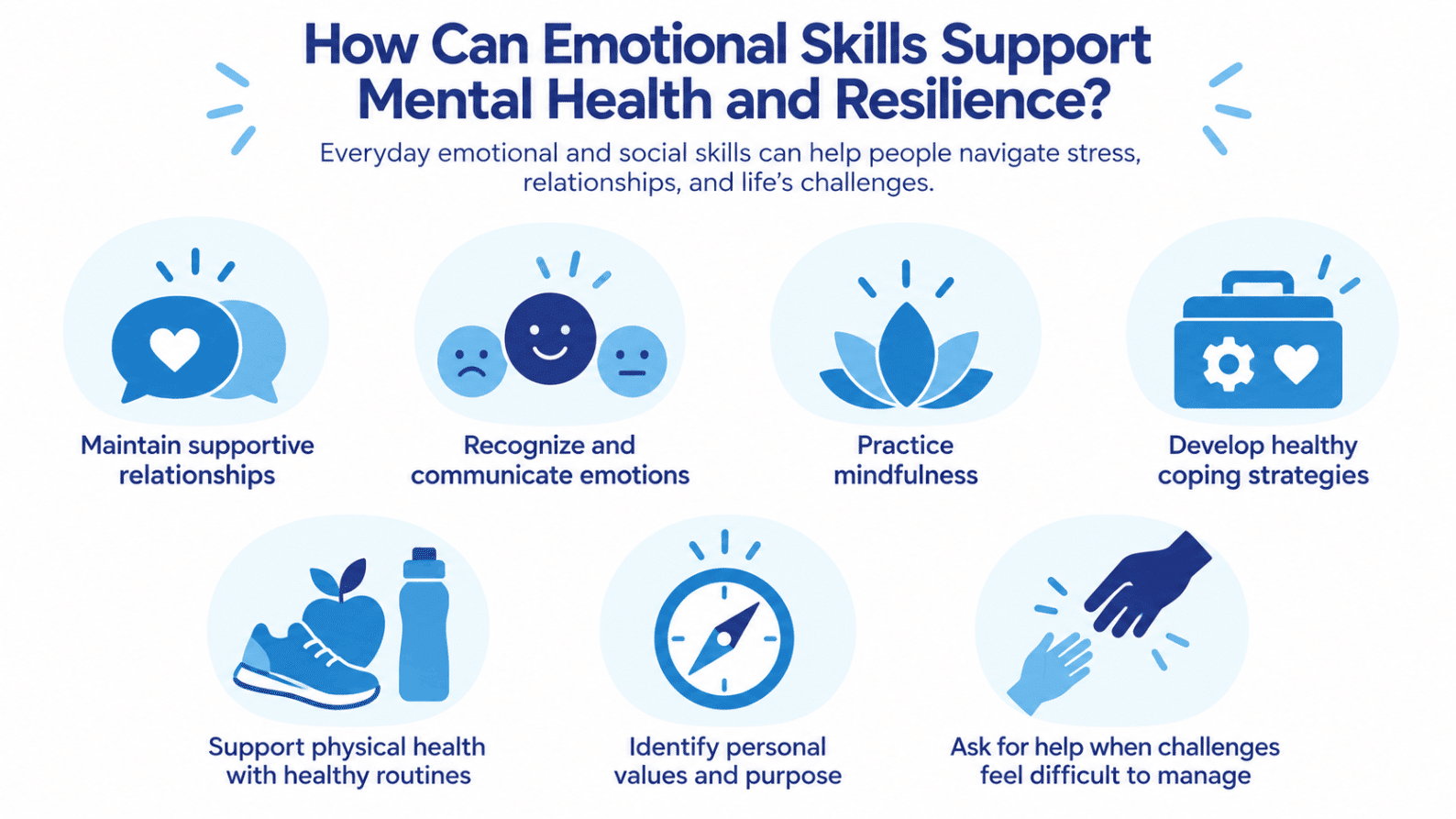
How Can Emotional Skills Support Mental Health and Resilience?
#image_title
Emotional and social skills can support mental health by helping people recognize feelings, communicate needs, manage stressful situations, and maintain relationships. They are only one part of mental health, however, and communication skills are not a substitute for mental health care when it is needed.
Building resilience can help people navigate life’s challenges, including disappointment, conflict, loneliness, changes in relationships, and personal loss.
Helpful practices may include:
- Maintaining supportive relationships.
- Recognizing and communicating emotions.
- Practicing mindfulness or meditation.
- Developing healthy coping strategies.
- Maintaining routines that support physical health.
- Identifying personal values and a sense of purpose.
- Asking for help when challenges become difficult to manage.
Mental and physical health can also influence one another. For example, prolonged stress can affect sleep, energy, and other aspects of physical well-being. Mental health should therefore be viewed as part of overall health rather than something entirely separate from the body.
Good communication alone also cannot prevent or resolve mental illnesses. Someone experiencing persistent distress, severe loneliness, substance use concerns, or significant changes in functioning may benefit from professional evaluation and support.
Seeking professional help is not a failure of resilience. It can be an appropriate response when someone needs additional support.
Want to help your teen build greater confidence and a healthier sense of self? Explore these practical self-esteem activities for teens that can support personal growth and everyday challenges.
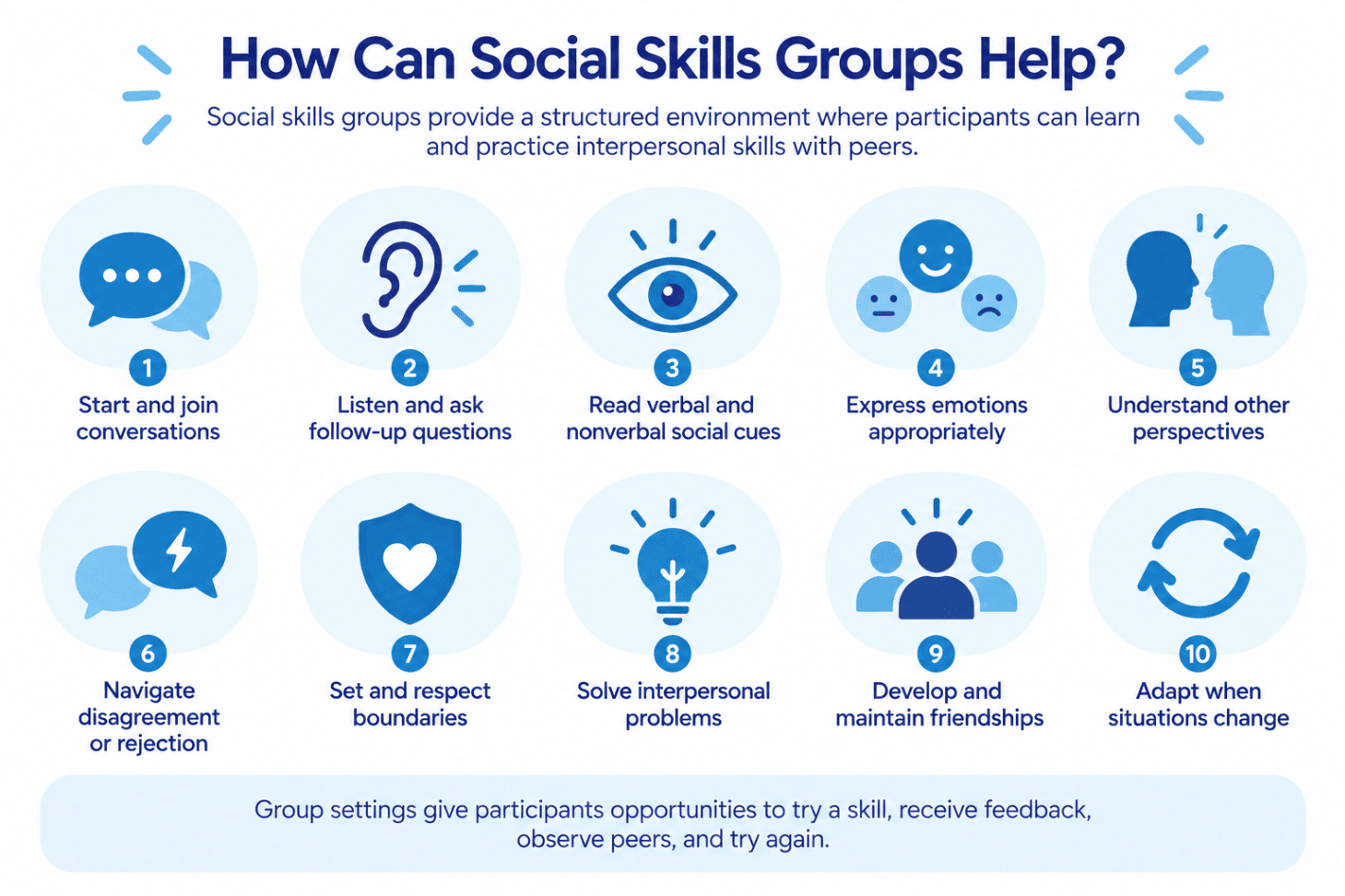
How Can Social Skills Groups Help?
#image_title
Social skills groups provide a structured environment where participants can learn and practice interpersonal skills with peers. Instead of only discussing how to handle a social situation, participants can have opportunities to practice the skills involved.
Depending on age and individual goals, practice may include:
- Starting and joining conversations.
- Listening and asking follow-up questions.
- Reading verbal and nonverbal social cues.
- Expressing emotions appropriately.
- Understanding other perspectives.
- Navigating disagreement or rejection.
- Setting and respecting boundaries.
- Solving interpersonal problems.
- Developing and maintaining friendships.
- Adapting when situations change.
This distinction matters. Reading a list of 10 sentences emotionally intelligent people use under pressure can provide useful ideas, but using those words naturally during a real disagreement requires practice. A group setting can give participants opportunities to try a skill, receive feedback, observe peers, and try again.
How Does Total Life Counseling Support Social Skills for Ages 6–29?
Total Life Counseling offers social skills groups for children, teens, and young adults ages 6–29, providing opportunities to practice age-relevant communication and interpersonal skills with peers. The challenges naturally change with age. Younger children may work on areas such as joining play, taking turns, handling frustration, or recognizing social cues.
Teens may focus on:
- Conversation skills.
- Friendships and peer interactions.
- Reading social cues and body language.
- Emotional regulation.
- Conflict resolution.
- Assertive communication and boundaries.
Young adults may encounter additional challenges related to college, work, dating, independence, friendships, and group interactions.
Rather than expecting someone to automatically know how to handle every social situation, structured practice can break communication into specific, learnable skills.
If your child, teen, or young adult could benefit from additional social skills practice, explore Total Life Counseling’s social skills groups for ages 6–29 and contact TLC to discuss available groups.
Conclusion
The phrases emotionally intelligent people use reflect practical skills that can help people navigate everyday interactions. Asking for clarification supports perspective-taking. Pausing can help with emotional regulation. Acknowledging feelings demonstrates empathy, while admitting mistakes encourages accountability and personal growth.
These abilities can contribute to resilience, healthier relationships, and a more constructive outlook when navigating setbacks and social challenges. They are skills that children, teens, and young adults can continue developing through experience and practice. For some young people, structured social practice provides additional opportunities to build those skills.
Licensed Counselors & Therapists
Meet Our Team of Certified & Experienced Professionals
Total Life Counseling Center consists of Licensed Counselors, Masters Level Therapists, Espanol Counselors, Licensed Mental Health Counselors, Business Coaches, Image Enhancement Coaches who provide counseling for emotional, mental, physical and spiritual care including marriage, individual, family, substance abuse and more. Our Counselors are Experts for National and Local TV, Radio and Print Media and we have an excellent reputation amongst graduate & private schools, attorneys, doctors, therapists, providers and corporations.

Dana West
MSW, Licensed clinical social worker
Vice President, Counselor, Guest Speaker, Addictions, Trauma, Couples, Abuse, and more!

Mathew Martin
MS, LICENSED MENTAL HEALTH COUNSELOR
Counselor, Coach, Guest Speaker, Marriage, Individual Males, Substance Abuse and more!


Frequently Asked Questions
What Are Some Characteristics of People Who Are Mentally and Emotionally Healthy?
Emotionally healthy people may demonstrate self-awareness, empathy, resilience, healthy boundaries, and appropriate emotional regulation. Good mental health does not mean always feeling positive. It includes recognizing difficult emotions and using healthy ways to navigate them.
What Are Some Phrases Emotionally Intelligent People Use Under Pressure?
Examples include “I need a minute,” “Can you help me understand?” “I understand why you’re upset,” and “Can we find another solution?” These phrases can support regulation, perspective-taking, empathy, and problem-solving during stressful situations.
How Do Healthy People Regulate Their Emotions?
People may regulate emotions by identifying what they feel, pausing before reacting, communicating their needs, practicing mindfulness, or using healthy coping strategies. Regulation involves responding constructively to emotions rather than pretending negative feelings do not exist.
What Are the Characteristics of Strong Emotional Health in Children?
Children developing strong emotional health may learn to identify feelings, communicate needs, form relationships, adapt to setbacks, and use age-appropriate coping skills. Development varies, and a child may need additional practice in specific social-emotional areas.
Can Social Skills Groups Help With Loneliness?
Social skills groups can provide opportunities to practice conversation, cooperation, perspective-taking, and other relationship skills with peers. Loneliness can have many causes, however, so the right type of support depends on the individual’s circumstances and needs.
What Ages Can Participate in TLC Social Skills Groups?
Total Life Counseling offers social skills groups for children, teens, and young adults ages 6–29. Because social needs vary considerably by age, families can contact TLC to discuss current groups and appropriate options.

Filed in: Social Skills, social skills
Share This Story, Choose Your Platform!
Total Life Counseling Center consists of Licensed Counselors, masters level therapists, Español counselors, Licensed Mental Health Counselors, business coaches, and image enhancement coaches who provide counseling for emotional, mental, physical and spiritual care including marriage, individual, family, substance abuse and more. TLC’s family, trauma and marriage experts have been interviewed on National and Local TV/Radio over 200 times for their expert advice on Fox News, OWN, WETV, ABC’s Medical Minute and more. Our skilled counselors are relational, approachable and specialists providing therapy services in the Central Florida area including: Orlando, Winter Park, MetroWest, Windermere, Dr. Phillips, East Orlando, Lake Mary, and Clermont, Boca Raton Florida, and Dallas, TX.
About the Author: Jim West