

How ADHD and Social Media Impact Focus and Behavior?

Key Highlights
- ADHD and social media are closely linked, especially among young adults with high digital media use.
- Social media triggers short-term reward loops, making focus and self-control harder for ADHD brains.
- It does not cause ADHD, but problematic social media use can mimic or worsen symptoms of ADHD.
- Common effects include reduced attention span, impulsivity, sleep disruption, and negative emotions.
- ADHD makes social media harder to manage due to time blindness and impaired executive functioning.
- Improving focus requires structured habits, time limits, and intentional alternatives, not just willpower.
- Professional support from providers like Total Life Counseling (TLC) can help build personalised strategies to manage ADHD and develop healthier digital habits.
The connection between attention deficit hyperactivity disorder (ADHD) and social media use is becoming harder to ignore, especially for young adults and high school students trying to keep up with everyday demands. According to the Pew Research Center, teens spend around three to five hours daily on social media, and over time, it can start to feel like focus is slipping more easily. If you have ever found yourself stuck in a scroll or struggling to pull your attention back, you are not alone.
It is natural to question what is happening. Is social media affecting your mental health, or making ADHD symptoms feel more intense? While ADHD is a recognised condition defined by the American Psychiatric Association, today’s digital habits can quietly make focus and self-control feel more difficult.
In this blog, we will walk through what is happening and how you can start finding balance again.
What Is ADHD and How Does It Affect Focus?
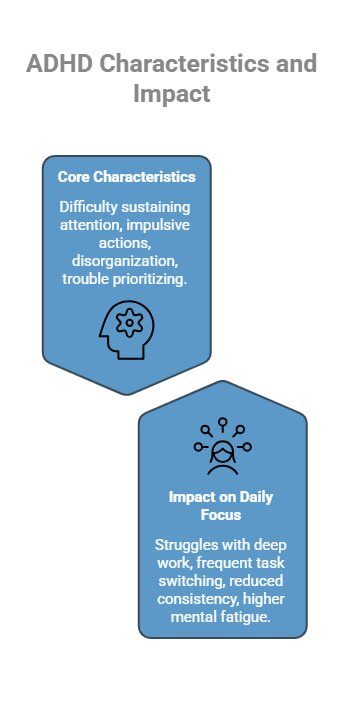
Attention-deficit hyperactivity disorder (ADHD) is a neurodevelopmental condition that affects attention, impulse control, and executive functioning.
According to the American Psychiatric Association, it involves persistent patterns of inattention and hyperactivity that interfere with daily focus, organisation, and task completion.
ADHD affects how attention works, not just how long it lasts.
What Are the Core Characteristics of ADHD?
ADHD commonly presents through patterns that affect how individuals think, act, and manage tasks:
- Difficulty sustaining attention on low-stimulation tasks.
- Impulsive actions or quick, unplanned decisions.
- Disorganisation and poor time management.
- Trouble prioritising or completing tasks.
How Does ADHD Impact Daily Focus?
These characteristics often show up in everyday situations:
- Struggles with deep work or long-form reading.
- Frequent task switching without completion.
- Reduced consistency in routines.
- Higher mental fatigue during structured or repetitive tasks.
These markers of ADHD become more visible in high-stimulation environments. As digital media use increases, especially among young adults, maintaining stable attention requires more effort.
How Does Social Media Affect the ADHD Brain?
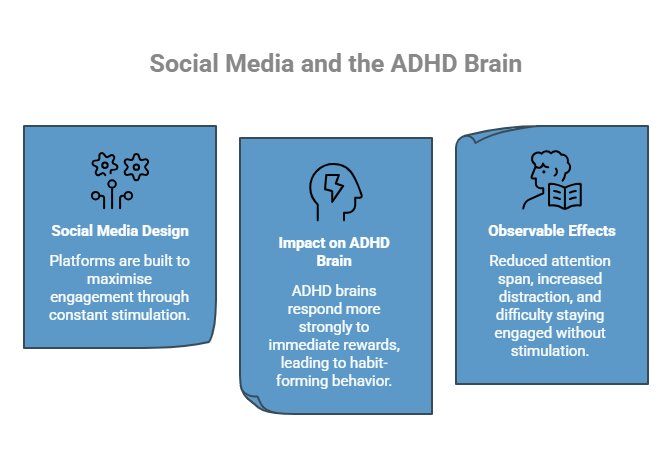
Social media is designed to capture attention quickly and repeatedly. For individuals with ADHD, this creates a stronger pull because the brain is already more sensitive to stimulation and reward.
The result is a gap between how digital environments work and what real-life tasks require.
What Is Social Media Designed to Do?
Social platforms are built to maximise engagement through constant stimulation. Their design encourages users to stay active for longer periods without noticing.
This includes:
- Delivering rapid, continuous content updates
- Encouraging frequent interaction and checking
- Prioritising novelty over depth
How Does Social Media Impact the ADHD Brain?
Because ADHD brains respond more strongly to immediate rewards, this type of stimulation can quickly become habit-forming.
Over time, it can:
- Build dependence on instant rewards
- Lower tolerance for delayed outcomes
- Encourage habitual multitasking
What Are the Observable Effects Over Time?
As this pattern continues, the effects often become more visible in daily life, especially in tasks that require sustained attention.
Common signs include:
- Reduced attention span for non-digital tasks
- Increased distraction during work or study
- Difficulty staying engaged without stimulation
According to a research, including systematic reviews, shows that high social media use is associated with attention difficulties and problematic internet use, particularly among high school students and young adults.
A systematic review shows that high social media use intensity is linked to attention difficulties and problematic internet use, particularly in high school students and young adults.
Can Social Media Cause ADHD or ADHD-Like Symptoms?
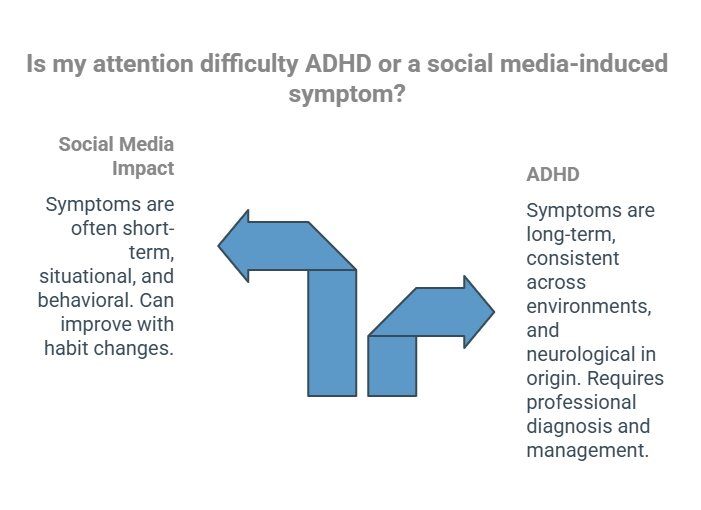
It is a common concern, especially when focus starts to feel harder to manage. Social media does not cause ADHD, which is a clinically recognised condition. However, excessive use can create ADHD-like symptoms that feel similar, making it difficult to understand what is actually happening.
According to the American Psychiatric Association, ADHD is a neurodevelopmental condition involving persistent patterns of inattention, impulsivity, and hyperactivity that affect daily functioning. The confusion often comes from symptom overlap, not the same root cause.
What Can Social Media Actually Influence?
Social media changes how attention is used and trained over time. With repeated exposure to fast, high-stimulation content, the brain adapts in ways that can make sustained focus feel more difficult.
- Attention fragmentation from constant switching.
- Reduced cognitive endurance for longer tasks.
- Dependence on external stimulation for engagement.
How Is ADHD Different from ADHD-Like Symptoms?
Understanding the difference between a clinical condition and behaviour shaped by the environment helps bring clarity and direction. While symptoms may appear similar, their cause, duration, and long-term impact are very different.
| Factor | ADHD | Social Media Impact |
|---|---|---|
| Duration | Long-term, consistent | Often short-term, situational |
| Cause | Neurological | Behavioural, environment-driven |
| Reversibility | Managed, not cured | Often improves with habit changes |
Call for a Complimentary 15 Minute Phone Consultation
Se Habla Español: We have Portuguese and Spanish speaking counselors as well.
Why Does This Distinction Matter?
This distinction helps you respond more effectively instead of reacting based on assumptions. It creates clarity around what needs professional support and what can be improved through simple habit changes.
- Prevents incorrect self-diagnosis.
- Helps identify controllable habits.
- Guides the right form of support.
In ADHD, symptoms typically persist across environments and over time. In contrast, attention issues linked to excessive social media use often improve when usage patterns become more structured and intentional.
Do ADHD and Social Media Use Make Symptoms Worse?
Yes, excessive social media use can worsen significant ADHD symptoms, especially those related to focus, impulsivity, and emotional regulation. Higher social media use intensity is linked to reduced attention control, increased distraction, and difficulty managing daily tasks.
These effects often build gradually and may not feel obvious at first. Over time, small shifts in attention, behaviour, and mood begin to affect daily routines, especially among young adults with high digital media use.
What Changes Might You Start Noticing?
As these patterns develop, the effects often show up in everyday habits:
- Shortened attention span: Tasks feel harder to complete without checking your phone.
- Increased impulsivity: Frequent switching between social media accounts without purpose.
- Reduced task consistency: Starting tasks feels easier than finishing them.
- Sleep disruption: Late-night scrolling affects rest and next-day focus.
- Mental fatigue: Feeling drained despite low physical effort.
- Emotional shifts: Increased comparison, overstimulation, and negative emotions.
When Does It Become a Concern?
Over time, these patterns can move beyond casual use and start affecting your overall routine. It may be a concern if:
- You rely on social media for constant stimulation.
- You feel restless or uncomfortable without it.
- Your academic performance or productivity begins to decline.
- Your sleep and daily routines are consistently disrupted.
At this stage, the issue is often linked to problematic social media use, not just normal engagement. Recognising this early can help you take control before it starts affecting your mental health more deeply.
What Are the Signs of Social Media Overuse in ADHD?
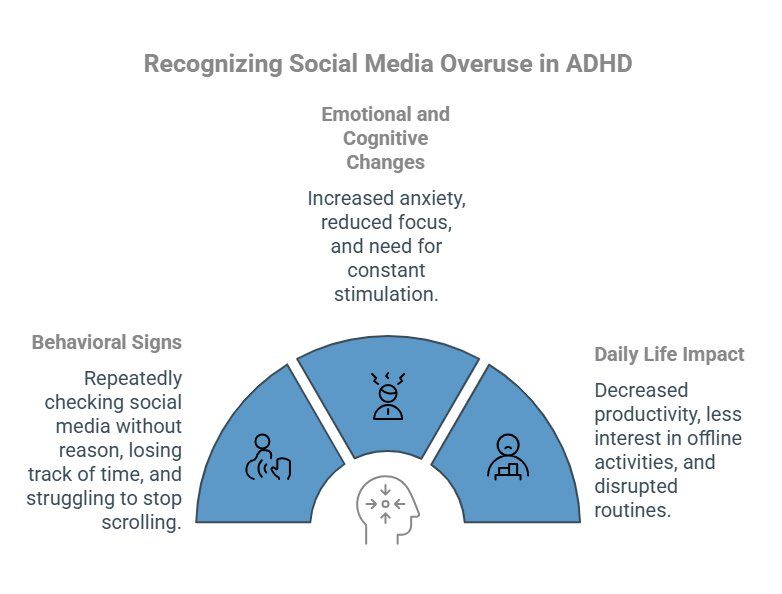
Social media overuse in ADHD rarely feels obvious at the beginning. What starts as quick scrolling can gradually affect your focus, mood, and daily rhythm. If your usage feels harder to manage, these signs can help you recognise the shift.
What Are the Behavioral Signs to Watch For?
The first signs usually show up in daily habits, especially how often and automatically you reach for your phone:
- Checking social media accounts repeatedly without a clear reason.
- Losing track of time while scrolling through feeds or videos.
- Struggling to stop, even when you know you should.
What Emotional and Cognitive Changes Can Happen?
As usage increases, the impact often becomes internal, affecting how you feel and think:
- Feeling more anxious, restless, or easily irritated.
- Experiencing reduced focus and mental clarity.
- Needing constant stimulation to stay engaged.
How Does It Affect Your Daily Life Over Time?
Eventually, these patterns begin to show up in areas that matter most:
- Drop in academic performance or work productivity.
- Less interest in offline activities or conversations.
- Disrupted routines, including sleep and daily structure.
If any of this feels familiar, you are not alone. These patterns are more common than they seem, especially in today’s digital environment. The important part is noticing them early, because awareness is the first step toward building healthier, more balanced habits.
Not sure if what you’re experiencing is ADHD or something else? Take a closer look at the signs and get clarity here.
Why Is Social Media Harder to Control With ADHD?
For many people with attention deficit hyperactivity disorder, staying in control of habits is not just about discipline. It is linked to how the brain manages attention, rewards, and decision-making.
ADHD affects executive functioning, which plays a key role in:
- Impulse control
- Time awareness
- Decision-making
This is where social media becomes especially challenging. Platforms are designed for quick rewards, which makes it harder to pause or step away.
A common ADHD trait, often called time blindness, makes it difficult to notice how long you have been using digital media. What feels like a few minutes can easily turn into an hour.
Because of this, reducing problematic social media use is not about trying harder. It requires structure, awareness, and systems that support better choices.
Is ADHD genetic, or shaped by environment and daily habits? Explore what research says about inherited traits and what it means for you or your child.
How Can You Manage Social Media Use With ADHD?
Once you understand why it feels difficult, the next step is to learn how to manage it realistically. The goal is not to eliminate social media, but to create boundaries that protect your focus and overall mental health.
Practical Strategies
Start with small, structured changes that are easy to maintain:
- Set time limits using app timers or built-in screen controls
- Reduce exposure to high-stimulation content like endless TikTok videos
- Keep your phone out of reach during focused tasks
- Replace passive scrolling with simple offline activities
These steps help reduce the intensity of social media use without feeling restrictive.
When Self-Control Is Not Enough
There are times when willpower alone is not enough, and that is completely okay.
- Use accountability tools to manage problematic internet use
- Explore therapy-based support, such as behavioral parent training for younger users
- Build daily routines that reduce decision fatigue
The first step is noticing your patterns without judgment. From there, small and consistent changes can make a meaningful difference.
Looking for gentle, effective ways to support a child with ADHD? Explore natural, parent-friendly strategies that build focus, calm, and daily balance.
What Are Healthier Alternatives to Social Media for ADHD Brains?
Reducing screen time becomes easier when you replace it with something that still feels engaging. ADHD brains do not need less stimulation. They need better, more intentional stimulation that supports focus instead of draining it.
Here are some effective alternatives:
- Physical activities like walking, cycling, or short workouts to regulate energy
- Creative hobbies such as drawing, music, or building something hands-on
- Structured activities like puzzles or strategy games that hold attention
- Learning-based content with clear goals and progress (courses, skill-building)
- Short, intentional reading or audiobooks instead of passive scrolling
- Social interactions in real life to reduce dependence on social networking
- Scheduled, limited use of social media sites for specific purposes
- Offline routines that create consistency and reduce impulsive screen use
When used mindfully, social media can still have a positive impact. The goal is not complete avoidance, but reducing problematic social media use and choosing activities that improve focus, stability, and long-term mental health.
When Should You Seek Professional Help?
If social media use is starting to affect your daily life, it may be time to seek support. This is not about overreacting. It is about recognising when something is no longer manageable on your own.
Consider reaching out if:
- You are experiencing ongoing mental health issues linked to screen use
- Your focus, sleep, or relationships are consistently affected
- You feel unable to reduce or control your social media use
- You notice significant ADHD symptoms becoming more intense
- You rely on social media to cope with stress, boredom, or negative emotions
- Your productivity or academic performance is declining
- You feel mentally drained, anxious, or overwhelmed after using social media
- You are unsure whether your symptoms relate to ADHD or other psychiatric disorders
A qualified professional can help you understand whether your challenges align with ADHD diagnoses or are influenced by problematic use of social media. More importantly, they can guide you toward structured, personalised strategies that actually work.
ADHD doesn’t just affect focus; it can shape how you communicate, connect, and resolve conflict in relationships. Explore the 10 common struggles ADHD can create in marriage and how to navigate them with clarity and support.
How Total Life Counseling Supports ADHD and Digital Overload
If managing ADHD and social media use feels overwhelming, you don’t have to handle it alone.
At Total Life Counseling, support is practical and personalised. The focus is on helping you understand your attention patterns and build strategies that actually work in daily life.
Here’s how they help:
- Identify how social media use affects your focus and mood
- Separate ADHD symptoms from problematic social media use
- Build simple routines to improve attention and reduce overwhelm
- Manage impulsivity, stress, and mental fatigue
- Support young adults and families with structured approaches
The goal is not to remove social media, but to help you use it in a way that supports your mental health. Book a confidential consultation and take the first step toward better focus and balance.
Conclusion
The connection between ADHD and social media is not about cause, but impact. While attention deficit hyperactivity disorder is a clinical condition, the way we engage with digital media can significantly influence how symptoms appear and evolve.
If you are noticing reduced focus, increased impulsivity, or declining mental health, your digital habits may be playing a larger role than expected. The solution is not elimination, but intentional use. Start with small changes, set time limits, and seek support when needed. The goal is not just less screen time, but better attention, clarity, and control.

Jim West
MA, LICENSED MENTAL HEALTH COUNSELOR, national certified counselor
President, Counselor, Guest Speaker, Author, Social Skills, ADHD, ODD, ASD, children, teens, and more!

Dana West
MSW, Licensed clinical social worker
Vice President, Counselor, Guest Speaker, Addictions, Trauma, Couples, Abuse, and more!

Mathew Martin
MS, LICENSED MENTAL HEALTH COUNSELOR
Counselor, Coach, Guest Speaker, Marriage, Individual Males, Substance Abuse and more!

Brandon Feinberg
MS, LICENSED MENTAL HEALTH COUNSELOR
Male Counselor, Licensed Mental Health Counselor specializing in ADHD, Asperger Syndrome, Autism Spectrum Disorders, and more!

Lyris Steuber
MS, licesned marriage & family therapist
Counselor, Coach, Marriage & Family, Play Therapy, Divorce, Adolescent and more!

Valerie Ware
Licensed Psychologist and Behavioral Specialist
Psychological Evaluator, Autism, ADHD, Learning Disabilities, Anxiety, Gifted, Career Pathways, and emotional assessments.

Gemima McMahon
MA, LICENSED MENTAL HEALTH COUNSELOR
Licensed Mental Health Counselor specializing in Women’s issues, Trauma, Anxiety, Depression, Cutting, Couples, Children and Teenagers and more!

Audrey DeBruler
MS, LMHC, Licensed Mental Health Counselor
Children, Adolescents, Young Adults, Faith Based Counseling, Trauma Recovery, Anxiety and more!

David Duany
MA, LICENSED MENTAL HEALTH COUNSELOR
Licensed Mental Health Counselor specializing in ADHD, Social Skills, and Anger Management counseling for children, young adults, and families.

Katherine Waldheim
MS, Registered Mental Health Counseling Intern
Trauma, anxiety, couples counseling, and child & adolescent counseling services and more!

Sarah Dornas Albuquerque
MS – Registered Mental Health Counselor Intern
EMDR, Anxiety, Depression, Children, Teens, Young Adults, English, Spanish and Portugues and Adult Counseling

Julissa Gonzalez
MS – Candidate Mental Health Counselor Intern
Children & teens, anxiety, women, and family counseling.
Licensed Counselors & Therapists
Meet Our Team of Certified & Experienced Professionals
Total Life Counseling Center consists of Licensed Counselors, Masters Level Therapists, Espanol Counselors, Licensed Mental Health Counselors, Business Coaches, Image Enhancement Coaches who provide counseling for emotional, mental, physical and spiritual care including marriage, individual, family, substance abuse and more. Our team of certified and experienced professionals, dedicated to serving a comprehensive spectrum of mental health and relationship issues such as couples, women and men’s issues, children and teens with oppositional defiance, video game addiction, ADHD, ASD, anxiety, depression, and trauma survivors, is here to support and guide you through your journey towards healing and navigating life transitions. This approach not only enhances the effectiveness of the counseling provided but also builds trust within the community and among potential clients, who may be seeking support.
We offer next level counselors specialized in areas such as relationships, video game & drug/alcohol addictions, abuse, trauma, depression, and ADHD. Our Therapists are EMDR (eye movement desensitization) trauma therapy trained, cognitive behavioral therapy, specialize in ADHD and Oppositional Defiant Children, and are also professional Gottman method marriage couples counselors to give the best results to couples and to provide the best comprehensive spectrum of mental health and relationship care for our clients.
Struggling with Anger? We offer 8 hour anger management group therapy!
Discounted Rates and the president of Total Life Counseling Center Jim West does not want to turn people away and we have counselors at various levels of experience at a discounted rate that are trained by our next level counselors!
Frequently Asked Questions
What is the link between ADHD and social media use?
Social media and ADHD are closely linked because both involve attention and reward systems. People with ADHD may be more drawn to fast, stimulating content, making it harder to manage usage and maintain focus on slower, real-world tasks.
Can social media make ADHD symptoms worse?
Yes, excessive social media use can worsen ADHD symptoms like inattention, impulsivity, and distraction. Constant stimulation reduces tolerance for slower tasks, making it harder to focus, complete work, and stay engaged without digital input.
Why do people with ADHD struggle more with social media?
ADHD affects impulse control and reward sensitivity. Social media provides instant feedback and novelty, which the ADHD brain prefers. This makes it harder to stop scrolling and easier to lose track of time or shift attention frequently.
Does social media cause ADHD in young adults?
No, social media does not cause ADHD. However, high digital use can mimic similar symptoms, such as poor focus and impulsivity. This can make it harder to distinguish between true ADHD and behaviour shaped by excessive screen exposure.
How does social media affect attention span in ADHD?
Frequent exposure to short-form content trains the brain to expect quick rewards. Over time, this reduces the ability to focus on longer tasks, making reading, studying, or deep work feel more difficult and mentally exhausting.
What are the signs of social media overuse in ADHD?
Common signs include constant checking, difficulty stopping, reduced focus, poor sleep, and increased distraction. Individuals may also feel restless without their phone and struggle to complete tasks without switching attention frequently.
How can people with ADHD manage social media better?
Managing social media requires structure, not just willpower. Setting time limits, reducing notifications, and creating device-free periods can help. Replacing screen time with engaging offline activities also improves focus and reduces dependency over time.
Filed in: ADHD, Blog, Jim West, Social media
Share This Story, Choose Your Platform!
Total Life Counseling Center consists of Licensed Counselors, masters level therapists, Español counselors, Licensed Mental Health Counselors, business coaches, and image enhancement coaches who provide counseling for emotional, mental, physical and spiritual care including marriage, individual, family, substance abuse and more. TLC’s family, trauma and marriage experts have been interviewed on National and Local TV/Radio over 200 times for their expert advice on Fox News, OWN, WETV, ABC’s Medical Minute and more. Our skilled counselors are relational, approachable and specialists providing therapy services in the Central Florida area including: Orlando, Winter Park, MetroWest, Windermere, Dr. Phillips, East Orlando, Lake Mary, and Clermont, Boca Raton Florida, and Dallas, TX.
About the Author: Jim West