

89% of Sexual Advances Toward Children Happen Online: 10 Ways to Protect Your Child

Key Highlights
- Parents can reduce online risks by teaching children about grooming, boundaries, private images, trusted adults, and what to do when something feels wrong.
- Online sexual exploitation can begin through social media, games, messaging platforms, chatrooms, and other apps children use.
- Grooming may begin with friendship, attention, gifts, or compliments before progressing to secrecy, pressure, or sexual requests.
- Teach children that no one should pressure them to send private or sexual images, even if they know or trust that person.
- Privacy settings and parental controls can help, but they should be combined with regular, age-appropriate conversations about online safety.
- Do not rely only on “stranger danger.” Someone causing harm may already be known to or trusted by the child.
- Changes in behavior, secrecy, or distress after going online may warrant attention, although no single sign proves that abuse has occurred.
- If a child discloses sexual abuse, listen calmly, believe them, avoid blaming them, and prioritize their immediate safety. Total Life Counseling provides professional counseling support for children, teens, and families affected by sexual abuse and trauma.
For many parents, keeping a child safe online can feel difficult when new games, social platforms, messaging tools, and apps appear constantly. Children can connect with friends in seconds, but the same technology can also provide opportunities for grooming and sexual exploitation.
A widely shared statistic reports that 89% of sexual advances toward children occurred through internet chatrooms or instant messaging. This does not mean that 89% of all child sexual abuse occurs online. The statistic refers specifically to sexual advances in the online environments examined. It is important to preserve that distinction rather than overstate what the figure tells us.
Parents cannot monitor every conversation or eliminate every risk. Child sexual abuse prevention is instead about giving children practical safety skills, keeping communication open, and knowing how to respond when something feels wrong. Here are 10 steps parents and caregivers can take.
What Is Online Child Sexual Abuse and How Does It Happen?
Online child sexual abuse involves using digital technology to sexually abuse or exploit a child, while online grooming can be used to build trust and facilitate sexual exploitation or abuse. The abuse may occur entirely online, or digital communication may be used to facilitate abuse offline.
Child sexual abuse does not always involve physical contact. According to the CDC, CSA can include sexual activity with a child as well as non-contact acts such as exposing oneself to a child, showing sexual material, or taking sexual images.
Online abuse or child sexual exploitation may involve someone:
- Starting sexual conversations with a child.
- Sending pornography or other sexual content.
- Asking for nude or sexual images of children.
- Pressuring a child to expose their body on camera.
- Requesting or coercing sexual acts through video or livestreaming.
- Threatening to distribute an existing image unless more content is sent.
- Grooming a child for an in-person meeting.
- Engaging in exhibitionism or voyeurism for sexual purposes.
Children of all ages, ethnicities, economic backgrounds, and kinds of neighborhoods can experience abuse. The perpetrator may also be someone the child already knows rather than an unknown adult. That is why prevention needs to focus on recognizing unsafe behavior, not simply avoiding strangers.
How can childhood sexual abuse affect a survivor’s sense of safety and childhood? Explore how sexual abuse can impact childhood and the path toward healing.
Call for a Complimentary 15 Minute Phone Consultation
Se Habla Español: We have Portuguese and Spanish speaking counselors as well.

What Are 10 Ways to Help Protect Your Child From Online Sexual Abuse?
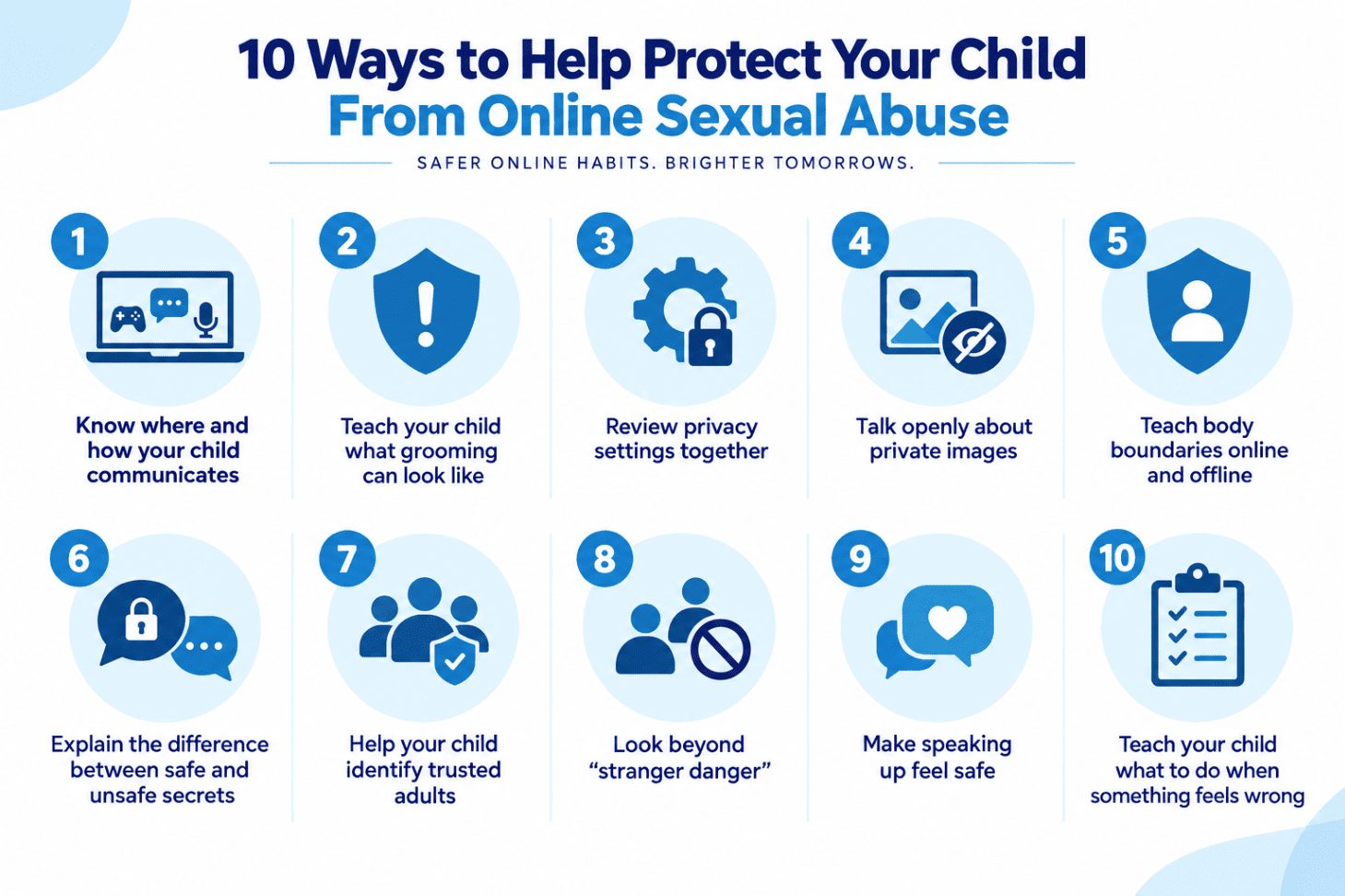
No single parental control or safety rule can guarantee protection. A stronger approach combines age-appropriate supervision with conversations about grooming, privacy, body boundaries, trusted adults, and how to get help.
1. Know Where and How Your Child Communicates
Start by understanding your child’s digital world. Depending on their age, they may communicate through:
- Social media.
- Multiplayer games.
- Messaging apps.
- Group chats.
- Livestreaming platforms.
- Video-sharing platforms.
Ask your child to show you how their favorite platforms and games work. For online games, ask whether they use text chat, voice chat, direct messages, or private groups, and whether they communicate with people they do not know offline. Find out who can contact them, whether conversations can become private, and what information other users can see.
Younger children generally need closer supervision. Older children may need greater independence, but online-safety conversations should continue as the platforms and ways they communicate change.
The goal is not to secretly monitor every interaction. It is to understand your child’s online environment well enough to recognize potential risks and have informed conversations about them.
2. Teach Your Child What Grooming Can Look Like
Grooming may begin with friendship and attention rather than an obvious sexual request. An abuser may compliment a child, take an intense interest in their hobbies, offer gifts, or make them feel unusually special. Over time, the person may introduce secrecy, sexual topics, or pressure.
Teach your child to tell you if someone:
- Asks them to keep conversations secret.
- Tries to move them to private messages.
- Regularly asks personal or sexual questions.
- Sends sexual material or pornography.
- Requests private images or videos.
- Offers gifts in exchange for secrecy.
- Becomes threatening when the child says no.
Children do not need to determine whether someone is a sexual abuser themselves. They simply need to know that uncomfortable or secretive behavior is worth telling a trusted adult about.
3. Review Privacy Settings Together
Privacy settings cannot prevent every unsafe interaction, but they can reduce unnecessary access to your child. Regularly review:
- Who can view their profile.
- Who can send messages.
- Whether their location is visible.
- Who can add them to groups.
- Who can comment on their posts.
- Whether other users can download their content.
- Which apps can access the camera, microphone, or location.
Explain why you are changing these settings rather than simply taking over the device. Children who understand the reason behind a safety rule can gradually learn to make safer decisions independently. Remember to review settings periodically. Platforms change, new features appear, and your child’s online habits will evolve as they get older.
4. Talk Openly About Private Images
Do not wait until something happens to discuss private images.
Teach children that nobody should pressure them to send photographs or videos showing their naked body, underwear, private areas, or sexual activity.
Older children and teens should also understand that digital content can be:
- Screenshotted.
- Copied.
- Altered.
- Forwarded.
- Posted publicly.
Most importantly, explain what they should do if they have already sent an image.
Tell them to come to you rather than continuing to respond to threats or requests. Fear of punishment can prevent a child from asking for help.
If someone manipulated, pressured, or threatened your child into providing sexual material, responsibility belongs with the person exploiting them, not the child.
5. Teach Body Boundaries Online and Offline
Body-safety conversations can begin long before children start using social media. Teach children that they have boundaries around their bodies and that other people’s boundaries matter too.
Age-appropriate lessons can include:
- Using accurate names for body parts.
- Understanding which areas of the body are private.
- Knowing they can object to unwanted touch.
- Recognizing inappropriate requests involving their body.
- Understanding that online sexual requests can violate boundaries too.
- Telling a trusted adult when something makes them uncomfortable.
As children get older, discussions can expand to include consent, sexual messages, image sharing, pornography, peer pressure, and healthy relationships. The goal is not to make children fearful of their bodies or ordinary affection. It is to give them clear language for recognizing and communicating boundaries.
6. Explain the Difference Between Safe and Unsafe Secrets
Secrecy is a common tool in child abuse and exploitation. Help your child distinguish between a temporary surprise and a secret that makes them feel frightened, uncomfortable, or confused. For example, hiding a birthday present for a few days is different from someone saying:
“Don’t tell your parents about our messages.”
Tell your child to speak to a trusted adult if someone asks them to keep secrets involving:
- Private body parts.
- Sexual messages.
- Unwanted touching.
- Private images.
- Threats.
- Sexual material.
- A hidden relationship.
Reassure them that telling you will not get them in trouble. This message is worth repeating. Children may need to hear it many times before they ever face an unsafe situation.
7. Help Your Child Identify Trusted Adults
Children should have several safe adults they can approach, not just one.
Together, identify people such as:
- A parent or caregiver.
- Another trusted family member.
- A teacher.
- A school counselor.
- A coach.
- A therapist.
A child may not always feel able to tell a parent first, particularly if they fear embarrassment or punishment.
Try saying:
“I hope you can always come to me. But if something happens and you don’t feel ready to tell me, please tell another adult you trust.” Giving children several routes to help can make it less likely that they feel trapped with an unsafe secret.
8. Look Beyond “Stranger Danger”
Teaching children to avoid strangers is not enough for child sexual abuse prevention. Sexual abusers are not always unknown adults. The person could be someone the child knows, a peer, an older young person, a family acquaintance, or someone who has gradually built an online relationship with them. Teach children to pay attention to behavior rather than familiarity.
Concerning behavior may include someone who:
- Repeatedly ignores boundaries.
- Makes sexual comments to a child.
- Shows them pornography.
- Sends sexual messages.
- Requests secrecy.
- Tries to isolate them.
- Pressures them for images.
- Offers gifts in exchange for sexual behavior or secrecy.
A familiar person does not automatically have the right to ignore a child’s boundaries.
9. Make Speaking Up Feel Safe
A child may not disclose sexual abuse immediately. They may fear punishment, shame, disbelief, family conflict, or losing access to their phone or favorite game. How adults respond matters. If your child tells you about an uncomfortable interaction, avoid beginning with:
“Why did you do that?”
Instead, try:
“I’m glad you told me.”
A child experiencing exploitation may have responded to messages, accepted gifts, returned to conversations, kept secrets, or sent an image. Those actions do not make the child responsible for an adult’s abusive behavior. Keeping communication open can make it easier for children to seek help.
It also means taking smaller concerns seriously. When children learn that they can tell you about uncomfortable interactions without immediately being blamed, they may feel safer bringing you bigger concerns later.
10. Teach Your Child What to Do When Something Feels Wrong
Warnings are more useful when children also know what action to take. Give your child a simple safety plan. Depending on the situation, they can:
- Stop responding.
- Leave the chat, game, call, or interaction.
- Avoid sending any more images or personal information.
- Tell a trusted adult.
- Save relevant evidence when appropriate.
- Block the person when it is safe to do so.
- Report the account through the platform.
- Get emergency help if anyone is in immediate danger.
Tell your child they can ask for help even if they broke a family internet rule, responded to the person, or sent something they now regret. The immediate priority should be their safety.
What Signs of Child Sexual Abuse Should Parents Watch For?
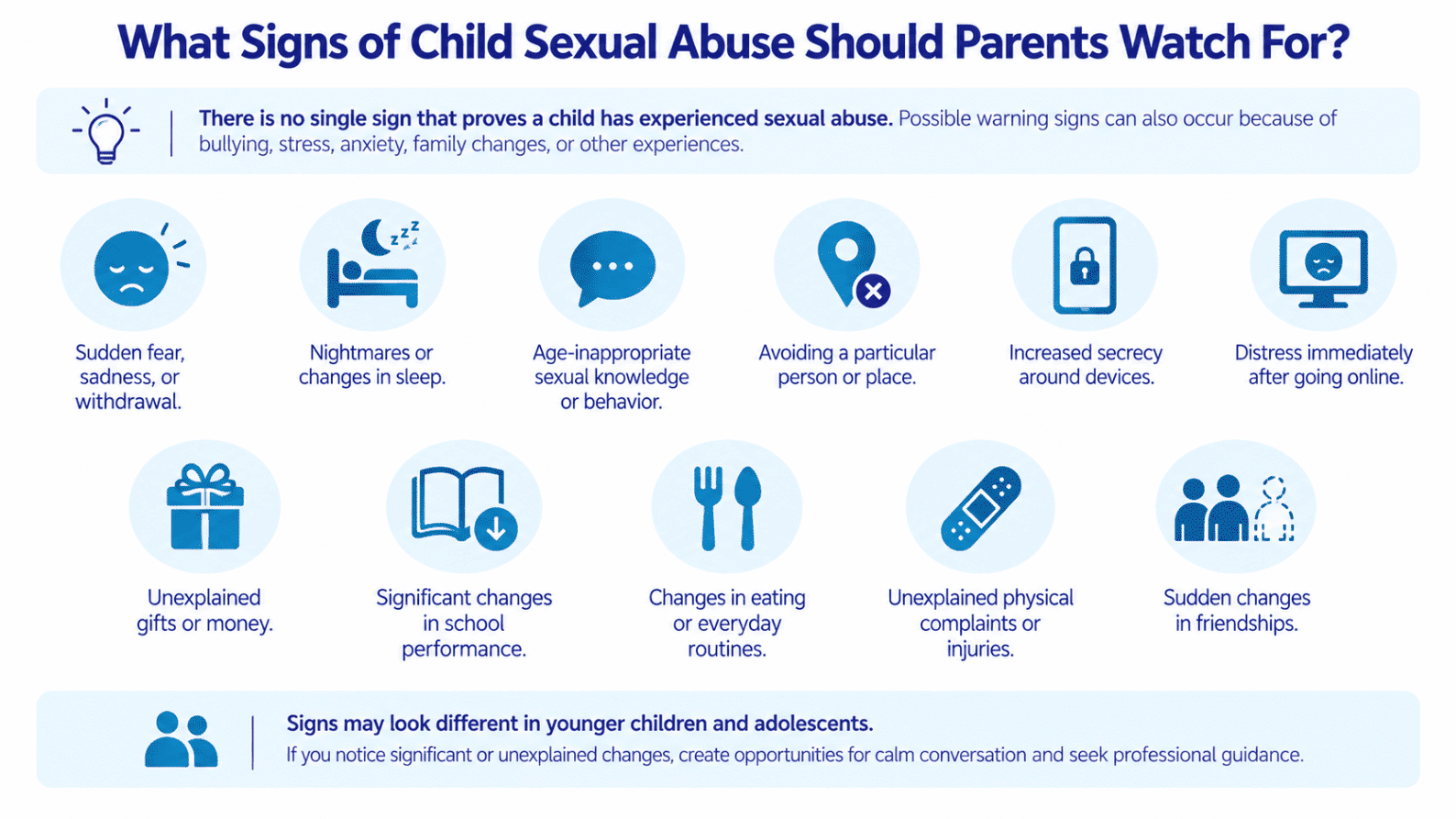
There is no single sign that proves a child has experienced sexual abuse. Possible warning signs can also occur because of bullying, stress, anxiety, family changes, or other experiences.
Parents should pay attention to significant or unexplained changes such as:
- Sudden fear, sadness, or withdrawal.
- Nightmares or changes in sleep.
- Age-inappropriate sexual knowledge or behavior.
- Avoiding a particular person or place.
- Increased secrecy around devices alongside other concerning changes in behavior.
- Distress immediately after going online.
- Unexplained gifts or money.
- Significant changes in school performance.
- Changes in eating or everyday routines.
- Unexplained physical complaints or injuries.
- Sudden changes in friendships.
The signs of child sexual abuse may also differ between younger children and adolescents. Rather than assuming what has happened, create opportunities for calm conversation. If you remain concerned, seek appropriate professional guidance.
Want more practical ways to keep your child safe from inappropriate sexual behavior? Explore these 10 tips to help protect your child and learn what parents can do.
What Should You Do If Your Child Discloses Sexual Abuse?
If a child discloses sexual abuse, prioritize safety, listen calmly, believe what they tell you, and make it clear that they are not responsible for what happened. Avoid repeatedly questioning the child or trying to investigate the abuse yourself.
Your first response can be simple:
- “I believe you.”
- “I’m glad you told me.”
- “This is not your fault.”
- “You are not in trouble.”
- “I’m going to help you.”
Allow your child to explain what happened in their own words. Avoid leading questions or pressing for unnecessary details. If online messages or sexual images are involved, do not unnecessarily forward, download, or distribute the material. Ask the appropriate authorities how evidence should be preserved.
Suspected child sexual abuse or exploitation should be reported promptly. In the United States, suspected online child sexual exploitation can be reported to the National Center for Missing & Exploited Children (NCMEC) CyberTipline at report.cybertip.org or by calling 1-800-THE-LOST (1-800-843-5678). Suspected child abuse can also be reported to the appropriate state or local child protective services or law enforcement agency. If a child is in immediate danger, call 911.
Supporting someone after sexual abuse can feel overwhelming. Learn 4 ways to help survivors of sexual abuse with greater care, understanding, and sensitivity.
When Should You Seek Professional Support?
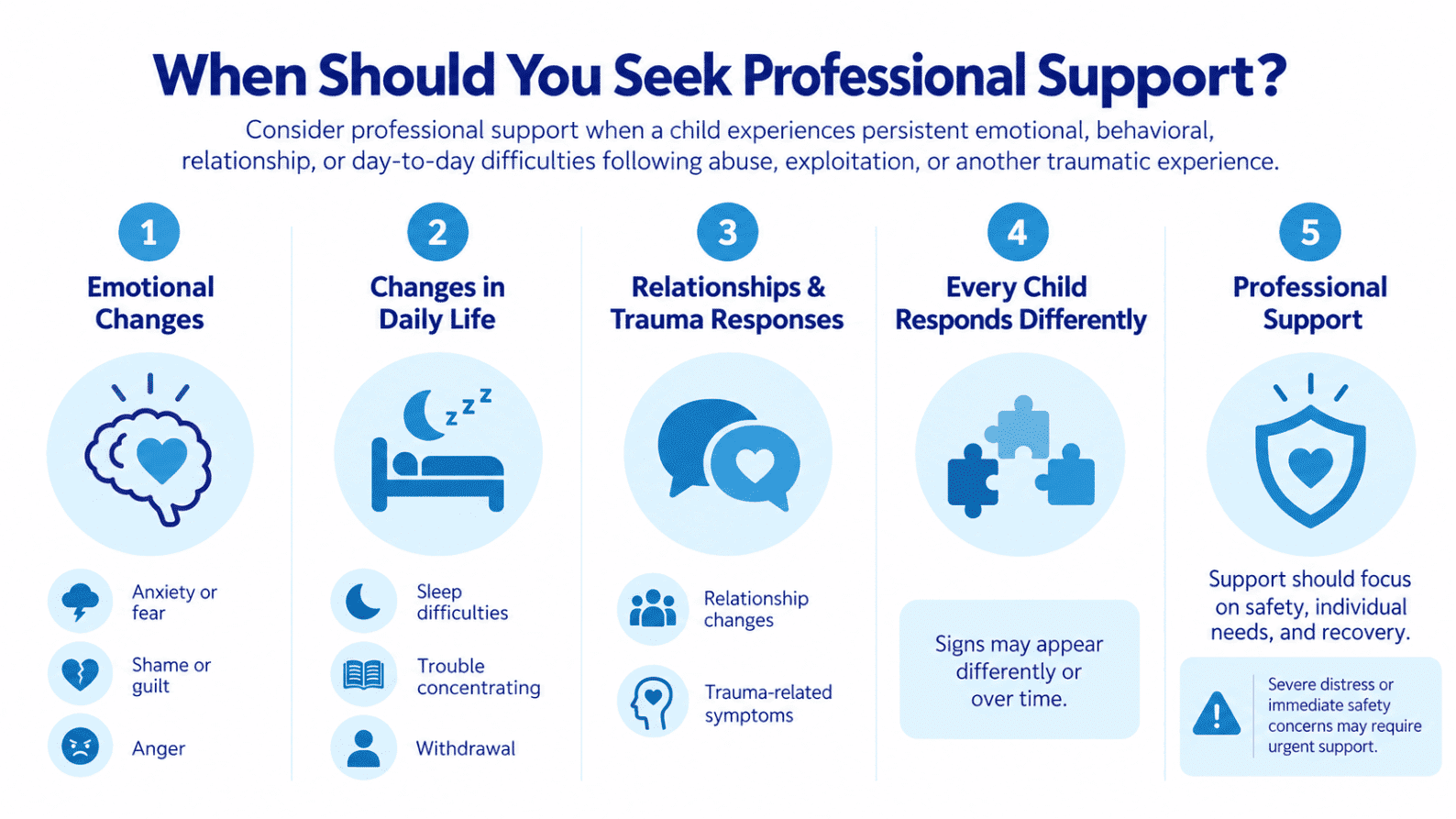
Professional support may be appropriate when a child experiences persistent emotional, behavioral, relationship, or day-to-day difficulties following abuse, exploitation, or another traumatic experience.
Childhood sexual abuse is considered an adverse childhood experience, but children do not all respond in the same way.
Possible effects may include:
- Anxiety or persistent fear.
- Shame or guilt.
- Anger.
- Sleep difficulties.
- Withdrawal.
- Problems concentrating.
- Changes in relationships.
- Trauma-related symptoms.
Sexual abuse affects every child differently, and visible distress may not appear immediately. A mental health professional experienced in child trauma can assess the child’s individual needs. Families dealing with an immediate traumatic event or severe distress may also require crisis intervention or other urgent support. Professional care should focus on safety and recovery rather than repeatedly forcing a child to retell what happened.
How Can Total Life Counseling Help Your Family?
Families dealing with abuse, exploitation, or another traumatic experience may need support alongside any medical, legal, child-protection, or law-enforcement response. Total Life Counseling works with children, teens, young adults, and families experiencing emotional, behavioral, relationship, and trauma-related challenges.
Depending on individual needs, counseling may address areas such as:
- Anxiety and fear.
- Emotional regulation.
- Coping strategies.
- Family communication.
- Behavioral changes.
- Relationship difficulties.
- Trauma recovery.
Support can also help parents and caregivers understand changes they are seeing and respond to their child’s needs without blame or unnecessary pressure.
Has your child experienced or disclosed sexual abuse or online exploitation? Contact Total Life Counseling to discuss counseling support for your child and family as they cope with the emotional impact and move forward.
What Should Parents Remember About Child Sexual Abuse Prevention?
You cannot control every person your child encounters online. You can make sure your child has clear safety skills and knows where to turn when something goes wrong. Start with practical steps: know the apps they use, talk openly about grooming and private images, teach body boundaries, identify trusted adults, and make disclosure feel safe. Most importantly, keep the conversation going as your child grows.
Online risks, relationships, and technology change. Your approach to safety should change with them. If you suspect abuse or exploitation, prioritize your child’s safety and seek appropriate child protection, medical, mental health, or law-enforcement support.
Licensed Counselors & Therapists
Meet Our Team of Certified & Experienced Professionals
Total Life Counseling Center consists of Licensed Counselors, Masters Level Therapists, Espanol Counselors, Licensed Mental Health Counselors, Business Coaches, Image Enhancement Coaches who provide counseling for emotional, mental, physical and spiritual care including marriage, individual, family, substance abuse and more. Our team of certified and experienced professionals, dedicated to serving a comprehensive spectrum of mental health and relationship issues such as couples, women and men’s issues, children and teens with oppositional defiance, video game addiction, ADHD, ASD, anxiety, depression, and trauma survivors, is here to support and guide you through your journey towards healing and navigating life transitions. This approach not only enhances the effectiveness of the counseling provided but also builds trust within the community and among potential clients, who may be seeking support.
We offer next level counselors specialized in areas such as relationships, video game & drug/alcohol addictions, abuse, trauma, depression, and ADHD. Our Therapists are EMDR (eye movement desensitization) trauma therapy trained, cognitive behavioral therapy, specialize in ADHD and Oppositional Defiant Children, and are also professional Gottman method marriage couples counselors to give the best results to couples and to provide the best comprehensive spectrum of mental health and relationship care for our clients.
Struggling with Anger? We offer 8 hour anger management group therapy!
Discounted Rates and the president of Total Life Counseling Center Jim West does not want to turn people away and we have counselors at various levels of experience at a discounted rate that are trained by our next level counselors!

Jim West
MA, LICENSED MENTAL HEALTH COUNSELOR, national certified counselor
President, Counselor, Guest Speaker, Author, Social Skills, ADHD, ODD, ASD, children, teens, and more!

Dana West
MSW, Licensed clinical social worker
Vice President, Counselor, Guest Speaker, Addictions, Trauma, Couples, Abuse, and more!

Mathew Martin
MS, LICENSED MENTAL HEALTH COUNSELOR
Counselor, Coach, Guest Speaker, Marriage, Individual Males, Substance Abuse and more!
Brandon Feinberg
MS, LICENSED MENTAL HEALTH COUNSELOR
Male Counselor, Licensed Mental Health Counselor specializing in ADHD, Asperger Syndrome, Autism Spectrum Disorders, and more!
Lyris Steuber
MS, licesned marriage & family therapist
Counselor, Coach, Marriage & Family, Play Therapy, Divorce, Adolescent and more!

Valerie Ware
Licensed Psychologist and Behavioral Specialist
Psychological Evaluator, Autism, ADHD, Learning Disabilities, Anxiety, Gifted, Career Pathways, and emotional assessments.

Gemima McMahon
MA, LICENSED MENTAL HEALTH COUNSELOR
Licensed Mental Health Counselor specializing in Women’s issues, Trauma, Anxiety, Depression, Cutting, Couples, Children and Teenagers and more!

Audrey DeBruler
MS, LMHC, Licensed Mental Health Counselor
Children, Adolescents, Young Adults, Faith Based Counseling, Trauma Recovery, Anxiety and more!

David Duany
MA, LICENSED MENTAL HEALTH COUNSELOR
Licensed Mental Health Counselor specializing in ADHD, Social Skills, and Anger Management counseling for children, young adults, and families.

Katherine Waldheim
MS, Registered Mental Health Counseling Intern
Trauma, anxiety, couples counseling, and child & adolescent counseling services and more!

Sarah Dornas Albuquerque
MS – Registered Mental Health Counselor Intern
EMDR, Anxiety, Depression, Children, Teens, Young Adults, English, Spanish and Portugues and Adult Counseling

Frequently Asked Questions
What are common signs of child sexual abuse in children?
Possible signs include sudden fear, withdrawal, sleep changes, age-inappropriate sexual behavior or knowledge, avoiding particular people, unexplained gifts, or distress around devices. These behaviors have other possible causes, so no individual sign confirms sexual abuse.
How can child sexual abuse be prevented?
Prevention includes teaching body boundaries, discussing grooming and unsafe secrets, reviewing online privacy, identifying trusted adults, and maintaining open communication. Adults should also recognize concerning behavior and take appropriate action when abuse or exploitation is suspected.
What facts should I know about child sexual abuse?
Child sexual abuse can affect children of all ages, ethnicities, communities, and economic backgrounds. The perpetrator may be someone the child knows, and abuse can include both physical contact and non-contact sexual exploitation.
What online threats contribute to child sexual abuse?
Online threats can include grooming, sexual messages, pornography exposure, requests for explicit images, coercion, sextortion, livestream exploitation, and attempts to arrange offline contact. Social media, gaming platforms, chat services, and messaging apps can potentially be misused.
How does online enticement relate to child sexual abuse?
Online enticement can involve using digital communication to manipulate a child for sexual purposes. A person may first establish trust before introducing sexual conversations, requesting images, arranging meetings, or using threats or coercion to maintain control.
What should I do if I suspect a child is being sexually abused?
Prioritize the child’s immediate safety and listen without blame. Avoid conducting your own detailed investigation. Contact the appropriate child protection agency or law enforcement for guidance, particularly when you believe the child may be in immediate danger.
What impact does child sexual abuse have on victims?
The effects of child sexual abuse vary. A child may experience anxiety, trauma symptoms, shame, sleep difficulties, behavioral changes, or relationship problems. Appropriate support can aid recovery, and experiencing sexual abuse does not determine a child’s future.
Are there any hotlines or resources for child sexual abuse victims?
In the United States, the Childhelp National Child Abuse Hotline is available at 1-800-422-4453. If a child faces immediate danger, call 911. Online child sexual exploitation can also be reported to appropriate law-enforcement and child-protection services.
What are the legal definitions of child sexual exploitation?
Legal definitions vary by jurisdiction. Generally, child sexual exploitation involves using or coercing a child in sexual activity or sexual material for another person’s benefit or gratification. Specific offenses and reporting requirements are defined by applicable federal and state laws.
Filed in: Children, Sexual Abuse
Share This Story, Choose Your Platform!
Total Life Counseling Center consists of Licensed Counselors, masters level therapists, Español counselors, Licensed Mental Health Counselors, business coaches, and image enhancement coaches who provide counseling for emotional, mental, physical and spiritual care including marriage, individual, family, substance abuse and more. TLC’s family, trauma and marriage experts have been interviewed on National and Local TV/Radio over 200 times for their expert advice on Fox News, OWN, WETV, ABC’s Medical Minute and more. Our skilled counselors are relational, approachable and specialists providing therapy services in the Central Florida area including: Orlando, Winter Park, MetroWest, Windermere, Dr. Phillips, East Orlando, Lake Mary, and Clermont, Boca Raton Florida, and Dallas, TX.
About the Author: Jim West